Can Cats Eat Mango? Safety, Risks & Serving Tips

✅ Direct Answer
Yes, cats can eat mango — but only the ripe, peeled flesh, in very small amounts. The skin, pit, and leaves are not safe. Mango is not toxic to healthy adult cats, but it is high in natural sugar and provides no real nutritional value for an obligate carnivore. Treat it as a rare occasional snack, never a habit.
It’s a warm afternoon and you’re slicing a ripe, golden mango over the kitchen sink. Before the juice even hits the cutting board, your cat is on the counter — sniffing, pawing, and looking at you like you owe her a bite.
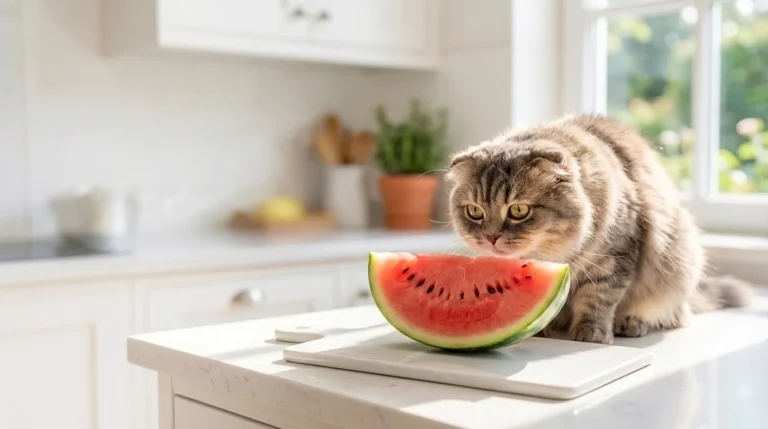
It happens with watermelon. It happens with cantaloupe. And it absolutely happens with mango.
Before you hand over a piece, you need the real answer — not just “yes” or “no,” but which part, how much, and what to do if she already helped herself.
This article covers everything: the safe part of mango, the dangerous parts, exact portions by cat type, and a clear action plan for the moments you didn’t get here in time.
Table of Contents
Quick Safety Table: Can Cats Eat Mango?
| Mango Part | Safe for Cats? | Risk Level | What to Do |
|---|---|---|---|
| 🟡 Ripe peeled flesh | ✅ Yes, occasionally | Low | Max 1–2 small cubes |
| 🟤 Mango pit / seed | ❌ No | High | Choking + cyanide compounds |
| 🟢 Mango skin / peel | ❌ No | Medium–High | Digestive irritant, hard to break down |
| 🍃 Mango leaves | ❌ No | Medium | Digestive upset, avoid entirely |
| 🥤 Mango juice / nectar | ❌ No | Medium | Concentrated sugar, no fiber |
| 🍬 Flavored mango products | ❌ No | High | May contain xylitol — toxic to cats |
⚠️ If your cat just chewed on the pit or swallowed a piece of mango skin, skip to the emergency section below.
Why Is Your Cat Interested in Mango?
Same reason she’s interested in your watermelon, your cantaloupe, and sometimes even your coffee.
Cats cannot taste sweetness. They are true obligate carnivores, and their genetic makeup simply does not include functional sweet taste receptors. So the rich, tropical sweetness you’re tasting when you eat a ripe mango? She doesn’t experience that at all.
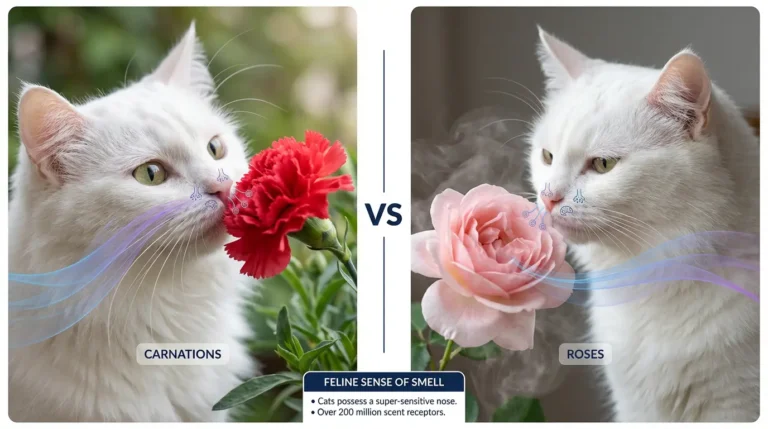
What she does notice is the smell. Mango has a powerful, complex aroma driven by compounds like terpenes and esters — and cats have a sense of smell that is roughly fourteen times stronger than ours. That fragrance, combined with the soft texture and the fact that you’re paying close attention to it, is more than enough to get her interested.
Her curiosity is endearing. It is also not a green light.
Is Mango Good for Cats?
A little — but not in any way that justifies making it a habit.
The One Honest Upside
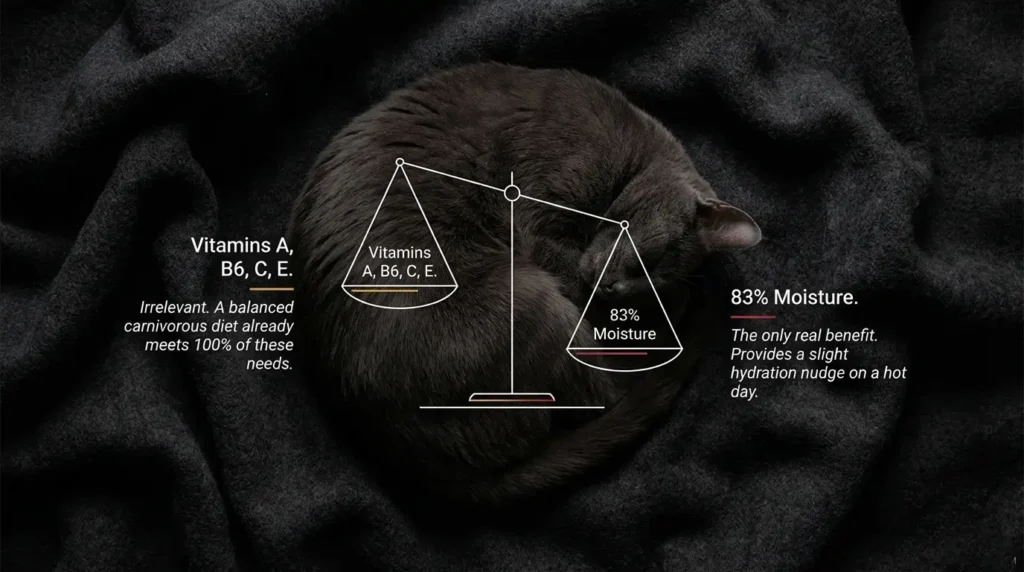
Mango contains vitamins A, B6, C, and E, plus folate and small amounts of fiber. In a human diet, those contribute meaningfully to health. In a cat’s diet — where her complete, balanced cat food already meets every nutritional requirement she has — a small cube of mango barely registers.
There is one minor practical benefit: moisture. Fresh mango flesh is roughly 83% water. For a cat who is a reluctant drinker, a tiny cube on a hot day gives her a small extra hydration nudge. That’s a real, if modest, benefit.
The Nutritional Reality
Mango is high in natural sugar. More so than watermelon. A 100g serving of mango has about 14g of sugar and 60 calories — roughly double the sugar load of watermelon flesh. That matters for portion control, especially for cats with any metabolic sensitivities.
Mango is a treat. Not a supplement. Not a functional food. The moment you start thinking of it as something healthy for your cat, the portions get bigger and the risks go up.
The Risks of Mango for Cats
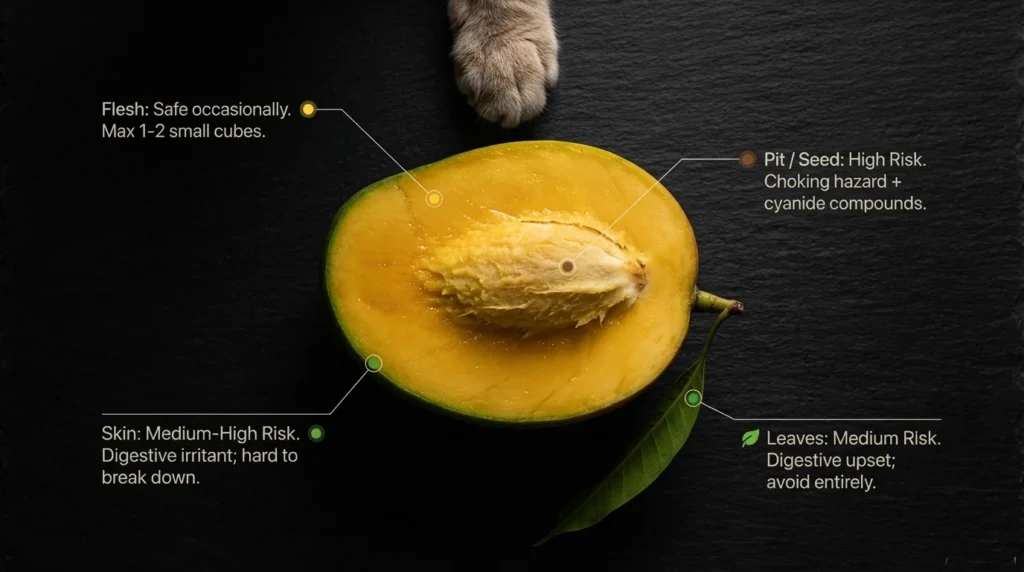
While the fresh flesh is generally fine in small amounts, there are three parts of a mango that can cause real harm.
The Pit: A Serious Hazard
The mango pit is large, hard, and shaped in a way that makes it a choking and intestinal blockage risk for cats. Beyond the physical danger, mango pits — like apple seeds and watermelon seeds — contain compounds related to cyanide that can be harmful if chewed and ingested.
Keep the pit well out of reach. Cats are curious and determined, and a mango pit left on the counter is exactly the kind of object that gets batted to the floor and investigated.
The Skin: Harder to Digest Than It Looks
Mango skin contains urushiol — the same compound found in poison ivy. In humans, it can cause contact dermatitis. In cats, it is primarily a digestive irritant. The skin is also tough and fibrous in a way that a cat’s digestive system struggles with, increasing the risk of vomiting, diarrhea, or in serious cases, a partial blockage.
Always peel the mango completely before offering any piece to your cat.
Sugar Overload and Stomach Upset
Even the safe flesh is high in fructose compared to other fruits. Too much, too fast leads to the classic signs of GI upset in cats: loose stools, vomiting, and bloating — usually within a few hours of eating.
How Much Mango Can a Cat Eat?

The 10% treat rule applies here just as it does with every other treat. Treats — including safe fruits — should make up no more than 10% of your cat’s daily caloric intake. For a typical healthy adult cat eating 200–250 calories per day, that’s 20–25 treat calories total.
Mango flesh contains roughly 60 calories per 100g. That works out to one small cube — about ¾ of an inch — as a safe, occasional maximum for a healthy adult cat.
Safety by Cat Profile
| Cat Type | Can They Eat Mango? | Notes |
|---|---|---|
| Healthy adult cat | ✅ Occasionally | 1 small cube, peeled flesh only |
| Senior cat (7+ years) | ⚠️ With caution | Very small amount; monitor closely |
| Kitten under 12 months | ❌ No | Developing digestive system |
| Diabetic cat | ❌ No | Mango is high in sugar — skip it |
| Overweight cat | ❌ No | Extra sugar calories counterproductive |
| Cats on prescription diets | ❌ No | Consult your vet before any additions |
💬 Sarah’s 24-Hour Rule: “One piece the size of a pinky nail. Wait 24 hours. Check the litter box. If everything looks normal, you know your cat tolerates it. If not, that’s your answer — and it’s an easy one to act on.”
How to Serve Mango Safely: 5 Steps
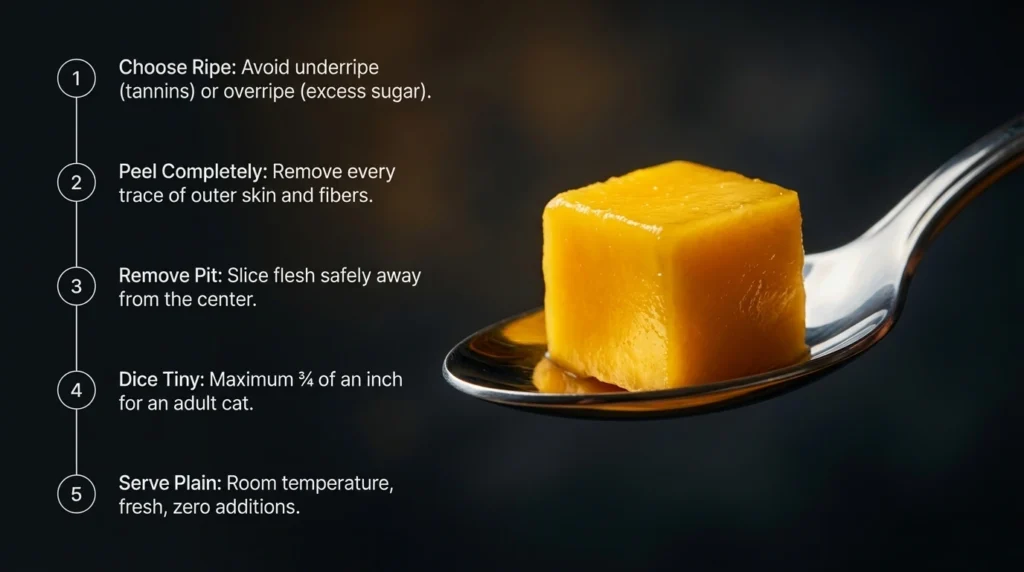
- Choose a ripe mango — not underripe (too firm, more tannins) and not overripe (higher sugar concentration).
- Peel the skin completely — remove every trace of the outer skin and the fibrous layer beneath it.
- Cut away the pit entirely — slice the flesh off the pit, then check for any remaining stringy fibers near the center.
- Dice into a tiny cube — roughly ¾ of an inch for a healthy adult cat; smaller for a first serving.
- Serve plain and fresh — no sugar, no syrup, no seasonings, no other additions. Serve at room temperature or slightly chilled.
Never serve mango in these forms:
- Dried mango — concentrated sugar, sometimes with added sweeteners
- Mango juice or nectar — all the sugar, none of the fiber
- Frozen mango products with added syrups
- Mango-flavored treats or candies — may contain xylitol
My Cat Already Ate Mango — What Now?
She ate a small piece of plain, peeled flesh: You’re almost certainly fine. Monitor for 24 hours and watch for vomiting, diarrhea, or bloating. If she’s acting normally, no action needed.
She ate a piece of the skin: Watch for digestive upset over the next 12–24 hours. Vomiting once or twice is not unusual. If symptoms persist beyond 24 hours or she seems lethargic, call your vet.
She chewed on or swallowed part of the pit: Take this seriously. The pit is a blockage risk and contains potentially harmful compounds. Watch for vomiting, loss of appetite, lethargy, or straining in the litter box. Call your vet if any of those signs appear within 12 hours.
📞 ASPCA Animal Poison Control: (888) 426-4435 — available 24 hours a day.
Better Fruit Alternatives for Curious Cats
If mango feels like too much prep or too much sugar, here are easier options:
- Blueberries — Low sugar, easy to serve, no prep required
- Cantaloupe — Similar moisture appeal, prepare like watermelon
- Watermelon — Seedless flesh only, great for hydration on hot days
- Plain cooked chicken — Always the safest, most species-appropriate treat you can give
→ Read next: Can Cats Eat Strawberries?
→ Related: Can Cats Eat Watermelon?
FAQ — Can Cats Eat Mango?
Can cats eat dried mango?
No — cats should not eat dried mango. The drying process removes most of the water content and concentrates the natural sugars to a level that is far too high for a cat’s digestive system. A small piece of dried mango can contain three to four times the sugar of the same amount of fresh mango flesh. That dramatically increases the risk of blood sugar spikes, diarrhea, and GI upset. Most commercially sold dried mango also contains added sugar, preservatives, or sulfites that have no place in a cat’s diet. If your cat is curious about a fruity treat, stick to a tiny cube of fresh, peeled mango flesh — and even then, only occasionally for a healthy adult cat.
Can cats eat mango skin?
No. Mango skin is not safe for cats and should always be removed completely before offering any piece of mango. The skin contains urushiol — the same irritating compound found in poison ivy — which can act as a digestive irritant in cats even in small amounts. It is also tough and fibrous, making it difficult for a cat’s digestive tract to break down. Eating mango skin can lead to vomiting, diarrhea, and in some cases contribute to a partial digestive blockage. Always peel the mango fully, remove the stringy layer beneath the skin, and serve only the clean, ripe, soft flesh — diced into a small cube and served plain with no additions.