Can Cats Eat Greek Yogurt? What’s Safe & What to Avoid
Can Cats Eat Greek Yogurt?
Yes — plain, unsweetened Greek yogurt is the safest dairy option for cats. Its extra straining process removes more lactose than regular yogurt, making it easier to digest. Offer no more than one teaspoon at a time, and only occasionally. Never give flavored, vanilla, or sugar-free Greek yogurt — those may contain xylitol, which is toxic to cats.
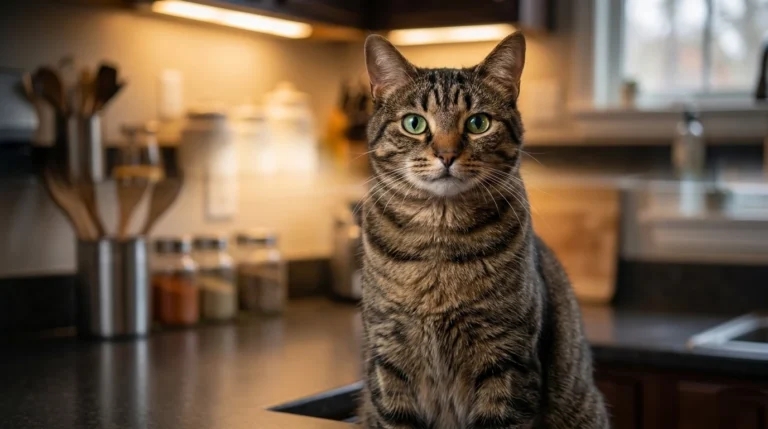
My cat Miso has a sixth sense for dairy. The second I pull anything from the fridge, she materializes on the counter with that look — the one that says “that’s mine, actually.”
The morning I opened a Chobani Greek yogurt was no different. She was already sniffing the container before I’d even grabbed a spoon.
Here’s what I found out after some digging: Greek yogurt is actually the least risky dairy product you could share with a cat. Not because it’s a health food for them — it isn’t — but because of what the straining process removes. If you’re going to let your cat have a lick of anything dairy-related, this is the one to choose.
Let me explain exactly why, how much is safe, and when you should skip it altogether.
Table of Contents
Why Greek Yogurt Is Safer Than Regular Yogurt for Cats
The answer comes down to one word: lactose.
Most adult cats don’t produce enough lactase — the enzyme that breaks down lactose — to process dairy comfortably. When undigested lactose reaches the large intestine, gut bacteria ferment it instead, which causes gas, bloating, and diarrhea. It’s the same mechanism as lactose intolerance in humans, just more common in cats. Up to 70% of adult cats experience some degree of it.
Greek yogurt goes through an extended straining process that removes a large portion of the liquid whey — and with it, a significant share of the lactose. Regular plain yogurt contains roughly 4–5 grams of lactose per 100g. Plain Greek yogurt comes in at approximately 2–3 grams per 100g. That reduction matters for a small digestive system.
The fermentation process also converts some of the remaining lactose into lactic acid, making it even gentler on the gut compared to straight milk or cream.
This doesn’t mean Greek yogurt is good for cats nutritionally. It just means the dairy risk is lower here than with most alternatives.
Greek Yogurt vs. Regular Yogurt — Quick Comparison
| Feature | Plain Greek Yogurt | Regular Plain Yogurt |
|---|---|---|
| Lactose per 100g | ~2–3g | ~4–5g |
| Protein content | Higher (due to straining) | Moderate |
| Fat content | Varies by type (full-fat, 0%, 2%) | Typically lower |
| Safe for cats? | ✅ Yes, in tiny amounts | ✅ Yes, but more cautious |
| Xylitol risk? | ❌ Only in flavored/diet versions | ❌ Only in flavored/diet versions |
| Best option overall? | ✅ Yes — lower lactose | ⚠️ Second choice |
| Flavored versions | ❌ No | ❌ No |
| Sugar-free versions | 🚨 Never — possible xylitol | 🚨 Never — possible xylitol |
How Much Greek Yogurt Can a Cat Have?
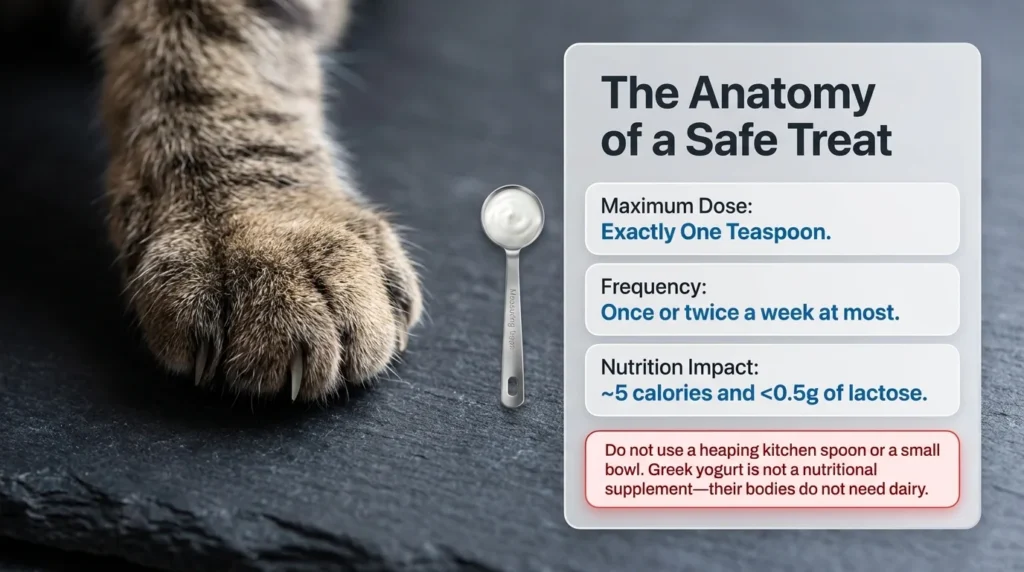
Here’s the answer most articles skip: one teaspoon, maximum.
That’s a literal standard measuring spoon — not a heaping kitchen spoon, not a small bowl. One teaspoon of plain Greek yogurt contains roughly 5 calories and less than 0.5g of lactose, which is manageable for most healthy adult cats.
Offer it once or twice a week at most. Greek yogurt is not a nutritional supplement for cats. Their bodies don’t need dairy, and regular exposure — even in small amounts — can contribute to ongoing digestive sensitivity in cats prone to stomach issues.
If your cat shows any looseness in the litter box after even a small amount, that’s their way of telling you to stop. Not every cat tolerates dairy equally, and there’s no reason to push it.
The Pill-Hiding Trick
This is the one practical situation where Greek yogurt genuinely earns its place in a cat household. If you have a cat who spits out pills — and many do it with astonishing skill — a small dab of plain Greek yogurt wrapped around the tablet works remarkably well. The thick texture coats the pill, the mild smell encourages licking, and most cats take it right off a spoon without realizing what they swallowed.
Use less than half a teaspoon for this purpose, and always confirm the yogurt is plain and unsweetened before you use it as a medication vehicle.
Which Greek Yogurts Are Safe — and Which to Avoid
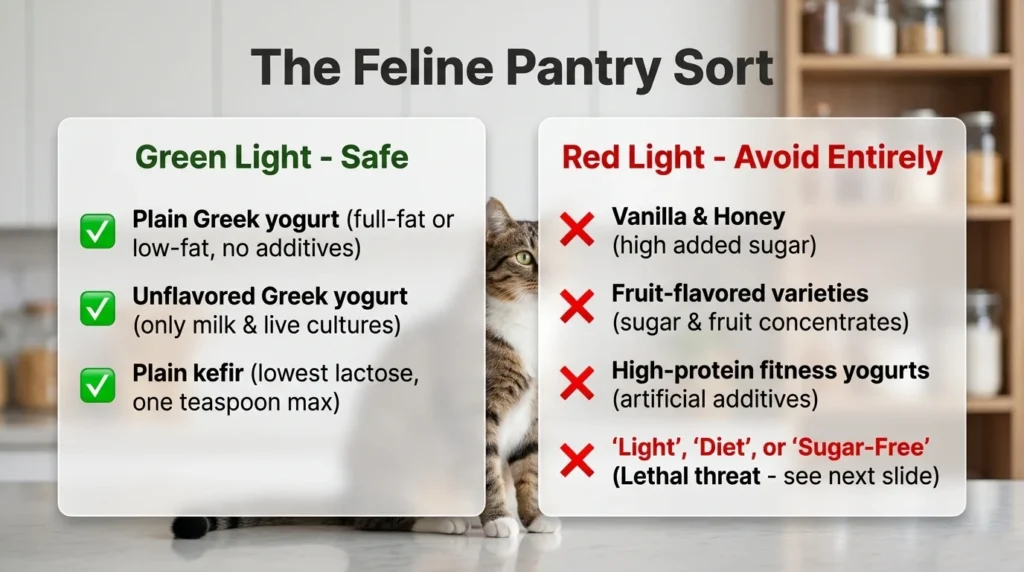
Not all Greek yogurt is the same, and the label matters more than the brand.
Safe options:
- Plain Greek yogurt, full-fat or low-fat, with no additives
- Unflavored Greek yogurt with only milk and live cultures listed as ingredients
- Plain kefir (similar logic, even lower lactose — one teaspoon only)
Avoid entirely:
- Vanilla Greek yogurt — contains added sugar and artificial flavor
- Honey Greek yogurt — high sugar, not appropriate for cats
- Flavored varieties (strawberry, blueberry, peach) — added sugars and fruit concentrates
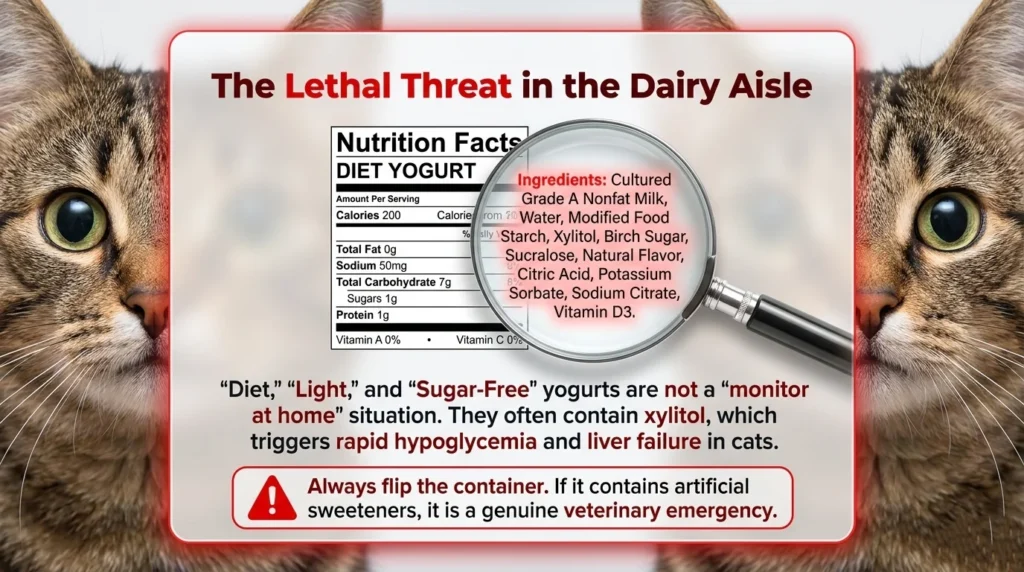
- “Light,” “diet,” or “sugar-free” Greek yogurt — these often contain xylitol, which causes rapid hypoglycemia and liver failure in cats. This is a genuine emergency, not a “monitor at home” situation.
- High-protein flavored Greek yogurts marketed as fitness foods — often contain sweeteners or artificial ingredients
The fastest way to check: flip the container and scan the ingredient list for xylitol, birch sugar, sucralose, or aspartame before your cat gets anywhere near it.
Signs Your Cat Doesn’t Tolerate Greek Yogurt
Even the safest form of dairy won’t agree with every cat. Watch for these in the 4–8 hours following their snack:
- Soft stools or diarrhea
- Straining in the litter box
- Visible bloating or discomfort
- Excessive gas
- Vomiting — especially more than once
- Lethargy or loss of appetite
If any of these show up after a teaspoon of plain Greek yogurt, your cat is telling you their gut doesn’t tolerate dairy well. That’s useful information. Skip the yogurt going forward and consider a feline-specific probiotic supplement instead — something like Purina FortiFlora, which delivers gut-health support without any lactose risk.
Key Takeaways
- Plain Greek yogurt is the safest dairy option for cats due to its lower lactose content from extended straining.
- One teaspoon maximum, offered occasionally — not daily.
- Always check the label before offering any Greek yogurt. Flavored and sugar-free versions can be dangerous.
- Xylitol in diet yogurt is a veterinary emergency. If your cat ate sugar-free Greek yogurt, call your vet immediately.
- Greek yogurt is not a probiotic supplement for cats. If you want gut-health support, choose a product made for felines.
→ Read next: Can Cats Eat Yogurt? The Full Safe & Unsafe Guide
→ Related: Can Cats Drink Milk? What Actually Happens
→ Explore: Can Cats Eat Cheese Safely