
Can Cats Drink Lactose-Free Milk? Finally, Some Good News!
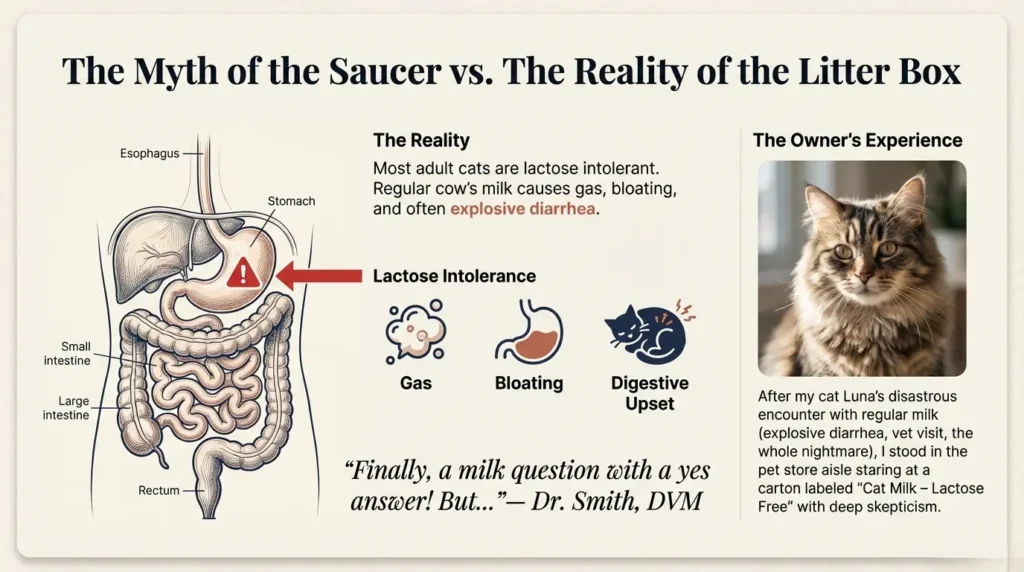
After my cat Luna’s disastrous encounter with regular milk (explosive diarrhea, vet visit, the whole nightmare), I stood in the pet store aisle staring at a carton labeled “Cat Milk – Lactose Free” with deep skepticism.
“Is this just a marketing gimmick?” I wondered. “Or can cats actually drink this stuff?”
I texted my vet a photo of the product. Her response: “Finally, a milk question with a yes answer! But…”
That “but” turned out to be pretty important.
If you’ve been searching for a way to safely give your cat something milk-like without the digestive disaster of regular dairy, lactose-free milk might actually be your answer. But before you start pouring it into your cat’s bowl, there are some crucial things you need to know.
Affiliate Disclosure: This article includes affiliate links. You buy through these links and support this site at no extra cost to you.
Can Cats Drink Lactose-Free Milk?
The Question: Can Cats Drink Lactose-Free Milk?
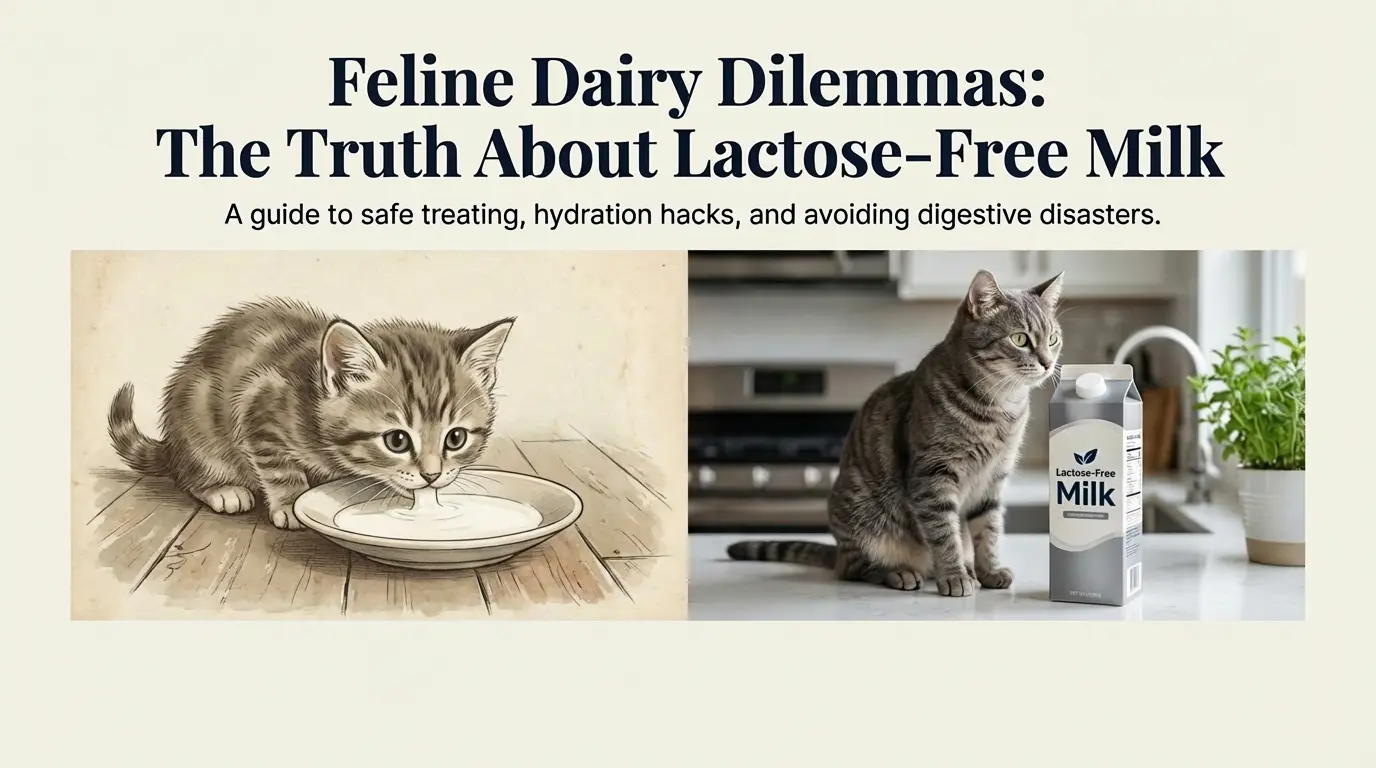
Here’s the short version: Yes, cats can drink lactose-free milk, but it should only be an occasional treat, not a dietary staple.
Lactose-free milk – whether it’s the human kind (like Lactaid) or specially formulated cat milk products – won’t cause the digestive chaos that regular milk does. That’s genuinely good news for those of us who want to give our cats something special without spending the next two days cleaning up aftermath.
But (and this is crucial) just because something won’t make your cat sick doesn’t automatically make it nutritious or necessary.
Let me explain the nuance here, because this is where a lot of cat parents get confused.
Understanding Lactose-Free Milk: What It Actually Is
When I first researched lactose-free milk, I assumed they’d somehow removed the lactose. Turns out, that’s not quite how it works.
The process: Manufacturers add the enzyme lactase to regular milk. This enzyme breaks down the lactose (milk sugar) into simpler sugars that are easier to digest. The lactose is still technically there – it’s just been pre-digested for you. Or in this case, for your cat.
Think of it like pre-chewing food. The food is still the same food, but it’s in a form that’s easier for your body to process.
For cats, this means: Their lactose-intolerant digestive system doesn’t have to do the heavy lifting. The lactose is already broken down, so they can consume it without the gas, bloating, and diarrhea that usually follows regular milk.
When I gave Luna her first taste of lactose-free cat milk (after getting my vet’s approval), I watched her like a hawk for the next 48 hours. No digestive issues. No soft stool. No midnight litter box emergencies.
I was honestly shocked.
Cat Milk vs. Human Lactose-Free Milk: Is There a Difference?
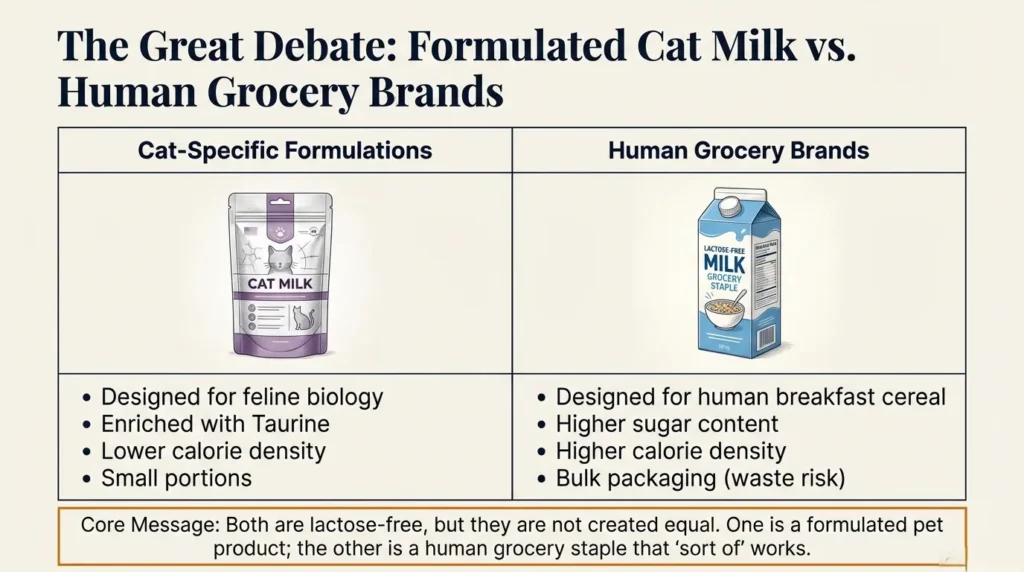
This is where things get interesting. Yes, both are lactose-free. But they’re not exactly the same.
Lactose-Free Cat Milk (Like Whiskas Cat Milk)
These products are specifically formulated for cats:

What’s good about them:
- Lactose reduced or removed completely
- Often enriched with taurine (essential for cats)
- Lower in calories than regular milk
- Some contain added vitamins
- Designed with cat nutrition in mind
- Come in convenient portion sizes
The reality check: They’re still basically treats. The nutritional value is minimal beyond hydration and the psychological joy your cat gets from the creamy texture.
I give Luna about 1-2 tablespoons of Whiskas Cat Milk twice a week. She absolutely loves it, and I love that I’m not playing Russian roulette with her digestive system.
Human Lactose-Free Milk (Like Lactaid)
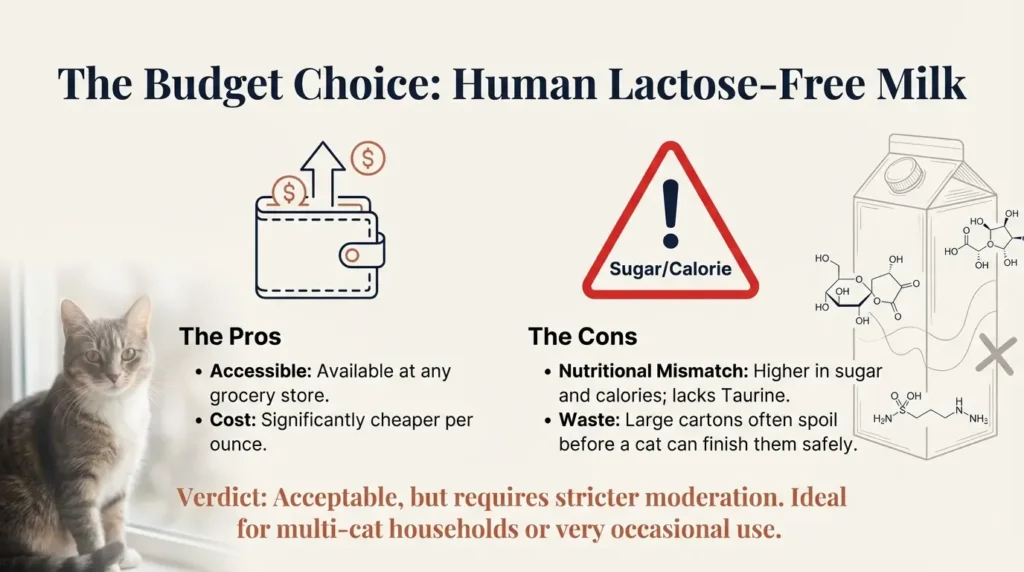
Regular lactose-free milk from the grocery store is a bit different:
Pros:
- Readily available
- Often cheaper than cat-specific products
- Still easier to digest than regular milk
Cons:
- Not formulated for cat nutrition
- Higher in calories and sugars than cat milk
- No added taurine or cat-specific vitamins
- Larger containers mean potential waste
- May still cause mild digestive upset in sensitive cats
My verdict: If you’re going to give your cat lactose-free milk, the cat-specific brands are worth the extra couple of dollars. They’re designed with feline biology in mind, and the portion control is built in.
How Much Lactose-Free Milk Is Safe?
Here’s where that “but” from my vet comes into play.
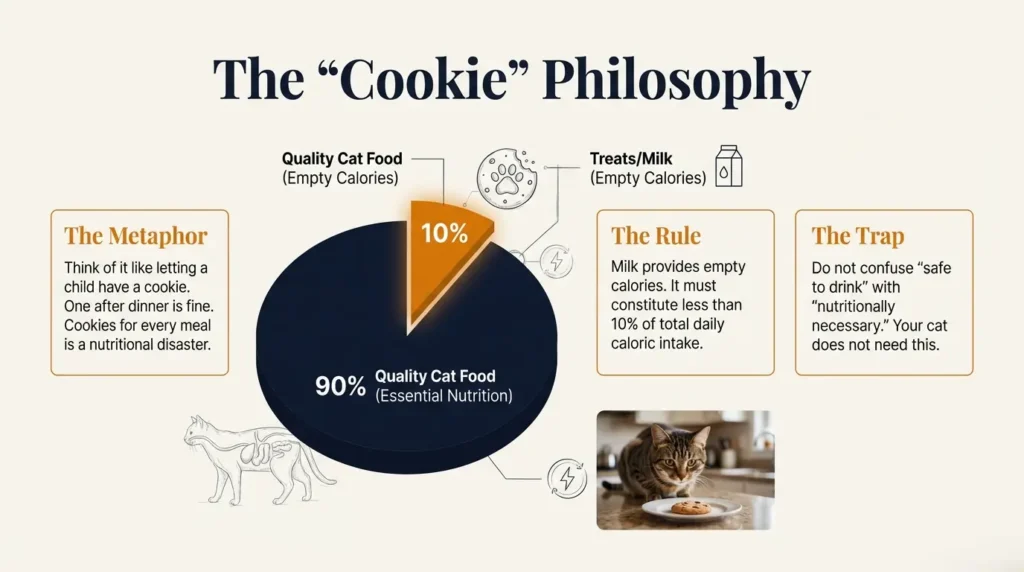
Even though lactose-free milk won’t destroy your cat’s digestive system, it’s still not nutritionally necessary. It’s empty calories that could be better spent on actual cat food.
The guidelines I follow:
- Maximum: 1-2 tablespoons per serving
- Frequency: 2-3 times per week at most
- Daily diet percentage: Less than 10% of total calories
Think of it like letting your kid have a cookie. One cookie after dinner a few times a week? Fine. Cookies for every meal? Nutritional disaster.
When I first got the lactose-free cat milk, I was so excited that Luna could finally have “milk” that I was giving it to her daily. My vet gently reminded me that I was essentially feeding her cat junk food every single day.
“She needs hydration and nutrition from water and quality food,” she explained. “The cat milk is just… fun. Treat it that way.”
I scaled back to twice a week, and honestly, Luna seems to appreciate it more now. Scarcity creates value, even for cats.
The Benefits: Why Bother With Lactose-Free Milk?
Okay, so if it’s not nutritionally essential, why give it to your cat at all?
1. Bonding and Enrichment
There’s something genuinely special about the way Luna’s eyes light up when she hears me open the cat milk carton. That moment of pure joy? That’s worth something.
Cats are creatures of routine and ritual. Having a special treat a couple times a week creates positive associations and strengthens your bond.
2. Hydration Boost (Sometimes)
For cats who are reluctant water drinkers, lactose-free milk can provide a hydration boost. The key word is “can” – it’s not a replacement for water, but it’s better than nothing.
I have a friend whose elderly cat barely drinks water anymore. Her vet suggested mixing a small amount of lactose-free cat milk with water to encourage drinking. It worked. The cat drinks the diluted mixture, stays hydrated, and hasn’t had any digestive issues.
3. Medication Delivery System
This is actually genius, and I wish I’d known about it sooner.
Some cats are impossible to pill. But if they love lactose-free milk, you can hide crushed medication in it (always check with your vet first about crushing pills).
When Luna needed antibiotics last year, my vet suggested mixing the liquid medication with a tiny bit of cat milk. Suddenly, medication time went from a wrestling match to Luna eagerly lapping up her “treat.”
4. Post-Weaning Transition
For kittens being weaned, some vets recommend using lactose-free kitten milk as a transitional step between nursing and solid food.
Important note: This should only be done under vet guidance. Kittens under 8 weeks should still be on kitten milk replacer (KMR), not lactose-free cow’s milk.
The Potential Downsides (Yes, There Are Some)
I’m not going to pretend lactose-free milk is perfect. Even though it’s way safer than regular milk, there are still some considerations:
Weight Gain
Lactose-free milk still contains calories. If you’re giving your cat milk treats on top of their regular food without adjusting portions, you’re adding unnecessary calories.
Luna gained almost a pound over a few months when I was giving her daily cat milk. My vet pointed out that a pound on a cat is equivalent to about 10-15 pounds on a human. Oops.
I cut back the frequency and she lost the weight, but it was a good reminder that treats have consequences.
Pickiness and Expectation
Some cats get so hooked on the taste of lactose-free milk that they start rejecting their water or regular food.
My neighbor made this mistake. She was giving her cat milk every single day, and the cat started refusing to drink plain water. It became a whole thing where she had to slowly wean the cat back off the milk to reset her expectations.
Prevention tip: Keep it special. If your cat gets it every day, it stops being a treat and becomes an expectation.
Individual Sensitivity
Even though lactose-free milk is safer, some cats still have reactions. Every cat is different.
I know someone whose cat has a sensitive stomach and even lactose-free milk gives her soft stool. They had to discontinue it entirely.
Always monitor your cat the first few times you introduce lactose-free milk. Watch for:
- Changes in stool consistency
- Vomiting
- Decreased appetite
- Lethargy
- Any signs of discomfort
Cost vs. Value
Let’s be real: lactose-free cat milk is not cheap. A small carton runs about $4-6 and contains maybe 6-8 servings.
Is it worth it? That’s up to you. For me, seeing Luna’s happy face twice a week is worth the cost. But I totally understand if you’d rather spend that money on higher-quality cat food or other supplies.
How to Introduce Lactose-Free Milk Safely
If you decide to try lactose-free milk with your cat, here’s the approach I wish I’d used from the beginning:
Day 1: Offer just half a teaspoon. I know, it seems ridiculously small. But you’re testing for reactions.
Days 2-3: Watch for any digestive changes. If everything looks normal, proceed.
Day 4: Offer one teaspoon. Continue monitoring.
Week 2: If no issues, you can work up to the full serving size (1-2 tablespoons).
Ongoing: Maintain the 2-3 times per week maximum frequency.
Pro tip: Serve it at room temperature or slightly cool, not straight from the fridge. Some cats prefer it that way, and it’s gentler on their stomach.
When Lactose-Free Milk Is NOT a Good Idea
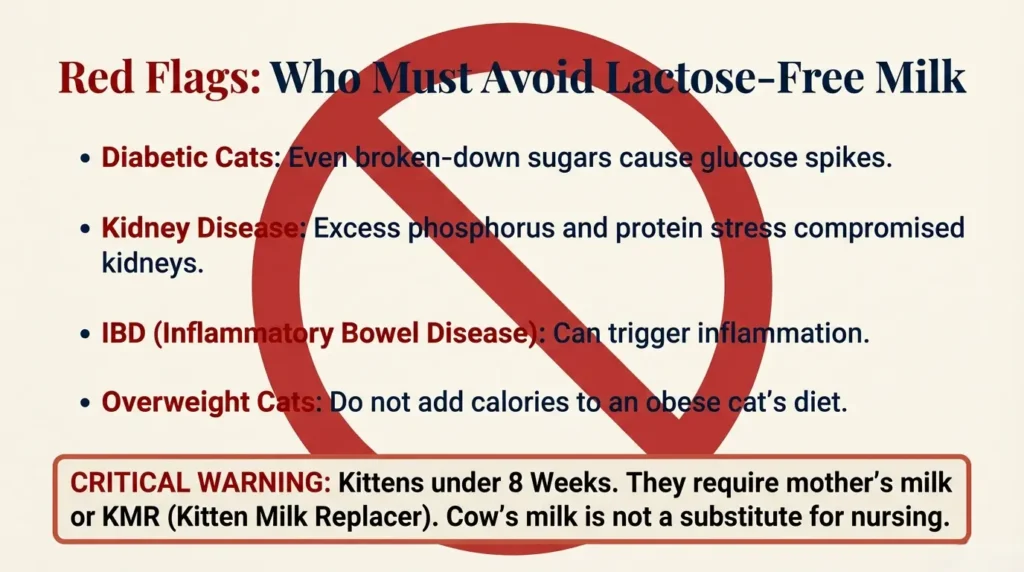
There are some situations where even lactose-free milk should be avoided:
Diabetic cats: The sugars in milk (even broken-down lactose) can affect blood glucose. Check with your vet first.
Cats with chronic kidney disease: Extra phosphorus and protein from milk can stress already compromised kidneys.
Cats with inflammatory bowel disease (IBD): Even lactose-free dairy can trigger inflammation in sensitive digestive systems.
Overweight cats: Those extra calories are the last thing they need.
Kittens under 8 weeks: They should only have mother’s milk or proper kitten milk replacer (KMR).
When in doubt, ask your vet. Luna’s annual checkup always includes a discussion of her diet, and I specifically ask about treats like cat milk to make sure they’re still appropriate for her age and health status.
My Honest Take: Is It Worth It?
After three years of giving Luna lactose-free cat milk as an occasional treat, here’s my honest assessment:
The good: It’s a safe way to give your cat something they genuinely enjoy without the digestive nightmare of regular milk. The bonding moment is real, and I love seeing her excited. For reluctant water drinkers or cats who need medication, it can be genuinely useful.
The reality: It’s not nutritionally necessary. Your cat will be perfectly healthy without it. You’re essentially buying liquid cat joy, which is fine, but let’s be honest about what it is.
My recommendation: If you want to give your cat a special treat and you can afford the occasional carton of lactose-free cat milk, go for it. Just keep portions small, frequency low, and expectations realistic.
If you’re on a tight budget or your cat has health issues, skip it. There are plenty of other ways to show your cat love – interactive play, quality time, upgraded food, comfortable sleeping spots. The milk is a luxury, not a necessity.
Better Alternatives to Consider
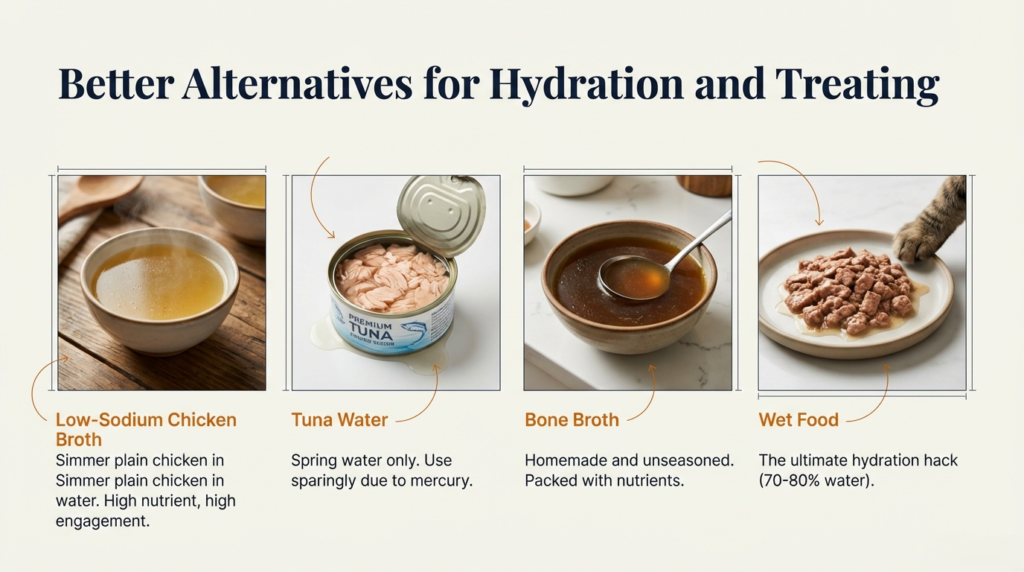
If you’re still unsure about lactose-free milk, here are alternatives I’ve tried that Luna also loves:
Low-sodium chicken broth: I make this by simmering plain chicken in water. Luna goes absolutely bonkers for it, and it’s arguably more nutritious than milk.
Tuna water: The liquid from cans of tuna (in water, not oil). Use sparingly due to mercury concerns, but as an occasional treat it’s great.
Bone broth: Homemade, unseasoned bone broth is packed with nutrients and cats love it.
Plain water in a cat fountain: This boosted Luna’s water intake more than any treat ever did.
Wet food: The ultimate hydration hack. High-quality wet food is 70-80% water and actually nutritious.
The Bottom Line
Can cats drink lactose-free milk? Yes, absolutely. Should it be a regular part of their diet? No, definitely not.
Lactose-free milk – especially cat-specific brands – is one of the few “milk” products that won’t send your cat running to the litter box in distress. That makes it infinitely better than regular dairy.
But it’s still basically a treat. A safe treat, a fun treat, a bonding-moment treat, but a treat nonetheless.
Luna gets her lactose-free cat milk twice a week, about a tablespoon each time. She loves it, I love giving it to her, and her digestive system loves not being destroyed by lactose. It’s a win all around.
Just remember: water is still the best drink for your cat. Everything else is just extra.
Want more info on safe treats for your cat? Check out our guide to human foods cats can and can’t eat, or browse our complete cat nutrition series. And if you’ve got questions about your specific cat’s diet, drop them in the comments – I read and respond to every single one!

2 Comments