
Can Cats Eat Yogurt? Safe Types, Toxic Risks & Vet Tips
The Direct Answer: Can Cats Eat Yogurt?
Yes, cats can eat plain, unsweetened yogurt in tiny amounts—about one teaspoon max. Greek yogurt is safest because it has less lactose. But here’s the critical part: flavored, sweetened, or sugar-free yogurts are dangerous. Xylitol, a common artificial sweetener, is fatally toxic to cats. Always check the label before sharing.
You turned your back for five seconds, and now your cat is happily licking the lid of your morning yogurt. Sound familiar?
I’ve been there. My cat Miso once destroyed a vanilla yogurt cup I left on the counter, and I immediately started spiraling — “Is vanilla safe? What about the sweetener? Do I need to call the vet?”
Here’s the honest truth: yogurt sits in a gray zone for cats. Some types are perfectly fine in small doses. Others are genuinely dangerous. The difference comes down to the ingredients list — and specifically, one sweetener that too many cat owners don’t know about.
In this guide, I’ll give you a fast, clear answer, a type-by-type breakdown, exact serving sizes, and what to do if your cat already ate the wrong kind.
Table of Contents
Is Yogurt Safe for Cats? The Quick Answer
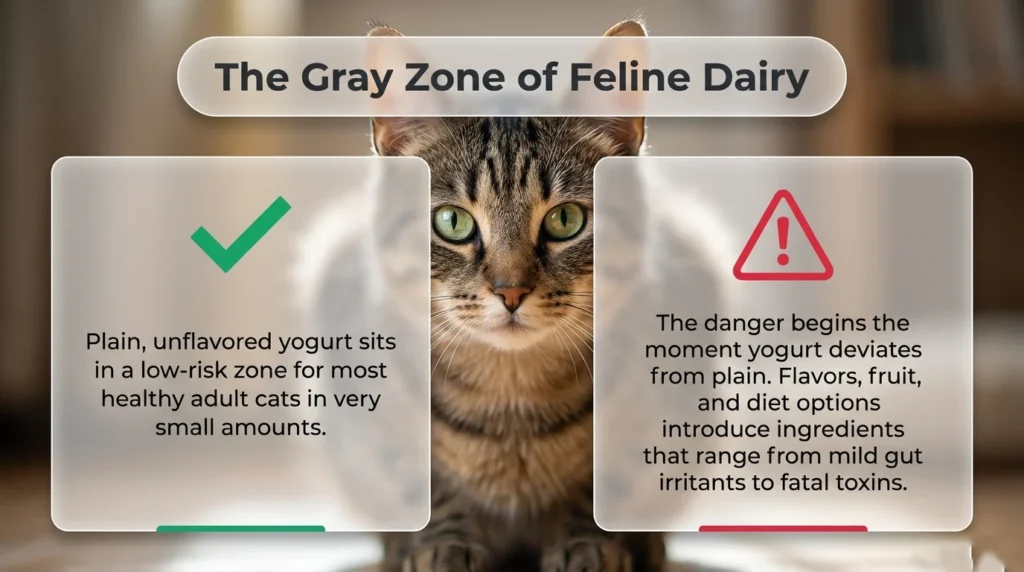
Yogurt is not toxic to cats in the same way onions or grapes are. But “not toxic” doesn’t automatically mean “safe to share freely.”
Plain yogurt — the kind with nothing added — sits in a low-risk zone for most healthy adult cats. The fermentation process breaks down a significant portion of the lactose, making it easier to digest than straight milk or cream. In very small amounts, it is unlikely to cause harm.
The problem starts the moment you move away from plain. Flavored yogurts, fruit-on-the-bottom varieties, vanilla, and especially “light” or “diet” options introduce ingredients that range from gut-irritating to life-threatening.
The most important rule before you let your cat have any lick of yogurt: read the label first.
Safe vs. Unsafe Yogurt for Cats — Quick-Check Table
| Yogurt Type | Safe for Cats? | Key Concern |
|---|---|---|
| Plain unsweetened yogurt | ✅ Yes, in small amounts | Lactose — monitor for upset stomach |
| Plain Greek yogurt | ✅ Best option | Lower lactose due to straining process |
| Vanilla yogurt | ❌ No | Added sugar, artificial flavors |
| Fruit-on-the-bottom yogurt | ❌ No | High sugar, fruit additives, potential xylitol |
| Sugar-free / diet yogurt | ❌ TOXIC — Never | Often contains xylitol, which causes liver failure |
| Strawberry / flavored yogurt | ❌ No | Sugar, syrups, potential artificial sweeteners |
| Coconut milk yogurt | ⚠️ Caution | High fat content, may cause diarrhea |
| Oat milk yogurt | ⚠️ Caution | High carbs and sugar, not suitable for regular use |
| Almond milk yogurt | ❌ No | Almonds are not safe for cats in concentrated forms |
| Kefir (plain) | ✅ Small amounts | Lower lactose, probiotic benefit — see notes below |
⚠️ Rule of thumb: If the yogurt has a flavor, fruit, added sugar, or says “diet,” “light,” or “sugar-free” anywhere on the label, keep it away from your cat entirely.
Can Cats Eat Greek Yogurt? (And Why It’s the Safer Pick)
If you’re going to offer your cat a tiny taste of yogurt at all, plain Greek yogurt is your best option — and here’s the simple reason why.
Regular plain yogurt contains roughly 4–5 grams of lactose per 100 grams. Greek yogurt goes through an extra straining process that removes a significant portion of the liquid whey. That straining reduces the lactose content by roughly half, making it considerably easier for a cat’s digestive system to handle.
Most adult cats stop producing adequate amounts of the lactase enzyme after they’re weaned as kittens. Without enough lactase to break down lactose, dairy triggers fermentation in the gut — which leads directly to gas, bloating, and diarrhea.
Greek yogurt doesn’t eliminate that risk entirely, but it lowers the burden on their digestive system compared to regular yogurt or straight milk.
What About Kefir?
Plain kefir — the fermented milk drink — actually has the lowest lactose content of any dairy product, because its fermentation process goes further than yogurt. Some veterinary nutritionists consider it a reasonable occasional treat for cats with sensitive stomachs, primarily for its probiotic bacteria. If you’re curious about this, can cats drink kefir is worth its own deep-dive, but the short version is: a teaspoon of plain, unsweetened kefir is safer than the same amount of regular milk.
Can Kittens Eat Yogurt?
No. Kittens should not be given yogurt. If a kitten has been weaned and is no longer nursing, their mother’s milk is no longer available — but that doesn’t mean human dairy is the answer. Kittens need a species-specific milk replacer (like KMR) if supplementation is required. Their digestive systems are far more sensitive than adult cats, and even plain yogurt can cause significant diarrhea and dehydration in young cats.
Why Dairy Upsets Most Adult Cats
Here’s the biology in plain terms, because understanding why helps you make smarter choices.
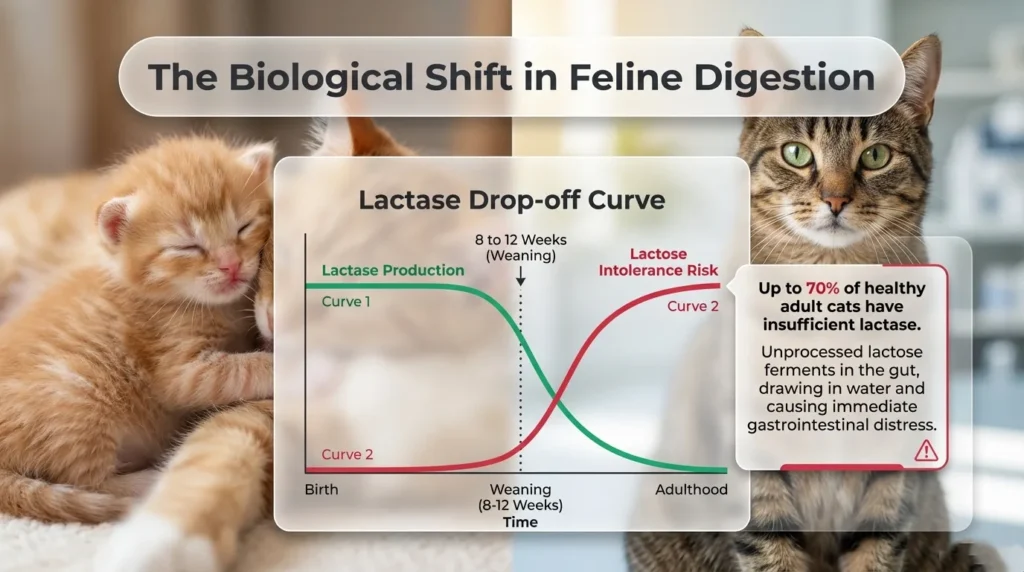
When kittens are born, they produce an enzyme called lactase specifically to digest their mother’s milk. Once they’re weaned — typically around 8 to 12 weeks — their bodies naturally reduce lactase production, because they no longer need it. Milk is no longer part of their expected diet.
By the time a cat is a healthy adult, up to 70% of them have insufficient lactase to properly process lactose. That percentage increases with age.
When lactose enters a lactase-deficient gut, it isn’t digested — it ferments. The bacteria in the large intestine go to work on it instead, producing gas and drawing water into the intestine. The result: bloating, cramping, diarrhea, and sometimes vomiting within a few hours of eating dairy.
Symptoms of Lactose Intolerance in Cats
Watch for these signs within 2–8 hours of your cat eating yogurt:
- Loose stools or diarrhea
- Straining in the litter box
- Visible bloating or a rounded abdomen
- Excessive flatulence
- Vomiting
- Reduced appetite
- Lethargy or seeming “off”
If your cat shows any of these after plain yogurt, they’re telling you dairy doesn’t agree with them. Don’t offer it again.
Why Yogurt Has Less Lactose Than Milk
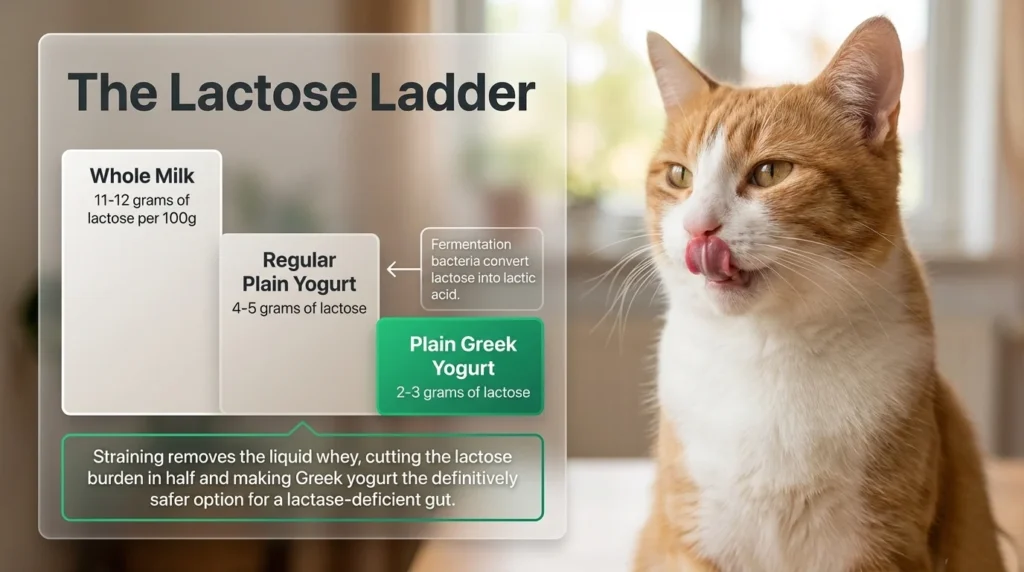
A glass of whole milk contains around 11–12 grams of lactose. Plain yogurt contains 4–5 grams. Greek yogurt contains approximately 2–3 grams. The fermentation bacteria in yogurt — Lactobacillus bulgaricus and Streptococcus thermophilus — convert a portion of the lactose into lactic acid during the culturing process.
This is the reason yogurt is often tolerated better than milk, both in cats and in lactose-sensitive humans.
How Much Yogurt Can a Cat Eat? (Exact Portions, Not Guesses)
Most articles on this topic tell you to give “a small amount” or “a little bit.” That’s vague and unhelpful. Here’s something more concrete.
The Teaspoon Rule
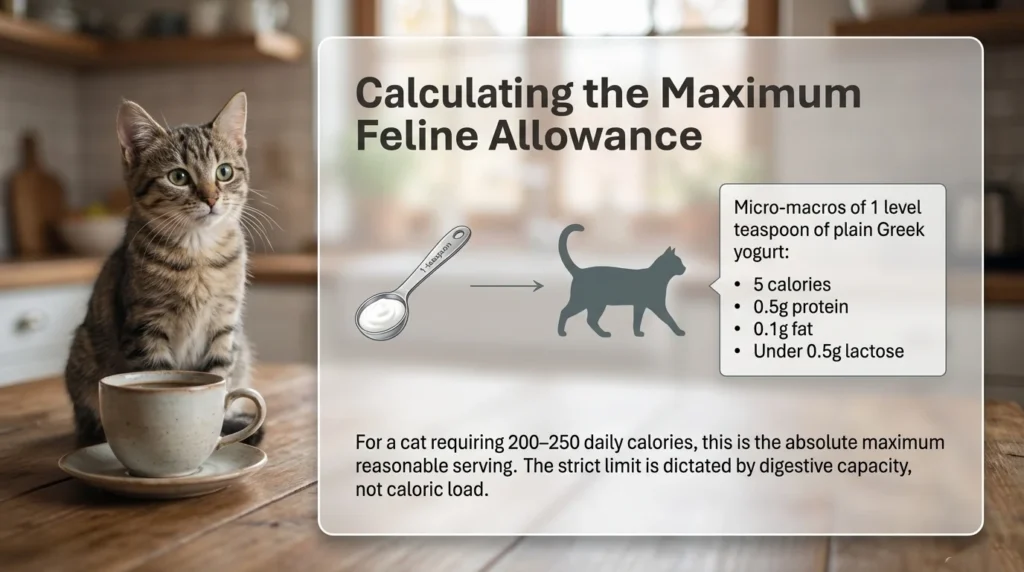
For a healthy adult cat of average weight (8–10 lbs), one teaspoon of plain yogurt is the maximum reasonable amount per serving. That’s roughly the volume of a standard kitchen measuring spoon — not a heaping tablespoon, not a small bowl.
To put that in perspective: one teaspoon of plain Greek yogurt contains approximately:
- 5 calories
- 0.5g protein
- 0.1g fat
- Under 0.5g lactose
For a 10-pound cat eating roughly 200–250 calories per day, one teaspoon is a genuinely small treat. The issue isn’t really the calorie load — it’s the digestive impact.
How Often Is Too Often?
Yogurt should be an occasional treat, not a daily supplement. Think of it the way you’d think of a special table scrap — fine once in a while, not a nutrition strategy.
If you’re giving yogurt hoping to support gut health or add probiotics, you’re better served by a product designed for cats. More on that below.
The Pro Trick: Using Yogurt to Hide Medication
Here’s the practical hack that almost no competitor article mentions.
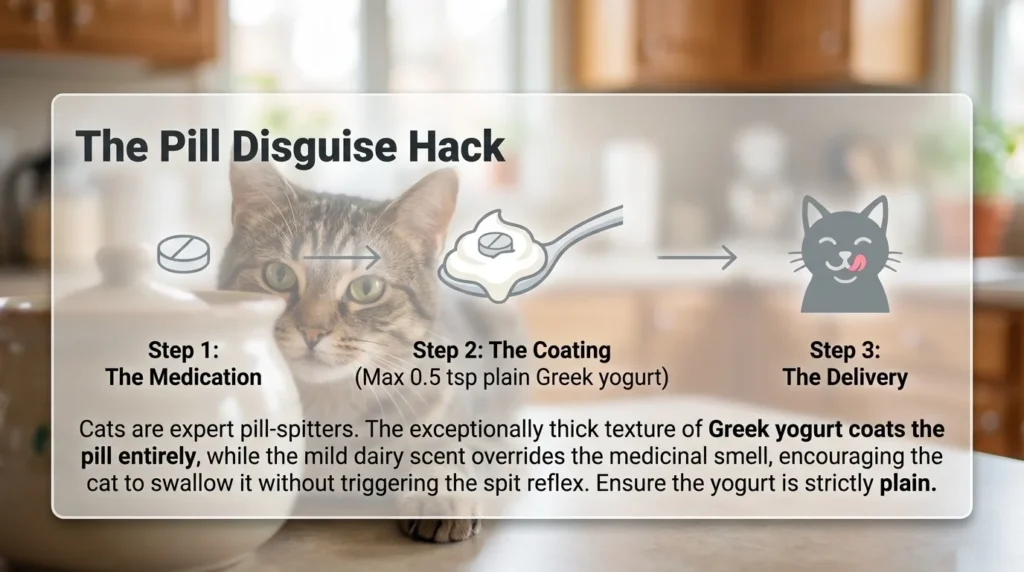
If your cat is resistant to taking pills — and many cats are extraordinarily good at spitting them out — a tiny dab of plain Greek yogurt can help. The thick texture coats a small pill easily, and the mild dairy scent often encourages cats to lick it right up.
Use no more than half a teaspoon for this purpose. Make sure the yogurt is strictly plain and unsweetened before using it as a pill vehicle.
The Xylitol Warning: This Is the Part That Matters Most
I want to give this its own section because it is the most important safety information in this entire article.
Xylitol is an artificial sweetener found in hundreds of “diet,” “light,” “reduced sugar,” and “sugar-free” food products — including yogurt. It is commonly listed under names like birch sugar, xylitol, E967, or simply as “natural sweetener.”
In cats and dogs, xylitol triggers a rapid release of insulin that causes dangerous hypoglycemia (low blood sugar), followed by potential liver failure — even in very small doses. This is not a “watch and wait” situation. It requires emergency veterinary care.
A Scenario That Could Save Your Cat’s Life
A reader once messaged me about her cat Luna. Luna had gotten into what looked like strawberry yogurt, so the owner assumed fruit was the issue and decided to monitor at home. What she hadn’t noticed was the small “sugar-free” label on the side of the container.
By the time Luna started vomiting and trembling four hours later, the owner rushed her to an emergency vet. Luna recovered, but only because treatment was started early.
If your cat ate sugar-free yogurt of any kind, do not wait for symptoms. Call the ASPCA Animal Poison Control Center at (888) 426-4435 or your nearest emergency vet immediately.
What to Do If Your Cat Already Ate Yogurt
Step 1: Identify What Type
Go find the container right now. Check the full ingredient list for:
- Xylitol, birch sugar, E967
- Artificial sweeteners of any kind
- Added sugars, fruit purees, syrups
- Artificial flavors or vanilla extract
Step 2: Assess the Situation
If it was plain yogurt: Monitor your cat for digestive upset over the next 4–8 hours. A small lick is unlikely to cause serious harm in a healthy adult cat. Watch for diarrhea, vomiting, or lethargy. Offer fresh water.
If it was flavored or sugary yogurt: Monitor carefully. High sugar is unlikely to be an emergency but can cause stomach upset. Limit food for a few hours and keep an eye on the litter box.
If it was sugar-free or diet yogurt: Call your vet or ASPCA Poison Control immediately. Don’t wait for symptoms.
Step 3: When to Call the Vet
Call your vet if you notice:
- Repeated vomiting (more than twice)
- Bloody stool or diarrhea
- Trembling, weakness, or collapse
- Drooling excessively
- Refusing to eat for more than 24 hours
- Yellowing of the skin or eyes (jaundice — a sign of liver stress)
Better Alternatives: What to Give Instead of Yogurt
If your goal is supporting your cat’s digestive health — especially if they’ve had stomach issues, antibiotic treatment, or irregular stools — yogurt is not the most reliable or consistent tool. Here’s what actually works better.
Feline-Specific Probiotic Supplements
Products like Purina Pro Plan FortiFlora are formulated specifically for cats, with strain-tested probiotic bacteria at clinically relevant concentrations. Unlike yogurt, you know exactly what’s in them, exactly how many live cultures per dose, and they contain no lactose, no sugar, and no risk of xylitol contamination.
FortiFlora is available on Amazon and Chewy and comes in individual powder sachets you sprinkle directly onto food. Most cats find the taste appealing.
Wet Food Toppers
High-moisture, meat-based wet food toppers serve a completely different purpose — hydration — but they also contain digestive enzymes and proteins that support gut motility naturally. Brands like Weruva and Tiki Cat make broths specifically designed as meal additions.
Cat Grass
For cats who graze and self-regulate their digestion, cat grass (typically wheatgrass or oat grass) is a safe, natural way to support gut movement. It’s not a probiotic, but many cats instinctively seek it out when their stomach feels off.
Yogurt Safety Checker
🐱 Quick Yogurt Safety Checker
Answer 3 questions to get an instant safety verdict.
Frequently Asked Questions
Key Takeaways
- Plain Greek yogurt is the safest option — small amount, maximum one teaspoon, occasional only.
- Most adult cats are lactose intolerant. Even safe yogurt can cause stomach upset in sensitive cats.
- Sugar-free and diet yogurts are potentially fatal. Xylitol causes liver failure — never offer these to cats.
- Flavored yogurts are a no. Vanilla, strawberry, fruit-on-the-bottom — all contain ingredients that are inappropriate for feline digestion.
- If you want probiotic support, choose a feline-specific supplement rather than relying on human yogurt.
- If in doubt, check the label. Spend 15 seconds scanning ingredients before your cat gets anywhere near it.
What to Do Right Now
- Check your fridge. Look at every yogurt container currently accessible to your cat and confirm it is plain, unsweetened, and free of artificial sweeteners.
- If your cat just ate the wrong type, use the checker tool above or scroll to the “What to Do” section to decide your next step.
- If you want to offer yogurt as an occasional treat, buy a small container of plain Greek yogurt with no additives and offer no more than one teaspoon at a time.
- If you want to support your cat’s gut health properly, ask your vet about Purina FortiFlora or a similar feline probiotic supplement.
Did your cat get into something else? Read next:
→ Can Cats Drink Milk? What Actually Happens
→ Can Cats Eat Cheese? Safe Amounts & Types
→ Best Probiotic Supplements for Cats in 2026
→ What Human Foods Can Cats Eat? The Safe & Unsafe List
Sarah Mitchell is a cat nutrition writer and founder of Purreats.com. She writes evidence-based cat food guides for everyday cat parents. All health-related content on Purreats.com is reviewed for accuracy prior to publication.
📌 Bookmark this page — updated regularly as new veterinary guidance becomes available.
Key Takeaways
The bottom line on cats and yogurt:
- Plain Greek yogurt is the safest option if you’re going to share—it has less lactose than regular yogurt thanks to the straining process
- Keep portions tiny—one teaspoon maximum, and only as an occasional treat
- Never give sugar-free yogurt—xylitol is fatally toxic to cats, even in small amounts
- Skip flavored varieties—added sugars, fruit syrups, and artificial ingredients offer no nutritional value and can cause stomach upset
- Most adult cats are lactose intolerant—they can’t properly digest dairy, which leads to diarrhea and digestive discomfort
- Watch for symptoms—if your cat ate yogurt, monitor for diarrhea, vomiting, or lethargy within 8-12 hours
- Cat-specific probiotics work better—products like Purina FortiFlora are formulated for feline digestive systems without the lactose burden
2 Comments