5 Smart Rules for How Much Dry Food to Feed a Cat
Do you remember the first time you brought a cat into your home? It was filled with soft purrs and curious noses. You worried about doing everything right, especially feeding.
Feeding your cat the right amount is crucial. It helps keep them at the right weight and prevents health issues. It also keeps them full of energy for play and grooming.
This guide will help you figure out how much dry food your cat needs. We’ll look at life stages, health, and how to measure food accurately. We’ll also talk about feeding habits that work in real life.
Online calculators and package guidelines are good starting points. But, cats with health issues need special plans from your vet. This guide is for U.S. Cat owners who want to give their pets good.
Table of Contents
Table of Contents
how much dry food to feed a cat
Giving your cat the correct amount of dry food is important for their health. Too little can stunt growth in kittens and cause muscle loss in adults. Too much can lead to obesity, pancreatitis, and less mobility. Use this guide to keep your cat healthy.
Why the question matters for your cat’s health
Feeding affects more than just weight. It can change litter habits, behavior, and dental health. Cats on dry food need extra water or wet food to stay hydrated. Vets say a stable body condition score (BCS 4–5/9) is best for health and mobility.
How body weight and life stage influence dry food amounts
Life stage affects calorie needs. Kittens need more calories for growth. Adults need maintenance calories based on size and activity. Seniors may need more protein to prevent muscle loss.
Use current and target weight to set portions. If your cat is overweight, aim for the ideal weight. This helps in safe and steady weight loss.
Common mistakes owners make when estimating portions
Don’t just follow the “cups per day” on the bag. Different kibbles have different calorie densities. Free feeding can lead to slow weight gain in indoor cats.
Household scoops vary. Use a kitchen scale for accurate portions. Many owners forget to count treats and table scraps. Adjust portions when your cat ages or has health changes.
For a practical plan, use a cat feeding guide with calorie targets. Track weight regularly and consult your vet for any unexpected changes.
Factors that determine proper portion sizes for cats
Choosing the right dry cat food portions involves several key factors. These include your cat’s age, activity level, health status, and the food’s calorie density. These elements help ensure your cat stays healthy and has the right amount of energy.
Age and life stage: kitten, adult, senior
Kittens grow quickly and need lots of calories and protein. Many vets suggest 3–4 small meals a day for young kittens. Some may switch to adult formulas once they grow up.
Adult cats need the right amount of calories based on their individual traits. Indoor cats usually need fewer calories than outdoor or very active cats. Watch their weight and body condition to adjust portions.
Senior cats might need fewer calories but still need enough protein to keep their muscles strong. They might also have trouble eating dry kibble because of dental issues. You might need to soften the kibble or mix in wet food.
Activity level and metabolism
Active and outdoor cats burn more calories. Indoor cats, especially those that are neutered or spayed, need smaller portions to avoid gaining weight.
Breed and individual differences also play a role. Some breeds, like Oriental and Abyssinian cats, are more active. Others, like British Shorthairs or Ragdolls, are less active. Stress, cold weather, and seasonal changes can also affect their calorie needs.
Health conditions that change calorie needs
Some health issues increase calorie needs. For example, hyperthyroidism and recovery from surgery or illness may require more calories. Early chronic kidney disease can also increase a cat’s appetite.
Other conditions might lower calorie needs. Osteoarthritis can reduce activity. Obesity and some cases of diabetes require careful calorie control. Always work with your vet to set safe weight-loss goals, usually no more than 1–2% body weight loss per week.
Type and calorie density of the dry cat food
Dry kibble has different calorie levels. Most formulas range from about 300 to 500 kcal per cup. Check the kcal per kilogram or cup on labels from brands like Purina, Hill’s Science Diet, Royal Canin, and Blue Buffalo when calculating portions.
Higher-protein, lower-carb diets and weight-management formulas have different calorie densities. The ingredients and life-stage formula affect how much you should feed. Accurate portioning requires translating calorie needs into cups or grams for the specific kibble you use.
| Factor | How it affects portions | Owner action |
|---|---|---|
| Age and life stage | Kittens need more calories per pound; seniors may need less but more protein | Feed kittens 3–4 meals/day; adjust adult/senior portions by monitoring weight |
| Activity and metabolism | High activity raises needs; indoor neutered cats need fewer calories | Increase portions for active cats; reduce for sedentary pets and measure often |
| Health conditions | Diseases can raise or lower calorie requirements | Consult your veterinarian for tailored calorie targets and safe weight plans |
| Calorie density of kibble | Kibbles range ~300–500 kcal/cup; formula type changes energy content | Check manufacturer kcal per cup/kg and convert calories to cups or grams |
| Environmental and seasonal factors | Cold environments and outdoor access increase calorie needs | Adjust portions seasonally and observe body condition |
How to calculate daily dry cat food portions
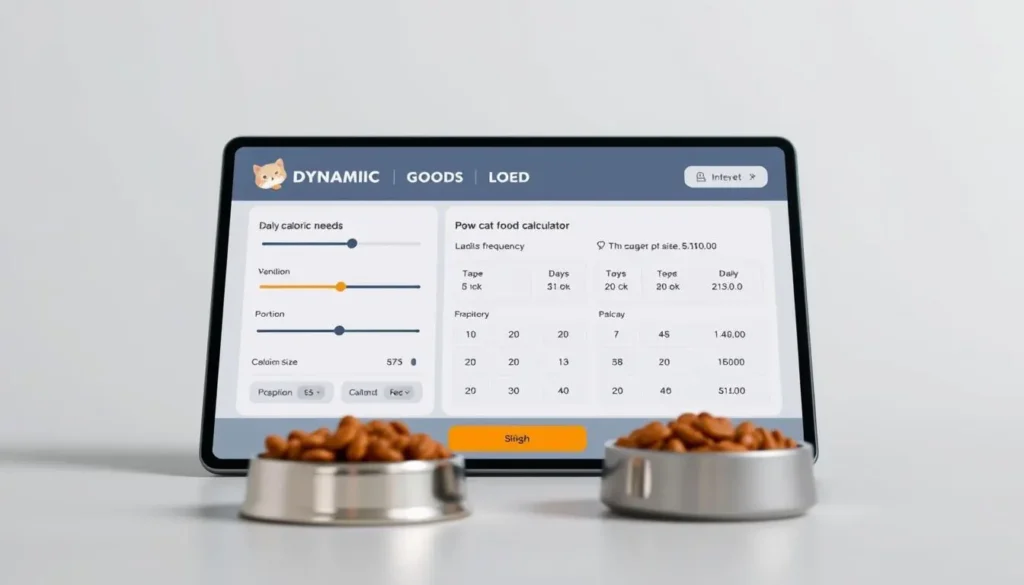
Feeding your cat the correct amount of food is important for their well-being. Start by following the package directions. Then, do a quick math check and track your cat’s weight over time. For more precise measurements, use a cat food quantity calculator. Also, learn how to convert between cups and grams for home use.
Using feeding guidelines on the package
First, read the label carefully. Most bags from Purina, Hill’s, and Royal Canin give recommended cups per day. They also note if the amounts are for adult cats.
Look for kcal per cup or kcal per 100 g on the guaranteed analysis panel. Remember, these guidelines are just a starting point. They assume average activity and body condition.
How to use a simple cat food quantity calculator
To start, figure out your cat’s target weight. To change pounds to kilograms, divide the number by 2.2046. Then, calculate Resting Energy Requirement (RER) and apply a life-stage multiplier.
The RER formula is: RER = 70 × (body weight in kg)^0.75. For kittens and very active cats, use 2–3× RER. For adult cats, use 1.2–1.4× RER. For overweight cats, use 0.8–1.0× RER under vet guidance.
For example, a 10-lb (4.54 kg) adult indoor cat’s RER is about 70 × 4.54^0.75. Then, multiply by 1.2–1.4 to get kcal/day. Use a cat food quantity calculator to find precise daily calories and portions.
Converting calories to cups or grams
Once you have kcal/day, divide by kcal per cup from the bag to get cups per day. To get grams, divide kcal/day by kcal per gram, or multiply cups by the grams per cup listed by the manufacturer.
For example, if a kibble is 350 kcal/cup and your cat needs 250 kcal/day, then 250 ÷ 350 = 0.71 cups/day, about 11.4 tablespoons. For accuracy, weigh the food on a kitchen scale. Grams give better precision than cups for daily rations.
Adjusting portions based on weight change and monitoring
Weigh your cat every 2–4 weeks while changing rations. Track body condition score and daily intake, including treats and wet food calories. If weight shifts by more than 5% in a month, reassess calories and consult your veterinarian.
Make gradual adjustments: change calories by 5–10% and re-evaluate after 2–4 weeks. Record treats and wet food so your cat food quantity calculator reflects total daily calories and keeps portions balanced.
| Step | What to do | Example for 10-lb (4.54 kg) cat |
|---|---|---|
| 1. Target weight | Confirm ideal weight and convert to kg | 10 lb ÷ 2.2046 = 4.54 kg |
| 2. Calculate RER | Use RER = 70 × (kg)^0.75 | RER ≈ 70 × 4.54^0.75 ≈ 200 kcal/day |
| 3. Apply multiplier | Choose based on life stage/activity | Adult indoor: 1.2–1.4 → 240–280 kcal/day |
| 4. Convert to cups | Divide kcal/day by kcal per cup on bag | 250 kcal ÷ 350 kcal/cup ≈ 0.71 cup (≈11.4 tbsp) |
| 5. Weigh and monitor | Use grams for precision; track weight every 2–4 weeks | Adjust calories by 5–10% if weight changes >5% in a month |
Best practices for feeding cats and managing portions
Feeding your cat right is key to their health and weight. Use clear routines, reliable tools, and careful portioning. This helps avoid confusion and keeps weight in check. Here are some tips to start today.

Scheduled meals vs. free feeding: pros and cons
Scheduled meals help control dry cat food portions. Most adult cats need two meals a day, while kittens need three to four. This makes it easier to manage their weight and monitor their appetite.
Free feeding might work for homes with many cats or for kittens learning to eat. But, it can lead to overeating in adult cats. Consider a timed feeder or puzzle feeder to slow down eating and add fun.
Measuring food accurately and choosing the right tools
Always weigh food when you can. A digital kitchen scale that reads to 1–5 grams is best. If using a scoop, calibrate it on a scale to ensure accuracy.
Measuring cups for dry ingredients are a good backup. Level each cup and clean it between uses for consistent portions. Avoid using household spoons as they are too variable.
Combining wet and dry food for balanced nutrition
Wet food adds moisture and often has more protein and less carbs. This mix supports urinary health and keeps your cat full. When mixing wet and dry food, subtract wet food calories from the daily total to keep kcal in check.
Choose AAFCO-complete diets that match your cat’s life stage. If your cat has a sensitive stomach, mix brands slowly under vet guidance. Small changes help avoid digestive issues.
Recognizing signs of overfeeding or underfeeding
Watch for weight gain, loss of a visible waist, trouble jumping, or lethargy as signs of overfeeding. Increased grooming to hide weight gain is another clue. If you see these signs, check your feeding routine.
Underfeeding shows as weight loss, visible ribs or spine, low activity, dull coat, or stalled growth in kittens. Use a 1–9 body-condition score and weigh your cat regularly. See a vet for any persistent changes.
Conclusion
To find out how much dry food to feed your cat, first figure out their target weight and life stage. Use the resting energy requirement (RER) and add the activity factor to estimate daily calories. This method helps you know how much dry food your cat needs, avoiding guesses based on pack labels.
Then, turn those calories into cups or grams using the kcal value on the kibble bag. Use a kitchen scale or a calibrated scoop to measure portions. Keep track of feeds to spot any trends. It’s good to have scheduled meals, include treats and wet food, and adjust portions as needed.
Remember, the amount of dry food for a cat varies. Keep an eye on your cat’s weight and make small, steady changes. For a simple feeding guide: weigh your cat, check the kibble’s kcal, and create a feeding plan. Review it every few weeks. If your cat has health issues or you’re unsure about calorie needs, talk to your vet or a vet nutritionist for personalized advice.