5 Best Grain Free Cat Food Picks for 2026
Quick Answer: What You Need to Know Right Now
Grain free cat food removes wheat, corn, rice, and oats, replacing them with ingredients like peas, potatoes, or tapioca. Here’s what most articles won’t tell you upfront: grain-free doesn’t mean healthier, lower-carb, or better quality. It just means no traditional grains. A grain-free food can actually have more carbohydrates than regular cat food if it’s loaded with potato starch or pea flour. The real question isn’t “grain or no grain”—it’s whether the food has enough quality animal protein and low enough carbs to actually support your cat’s health. Most healthy cats don’t need grain-free food at all, but for cats with genuine food sensitivities or chronic digestive issues, the right grain-free formula can make a real difference.
Last month, I was at the vet clinic waiting room when I overheard a woman tell the receptionist she’d just spent $73 on a bag of grain-free cat food because the label said “holistic” and “natural.” Her cat, she said, was still vomiting twice a week.
The vet tech leaned over the counter and asked one question: “What’s the first ingredient?”
The woman pulled up a photo on her phone. “Peas.”
I watched her face fall. She’d spent premium money on what was essentially pea protein with chicken flavoring. The “grain-free” label had done exactly what it was designed to do—convince her she was buying something superior. But her cat’s stomach told a different story.
That’s the problem with grain-free cat food. The label sounds healthy. The marketing feels scientific. The price suggests quality. But unless you know what you’re actually looking at, you can easily end up paying more for a formula that’s worse than the grain-inclusive food you were feeding before.
In this guide, I’ll show you what grain-free actually means, when it genuinely helps, how to identify a quality formula, and which products are worth considering based on your cat’s actual needs—not marketing fantasies.
Quick Comparison: Top Grain Free Cat Foods
| Product | Best For | Protein | Carbs (Est.) | Price/Day | Rating |
|---|---|---|---|---|---|
| Wellness CORE Original | Overall value | 45% | ~18% | $0.85 | ⭐⭐⭐⭐½ |
| Tiki Cat Puka Puka | Hydration & picky eaters | 12% (50% DM) | <2% | $1.35 | ⭐⭐⭐⭐⭐ |
| Orijen Original | Maximum protein | 40% (44% DM) | ~15% | $1.90 | ⭐⭐⭐⭐⭐ |
| American Journey | Budget-friendly | 40% | ~24% | $0.55 | ⭐⭐⭐⭐ |
| Ziwi Peak Air-Dried | Premium/allergies | 42% | <3% | $2.75 | ⭐⭐⭐⭐⭐ |
DM = Dry matter basis. Prices estimated for 10 lb cat.
What Grain Free Cat Food Really Means
Walk into any pet store and ask three different employees what “grain-free” means. You’ll get three different answers, and there’s a decent chance all three will be wrong.
Here’s the actual definition: grain-free cat food is formulated without wheat, corn, rice, oats, barley, or any other cereal grain. Instead, manufacturers use alternative carbohydrate sources—usually sweet potatoes, regular potatoes, peas, chickpeas, lentils, or tapioca—to provide structure to kibble or add body to wet food.
That’s it. That’s the whole definition.
Notice what’s not in that definition: the words “healthier,” “higher protein,” “low-carb,” or “premium quality.” Grain-free is a factual statement about ingredients, not a health claim. But somewhere between the manufacturing facility and your shopping cart, it morphed into a marketing promise that implies all kinds of benefits it doesn’t actually deliver.
Grain Free vs. Grain Inclusive: What Actually Changes
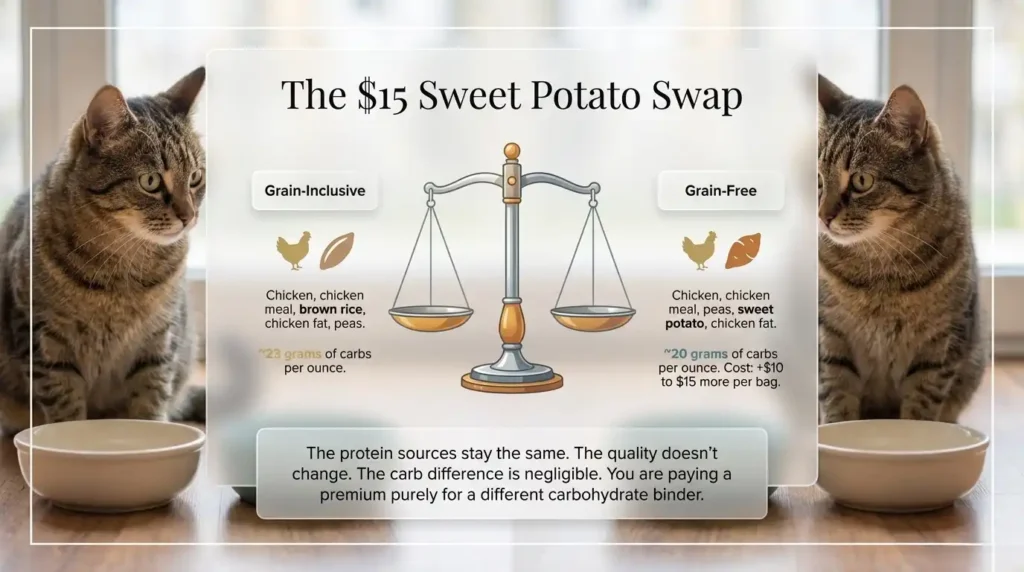
Let’s say you’re comparing two foods from the same manufacturer. One is grain-inclusive, one is grain-free. Here’s what typically happens:
Grain-inclusive version: Chicken, chicken meal, brown rice, chicken fat, peas
Grain-free version: Chicken, chicken meal, peas, sweet potato, chicken fat
See the difference? They just swapped brown rice for sweet potato. The protein sources stayed the same. The quality didn’t change. The formula is nearly identical—just with a different carb source.
Now here’s where it gets interesting. Brown rice has about 23 grams of carbs per ounce. Sweet potato has about 20 grams. The difference is negligible. But the grain-free version probably costs $10-15 more per bag.
Sometimes the swap makes the food worse. I’ve seen grain-inclusive foods with 35% carbs become grain-free foods with 42% carbs because the manufacturer replaced rice with potato starch and pea flour—both of which are more carb-dense than the grain they removed.
The bottom line: grain-free versus grain-inclusive tells you almost nothing about nutritional quality. What matters is the total formula—the protein sources, the carb percentage, the ingredient quality, and whether the food actually matches what your cat needs.
Why Cat Owners Go Looking for Grain Free Food
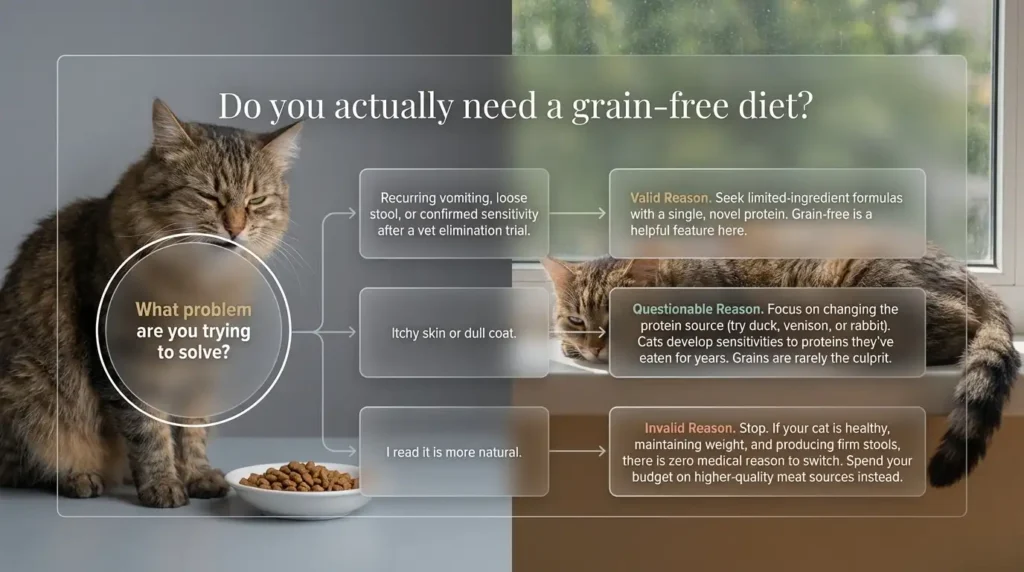
Most people start researching grain-free diets for one of four reasons:
Valid reason #1: Digestive symptoms that might be food-related. Your cat has recurring vomiting, loose stool, or gas that doesn’t resolve with deworming or probiotic support. Your vet suggests trying a diet change to see if a specific ingredient is the trigger.
Valid reason #2: Confirmed food sensitivity after an elimination trial. Your vet had you do a proper food trial with a novel protein and limited ingredients. Your cat improved. Now you’re looking for commercial options that match that success.
Questionable reason #3: Skin problems like itching or dull coat. This could be food-related. But it’s more likely to be caused by the protein source (chicken, beef, fish) than by grains. Cats can develop sensitivities to proteins they’ve eaten for years.
Invalid reason #4: “I read that grain-free is more natural.” This is pure marketing. Wild cats eat whole prey—mice, birds, insects. No commercial cat food replicates a natural diet, grain-free or otherwise.
The reality is that most cats don’t need grain-free food. But the ones who do—the ones with genuine sensitivities or chronic digestive issues—can see real improvement with the right formula.
Is Grain Free Cat Food Actually Good for Cats?
When Grain Free Might Actually Help
Let me be clear: for most cats, grain-free food offers no advantage over a quality grain-inclusive formula. But there are specific situations where it can make a difference.
True grain sensitivity. This is rare—far rarer than pet food companies want you to believe—but it does exist. Some cats develop an immune response to specific grain proteins. If your cat is one of them, removing grains from the diet can reduce inflammation and improve digestion. But you won’t know if grains are the problem unless you’ve done a proper elimination trial supervised by your vet.
Switching to a higher-quality formula that happens to be grain-free. Sometimes grain-free food works because you went from a low-quality grain-inclusive food (chicken by-products, corn gluten meal, wheat middlings) to a premium grain-free formula with real meat and better ingredients. The improvement isn’t because you removed grains. It’s because you upgraded the entire formula.
Feeding a low-carb diet for medical reasons. Cats with diabetes or obesity sometimes benefit from lower-carb, higher-protein diets. Many grain-free foods fit that profile—but not all. Some grain-free foods have more carbs than grain-inclusive options because they replace rice with potato starch.
Here’s what I tell people: if your cat is healthy, happy, maintaining good weight, has normal energy, and produces firm stools on their current food, there is zero reason to switch to grain-free. You’re spending extra money for no health benefit.
When Grain Free Is Just Expensive Marketing
I watched my neighbor switch her three cats to grain-free food last year because a YouTube video told her it would make their coats shinier. Cost her an extra $60 a month. Six weeks later, I asked how it was going.
“About the same,” she said. “Maybe a little shinier? Hard to tell.”
That’s $360 she spent on “maybe.” Her cats were already healthy. The grain-inclusive food she was using before had quality protein sources and reasonable carb levels. The switch didn’t solve a problem because there was no problem to solve.
What’s more common is owners spending extra money because the packaging looks premium, the ingredient list sounds impressive, and the label says things like “ancestral diet” or “biologically appropriate.” All of which are marketing terms with no regulatory meaning.
The DCM Controversy: What You Actually Need to Know
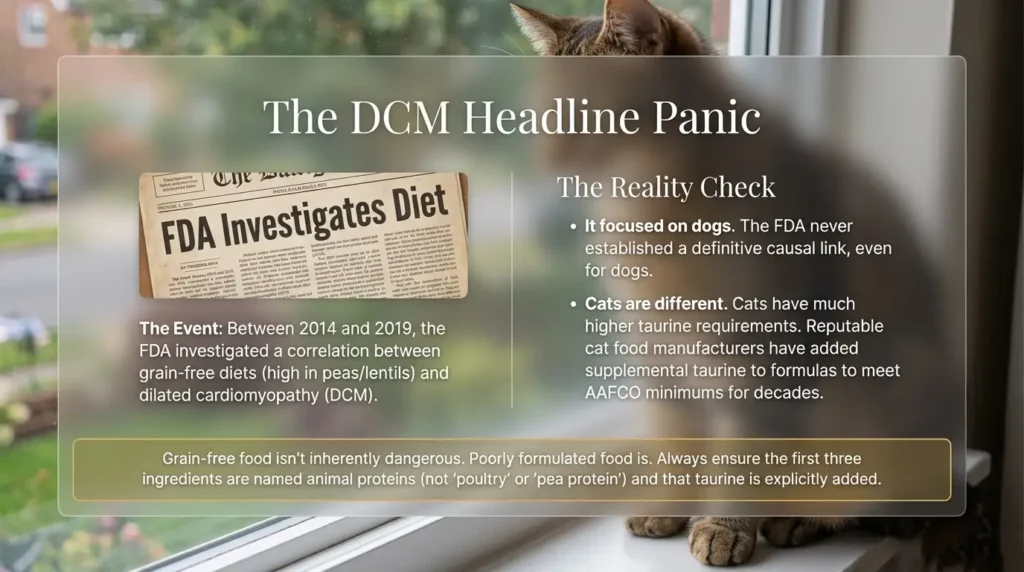
You’ve probably heard about the FDA investigation into grain-free dog food and dilated cardiomyopathy (DCM), a serious heart condition. Here’s what happened: between 2014 and 2019, the FDA received reports of dogs on grain-free diets developing DCM, particularly dogs eating foods with high levels of peas, lentils, and other legumes.
Now here’s what most headlines didn’t tell you: the investigation focused almost entirely on dogs, not cats. And even in dogs, the FDA never established a definitive causal link. They identified a correlation, but they couldn’t prove the food was the cause.
For cats, the picture is even murkier. Cats have much higher taurine requirements than dogs, and reputable cat food manufacturers have been adding supplemental taurine to commercial formulas for decades. A quality grain-free cat food should have plenty of added taurine to meet AAFCO minimums.
That said, not all grain-free foods are created equal. Some cheaper formulas use pea protein as a primary protein source instead of real meat. This drives up the protein percentage on paper but doesn’t provide the bioavailable amino acids your cat actually needs.
Bottom line: grain-free food isn’t dangerous. But poorly formulated food is dangerous, grain-free or otherwise. If you’re feeding grain-free, make sure the first three ingredients are named animal proteins (chicken, turkey, salmon—not “poultry” or “fish”), and make sure taurine is added to the formula.
How to Actually Choose a Good Grain Free Cat Food
Start with the Problem You’re Trying to Solve
Before you start comparing brands, ask yourself: What am I trying to fix?
Are you addressing recurring vomiting? Then you need a limited-ingredient formula with a single, novel protein source. Grain-free might be part of that, but it’s not the main feature.
Is your cat overweight? You need high protein, low carb, and moderate fat—with portion control.
Is your cat a picky eater? You need strong aroma, appealing texture, and variety. Wet food works better than dry. Grain-free is irrelevant.
Does your cat have itchy skin? You’re likely dealing with a protein sensitivity, not a grain issue. Try a novel protein (duck, venison, rabbit) before you worry about grain content.
Once you know what problem you’re solving, the ingredient list becomes way easier to evaluate.
How to Read an Ingredient List Without Getting Fooled
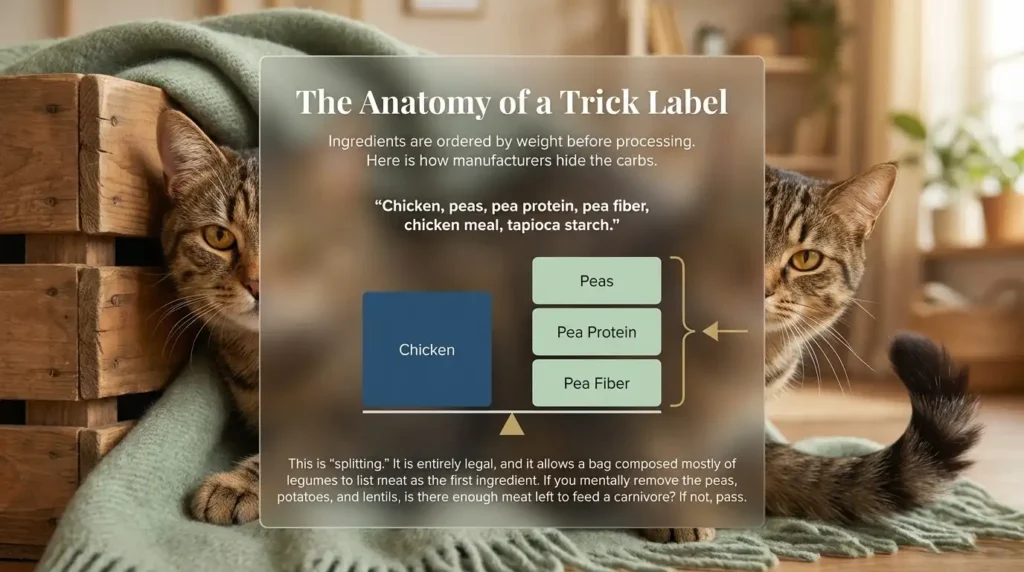
The ingredient list is ordered by weight before processing. That means the first ingredient is the heaviest. But here’s the trick pet food companies use: they split plant ingredients into multiple entries so they appear lower on the list.
Example:
Misleading ingredient list: Chicken, peas, pea protein, pea fiber, chicken meal, tapioca starch
Looks like chicken is the main ingredient, right? But if you add up peas + pea protein + pea fiber, you’ve got three pea-based ingredients that collectively outweigh the chicken. This is called “splitting.” It’s legal, but it’s deceptive.
What to look for in a quality grain-free formula:
Good signs:
- Named animal proteins in the first three positions (chicken, turkey, salmon—not “poultry meal” or “fish meal”)
- Whole meat or meat meals (chicken meal, turkey meal), not vague by-products
- Organ meats like chicken liver or turkey heart
- Minimal plant-based filler ingredients
Red flags:
- “Meat by-products” without specifying the source
- Pea protein or potato protein listed high on the ingredient list
- Long lists of gums and thickeners in wet food
- Vague terms like “animal digest” or “natural flavors”
- More than two legume-based ingredients in the top five
Here’s a quick test: if you mentally removed all the peas, potatoes, tapioca, and lentils from the ingredient list, would there still be enough animal protein left to feed a carnivore? If the answer is “maybe” or “not really,” pass.
Comparing Real Feeding Costs, Not Just Bag Prices
A $60 bag that lasts eight weeks costs less per month than a $35 bag that’s gone in three weeks. But most people compare shelf price, not actual feeding cost, and end up spending more money on “cheap” food.
Here’s how to calculate what you’ll actually spend:
Step 1: Check the calorie content per cup or per can (usually listed on the label or manufacturer website).
Step 2: Estimate your cat’s daily calorie needs. The rough guideline is 20 calories per pound of body weight for an average adult cat. A 10-pound cat needs about 200 calories per day.
Step 3: Divide daily calories needed by calories per serving. That tells you how much food your cat needs per day.
Step 4: Multiply servings per day by the cost per serving (bag price ÷ total servings in bag).
Step 5: Multiply daily cost by 30 to get monthly cost.
Use the calculator below to do the math instantly:
💰 Monthly Feeding Cost Calculator
The Best Grain Free Cat Foods That Actually Deliver
Best Overall: Wellness CORE Grain-Free Original
Best for: Healthy adult cats who need high protein and reasonable carbs without premium pricing
The first five ingredients are deboned turkey, turkey meal, chicken meal, peas, and potatoes—real animal protein up front, not filler. The crude protein is 45%, which is high for a mid-priced dry food. The estimated carbs come in around 18%.
Watch-outs: Contains peas and potatoes. Some cats find it too rich at first—transition slowly over 10-14 days.
Key stats:
- Protein: 45%
- Estimated carbs: ~18%
- Price per day: Around $0.85 for a 10 lb cat
Best Wet Food: Tiki Cat Puka Puka Luau
Best for: Cats who need hydration, picky eaters, high protein intake
This is shredded chicken in chicken consommé. That’s the whole ingredient list. No gums. No gravy. Just chicken and broth.
At 80% moisture, this is one of the best foods you can feed for hydration. The carb content is less than 2%. Cats love the texture—the shreds have visible muscle grain, which triggers prey instinct.
Watch-outs: Not calorie-dense. You’ll go through cans faster. Budget $1.20-$1.50 per day for a 10-pound cat.
Key stats:
- Protein: 12% as-fed (~50% dry matter)
- Carbs: <2%
- Price per day: $1.20-$1.50
Best for Maximum Protein: Orijen Original
Best for: Active cats, indoor hunters, anyone who wants the highest protein content
Orijen uses a whole-prey philosophy—85% animal ingredients including meat, organs, and cartilage. The protein level is 40% minimum as-fed, which translates to about 44-45% on a dry matter basis.
Watch-outs: Premium-priced at $1.80-$2.00 per day. Cats transitioning from lower-protein foods need a slow switch—two weeks minimum.
Key stats:
- Protein: 40% as-fed (~44% dry matter)
- Estimated carbs: ~15%
- Price per day: $1.80-$2.00
Best Budget Option: American Journey Grain-Free
Best for: Multi-cat households or budget-conscious owners
Chicken is the first ingredient, followed by chicken meal and peas. The protein content is around 40%. The estimated carbs are higher—around 23-25%—but that’s expected at this price point.
American Journey is a Chewy house brand, which means no middleman markup.
Watch-outs: More protein comes from pea protein compared to premium brands. Only available on Chewy.
Key stats:
- Protein: 40%
- Estimated carbs: ~23-25%
- Price per day: Around $0.55
Common Mistakes That Waste Money
Assuming Grain Free Means Healthier
This is the biggest misconception. A grain-free food loaded with pea protein and potato starch isn’t healthier than a grain-inclusive food with real chicken and rice.
Focus on the total formulation—protein sources, carb percentage, ingredient quality—not the presence or absence of grains.
Ignoring Where the Carbs Actually Come From
Just because there’s no corn doesn’t mean there are no carbs. I’ve seen grain-free foods with 35% carbs because the manufacturer replaced rice with potato flour and tapioca starch.
If you’re choosing grain-free to reduce carbs, you need to actually calculate the carb percentage. Don’t assume the grain-free label did it for you.
Switching Foods Overnight
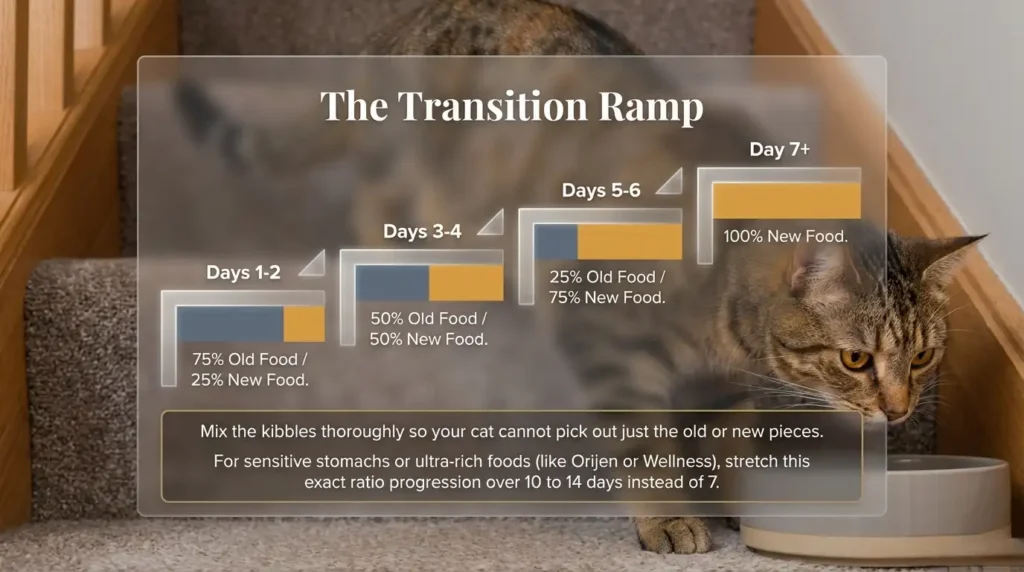
The standard transition timeline is 7 days:
- Days 1-2: 75% old food, 25% new food
- Days 3-4: 50% old, 50% new
- Days 5-6: 25% old, 75% new
- Day 7: 100% new food
Mix thoroughly so your cat can’t pick out just the old or new pieces. For sensitive stomachs, stretch this to 10-14 days.
Frequently Asked Questions
What You Actually Need to Remember
If you forget everything else in this article, remember these six things:
Grain-free doesn’t mean healthier. It just means no wheat, corn, rice, or oats. The quality of the total formula matters way more than grain status.
Most cats don’t need grain-free food. But for cats with genuine food sensitivities or chronic digestive issues, the right grain-free formula can help—especially if you’re also upgrading ingredient quality.
Ingredient quality matters more than the label. Look for named animal proteins in the first three ingredients, minimal plant-based fillers, and reasonable carb levels.
Calculate the carb percentage yourself. Many grain-free foods are higher-carb than you’d expect. Use the formula: 100 – protein – fat – fiber – moisture – ash.
Transition slowly. Seven days minimum, longer if your cat has a sensitive stomach. Mix the foods thoroughly.
If symptoms don’t improve after 4-6 weeks, talk to your vet. The problem might not be food-related.
What to Do Next
Step 1: Figure out what problem you’re actually trying to solve. Is this about digestion? Allergies? Weight? Or just feeding better-quality food?
Step 2: Shortlist 2-3 grain-free foods that match your cat’s need using the recommendations in this guide.
Step 3: Read labels carefully. Check protein sources, calculate carbs, and compare real monthly costs.
Step 4: Buy a small bag or case to test. Don’t commit to bulk quantities until you know your cat will eat it.
Step 5: Transition slowly and track results. Give it at least 2-4 weeks before deciding if it’s working.
Step 6: Talk to your vet if symptoms persist or if your cat has any medical conditions.
Have a question about your specific Grain Free Cat Food food you’re considering? Drop it in the comments below — I read and respond to every one.
→ Next: Best Wet Kitten Food: Full Reviews & Canned Food Guide
→ Deep dive: The 10 Best Grain Free Cat Foods → Next: Best Grain Free Dry Cat Food → Next: Best Grain Free Wet Cat Food
Bookmark this page — product picks and pricing verified quarterly.