4 Powerful Best Kitten Dry Food Picks for Fast Growth

You’ve decided to feed your kitten dry food — or maybe you’re trying to figure out if dry food belongs in your kitten’s routine at all. Either way, you’re in the right place.
Dry kitten food gets a mixed reputation online. Some corners of the internet treat it like a nutritional crime. Others treat it as the obvious default. The truth, as usual, is somewhere more practical in the middle — and knowing which kitten dry food to choose, how much to serve, and what to watch for makes all the difference between a kibble that supports healthy growth and one that just fills a bowl.
Here’s everything you need to know.
Table of Contents
Transparency note: Purreats uses affiliate links. If you buy through our links, we earn a small commission at no cost to you — and we only recommend foods we genuinely stand behind.
Does Your Kitten Actually Need Dry Food?
The short answer: no, dry food isn’t strictly required. A kitten can thrive on wet food alone — and for kittens under 3 months, wet food should absolutely be the primary diet.
But dry kitten food earns its place in the routine for several practical reasons:
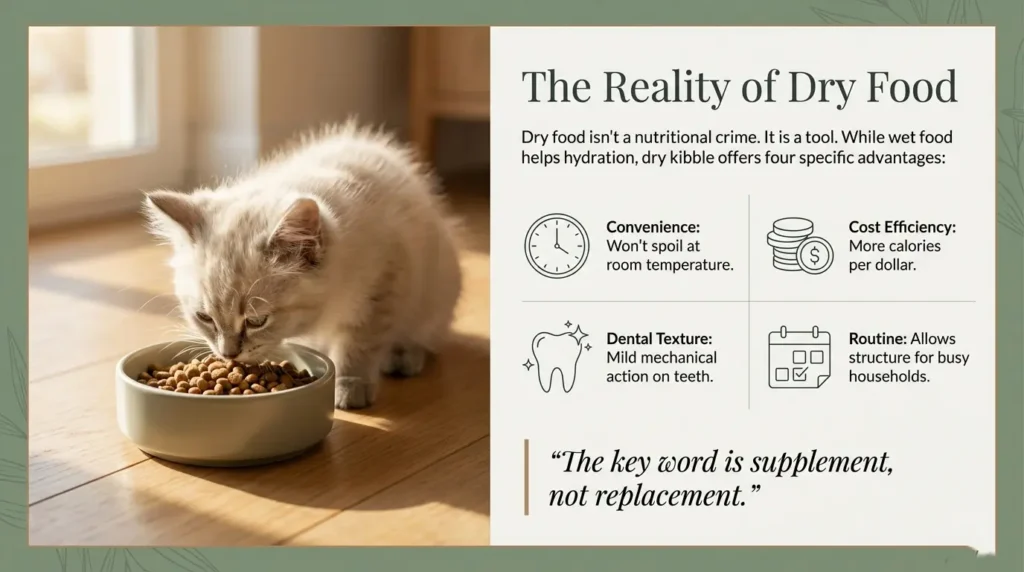
- Convenience: It doesn’t spoil at room temperature, which makes it ideal for grazing between wet meals.
- Cost efficiency: Dry food delivers more calories per dollar than most wet options — useful when you’re managing a budget.
- Dental texture: The crunch of kibble provides mild mechanical action on teeth, though this alone isn’t a substitute for dental care.
- Routine structure: For busy households, a measured portion of dry food in the afternoon keeps your kitten from going too long between meals without requiring you to be home.
The key word in all of the above is supplement — not replacement. If you’re using dry kitten food as your kitten’s only food source, hydration becomes a real concern you’ll need to address actively (a pet water fountain helps significantly).
What to Look for in a kitten dry food
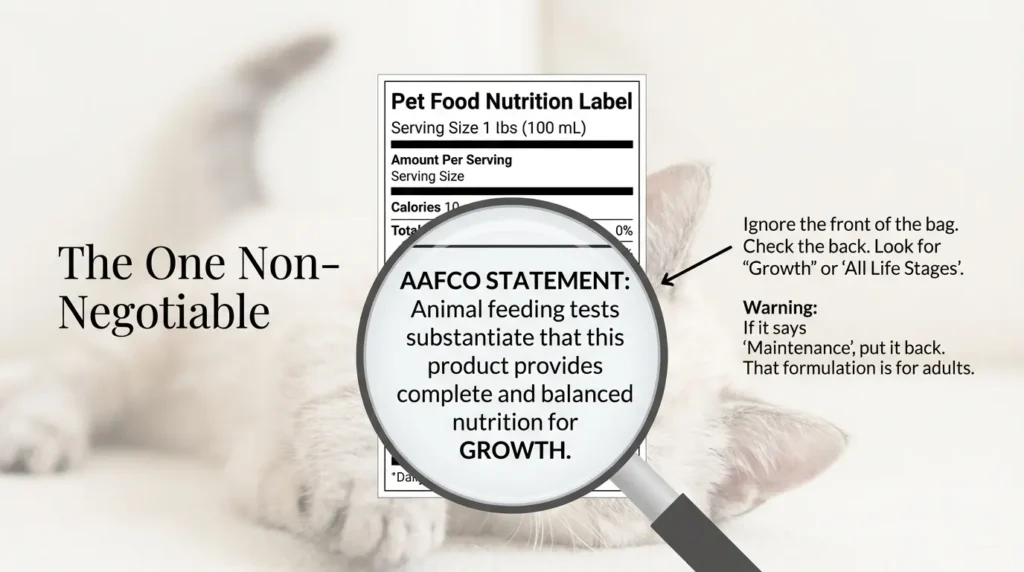
You already know not to trust the front of the bag. Here’s what to check on the back:
AAFCO “growth” or “all life stages” statement.
This is your one non-negotiable. If the nutritional adequacy statement says “maintenance,” that food is formulated for adult cats — not your growing kitten. Don’t buy it as a primary food.
Named protein in the first ingredient.
Chicken, turkey, salmon — a real, named animal protein should be the first thing you see. “Poultry meal” or “meat by-product meal” in the top spot is a step down in quality, though not automatically disqualifying.
Protein percentage.
Look for a minimum of 30% crude protein on the guaranteed analysis panel of a dry kitten food. Many quality formulas sit at 32–38%.
Fat percentage.
Kittens need fat for energy and growth. A minimum of 15% crude fat is a reasonable baseline — many premium formulas go higher.
No excessive fillers in the top 5 ingredients.
Corn, wheat, and soy aren’t inherently harmful, but if they dominate the top 5 ingredients, you’re looking at a carbohydrate-heavy formula that prioritizes cost over nutrition. Your kitten’s protein budget is limited — you want animal protein filling it, not plant starch.
Best kitten dry food Picks for 2026
🥇 Best Overall: Purina Pro Plan Kitten Chicken & Rice Formula
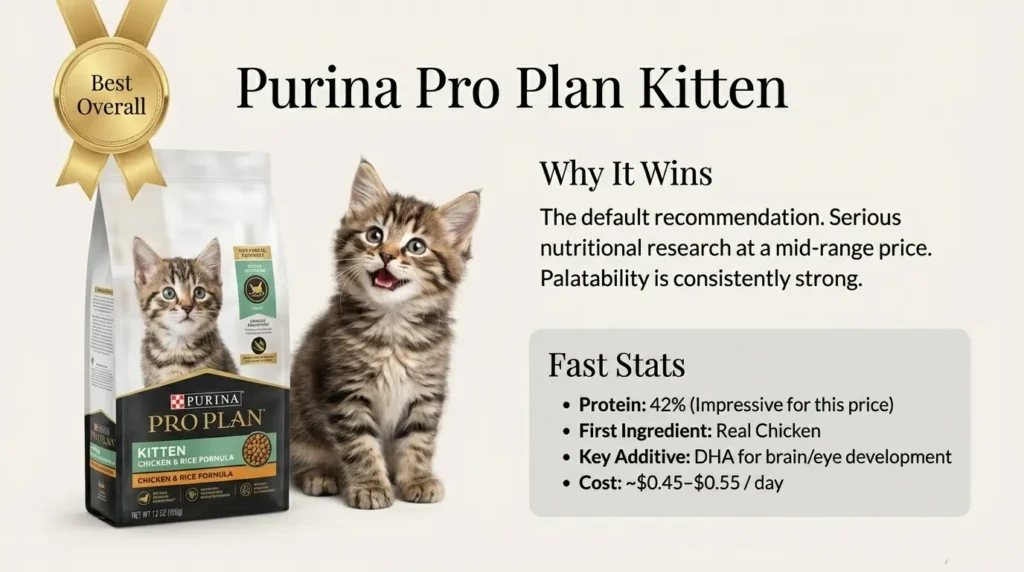
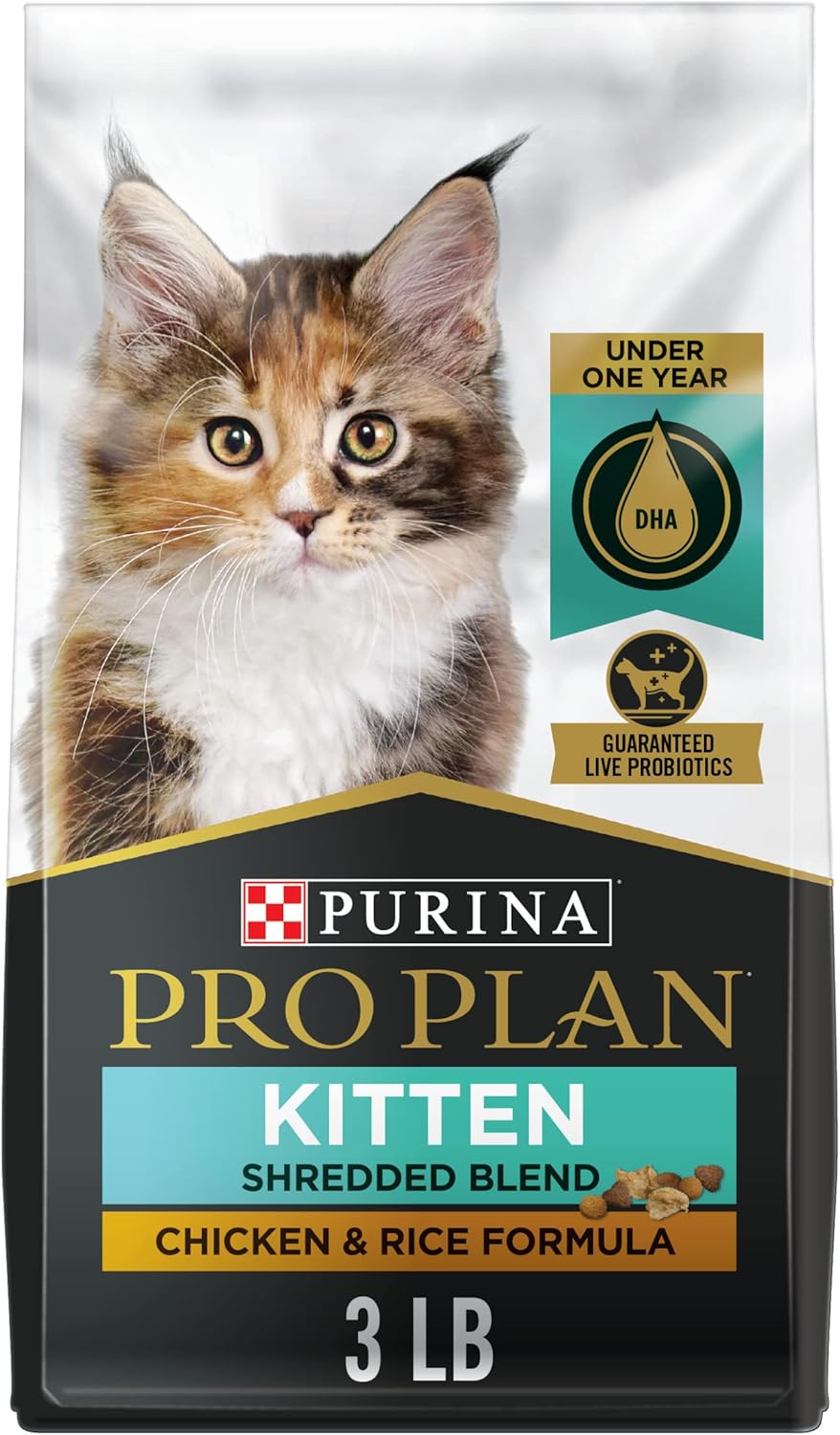

If someone asked me to recommend exactly one dry kitten food without knowing anything else about the kitten, this is the one I’d say.
Real chicken is the first ingredient. DHA from fish oil is included for brain and eye development. The AAFCO growth statement is confirmed. Crude protein sits at 42% — genuinely impressive for a dry formula in this price range. And palatability is consistently strong: even picky kittens tend to accept it well.
Pro Plan is a brand with serious nutritional research behind it, and this kitten line reflects that. You get premium-level nutrition at a mid-range price point.
✅ Best for: Most kittens 8 weeks–12 months, everyday primary dry food, first-time owners
First ingredient: Chicken
Crude protein: 42%
AAFCO: Growth ✓
Cost/day: ~$0.45–$0.55
🥈 Best for Structure: Royal Canin Kitten Dry
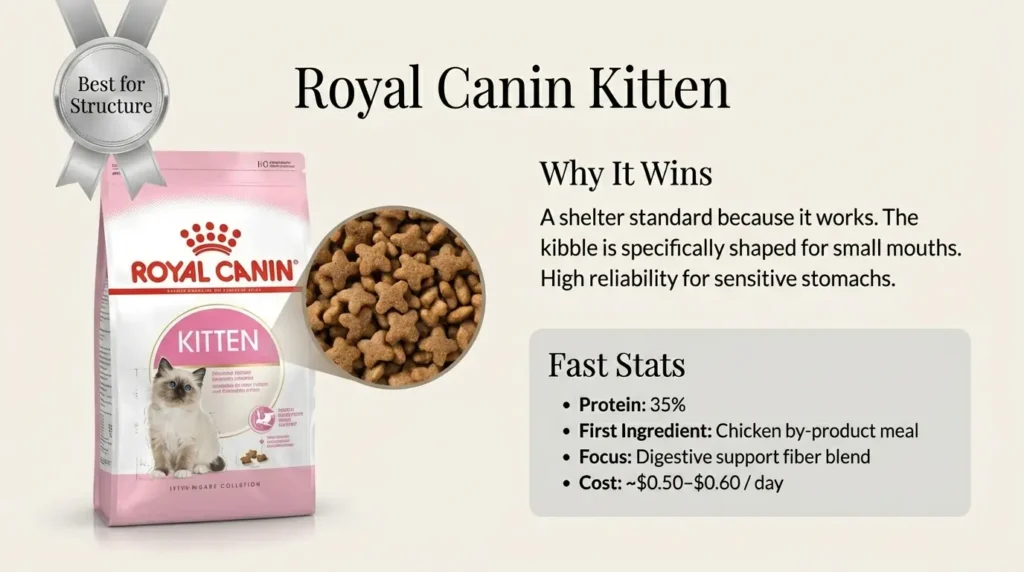
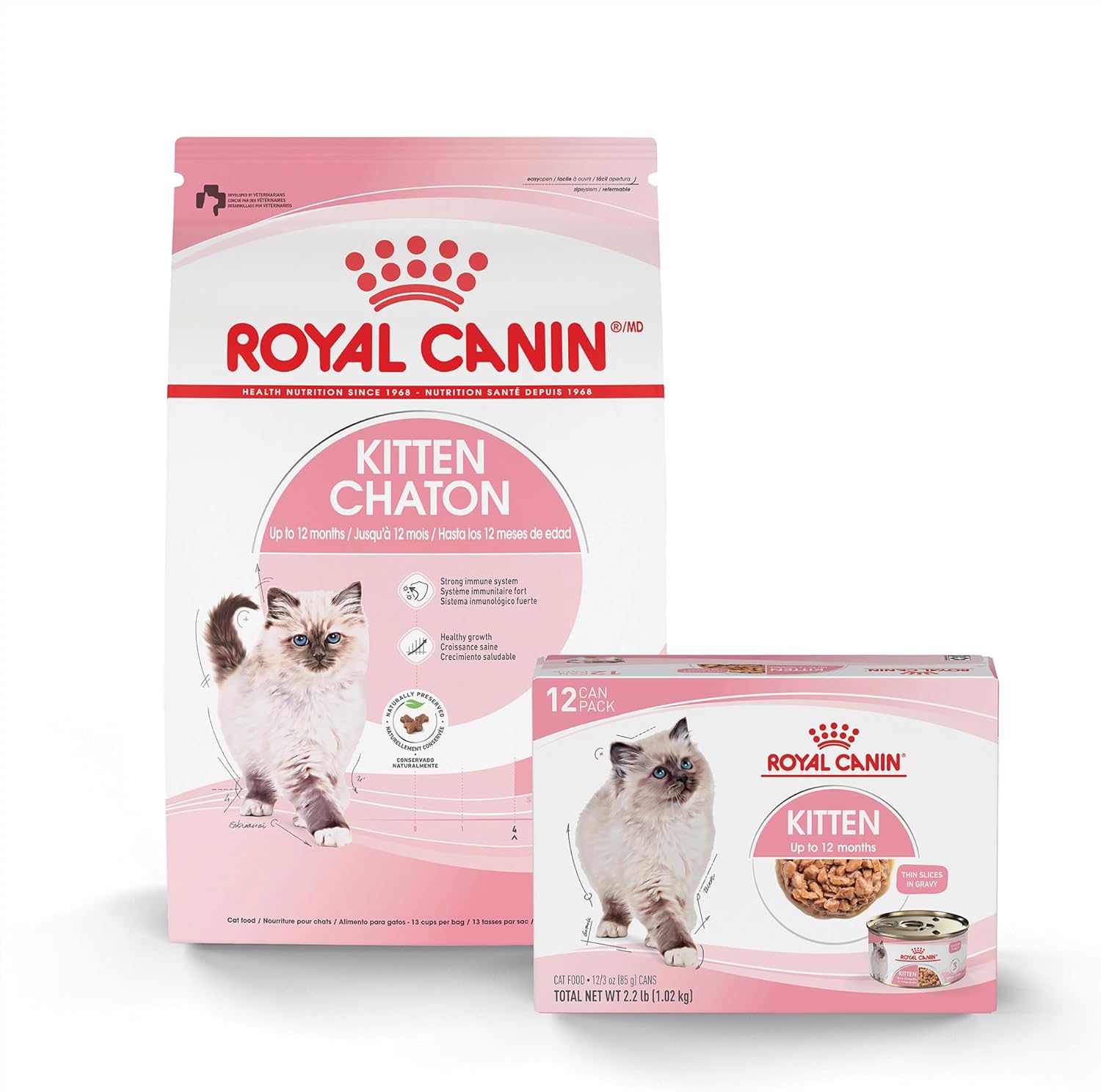

Royal Canin Kitten is a shelter standard — and shelters use it because it works reliably across hundreds of different kittens with different backgrounds and sensitivities.
What makes it distinctive is the kibble design itself: each piece is sized and shaped specifically for kittens’ smaller mouths and developing teeth. The formula includes a specific fiber blend for digestive support, and the palatability is extremely high.
The ingredient list isn’t as premium as Pro Plan — chicken by-product meal and pork by-products appear early. For a budget-conscious daily dry food, that’s acceptable. For an owner prioritizing whole meat sources, it’s worth noting.
✅ Best for: Structure-first owners, sensitive kittens, mixed wet + dry routines
First ingredient: Chicken by-product meal
Crude protein: 35%
AAFCO: Growth ✓
Cost/day: ~$0.50–$0.60
🥉 Best Premium Dry Kitten Food: Nulo Freestyle Kitten Salmon & Peas
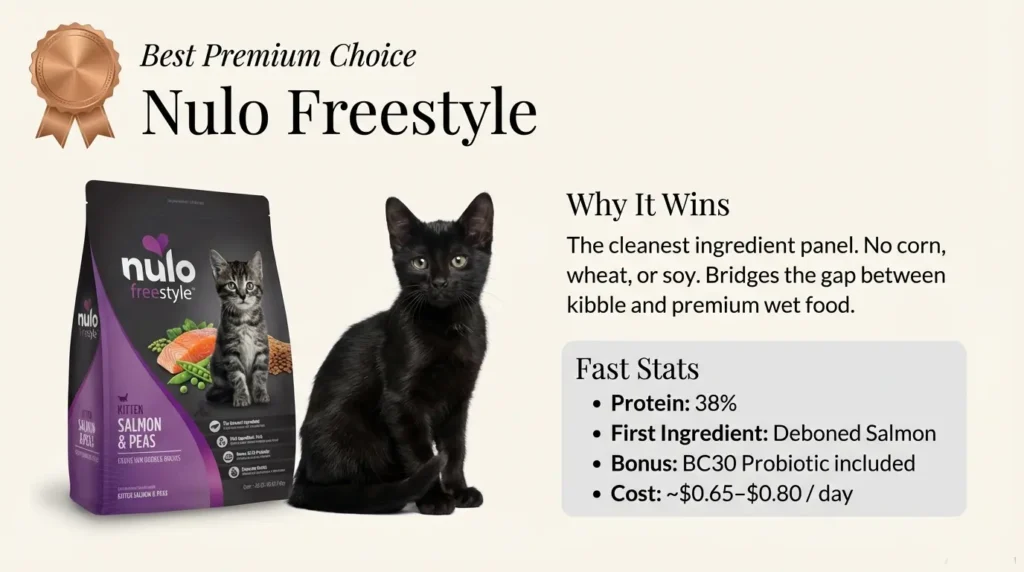

If you want the cleanest ingredient panel in the dry kitten food category — no corn, wheat, or soy; high-quality named proteins at the top; added probiotics — Nulo Freestyle is where that bar is set.
The first ingredient is deboned salmon. The formula is low in starch, high in animal protein (38% crude protein), and includes BC30 probiotic for digestive health. It’s one of the few dry kitten foods that genuinely bridges the quality gap between standard kibble and premium wet food formulas.
The price reflects that quality, but if you’re feeding a mixed routine (Nulo dry + a budget wet), you can balance the cost effectively.
✅ Best for: Premium-first owners, grain-sensitive kittens, high-protein diets
First ingredient: Deboned salmon
Crude protein: 38%
AAFCO: Growth ✓
Cost/day: ~$0.65–$0.80
Best Budget Dry Kitten Food: Purina Kitten Chow Nurturing Formula
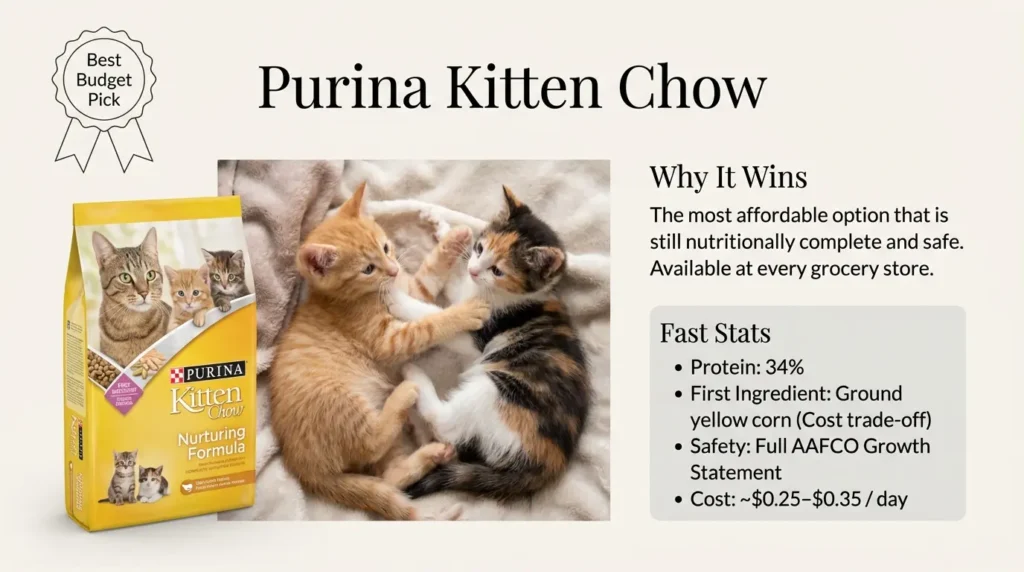

Let’s be direct: not every household can spend $40+/month on kitten food, and that’s a completely valid reality.
Purina Kitten Chow is the most affordable option on this list that still carries an AAFCO growth statement and a legitimate nutritional profile. Ground corn appears early in the ingredient list, and it’s not a formula you’d choose if premium nutrition was your primary goal — but it’s complete, balanced for growth, and available at every grocery store in the US.
If your budget is tight right now, Kitten Chow with one affordable wet food meal per day (like Fancy Feast Classic Pâté) gives your kitten a more balanced nutritional base than dry food alone.
✅ Best for: Budget-first owners, emergency or transitional feeding, multi-kitten households
First ingredient: Ground yellow corn
Crude protein: 34%
AAFCO: Growth ✓
Cost/day: ~$0.25–$0.35
How Much Dry Kitten Food to Feed Per Day
This table gives you a starting framework — but always cross-reference with your specific food’s feeding guide, since calorie density varies by brand:
| Kitten Age | Approx. Weight | Dry Food Per Day | Meals Per Day |
|---|---|---|---|
| 8–12 weeks | 1–2 lbs | ¼ – ⅓ cup | 3–4x |
| 3–4 months | 2–3 lbs | ⅓ – ½ cup | 3–4x |
| 4–6 months | 3–5 lbs | ½ – ¾ cup | 3x |
| 6–12 months | 5–9 lbs | ½ – ¾ cup | 2–3x |
Important: If you’re combining dry and wet food — which I’d recommend — reduce the dry portion accordingly. A rough rule: one 3 oz can of wet food replaces approximately ¼ cup of dry food in calorie terms (check your specific brands to confirm).
Body condition always overrides the chart. You should feel your kitten’s ribs easily without pressing, but not see them. Adjust up or down based on what you observe week to week, not just what the bag recommends.
The Biggest Dry Kitten Food Mistakes You’re Probably Making
Free-feeding without monitoring body condition.
Leaving dry food out all day is convenient, but kittens — especially younger ones — often don’t self-regulate well. If your kitten is getting noticeably round, switch to measured scheduled meals.
Choosing by price on the front of the bag.
The “premium” and “natural” claims on the packaging are marketing. The AAFCO statement and first five ingredients on the back tell you the truth.
Skipping the transition when switching brands.
Even switching between two dry kitten foods needs a gradual 7–10 day transition. GI upset from abrupt changes is real, uncomfortable for your kitten, and entirely preventable.
Relying on dry food alone for hydration.
If dry food is your kitten’s only food, you need to actively encourage water intake — a pet fountain dramatically increases how much most kittens drink. Or add at least one wet meal daily.
FAQ: Dry Kitten Food
Can I mix dry kitten food with water?
Should I buy grain-free dry kitten food?
How do I store dry kitten food to keep it fresh?
When should I switch from dry kitten food to adult dry food?
→ Back to the full guide: The 5 Best Kitten Foods of 2026, Picks for Healthy Growth
→ Also read: Best Dry Kitten Food: Label Guide Feeding Tips (2026)
→ Also read: Best Canned Kitten Food: Top Picks, Feeding Tips (2026)
→ Also read: Royal Canin Kitten Food Review: Is It Worth the Premium Price?
→ Cats.com: The 11 Best Kitten Foods of 2026
Have a question about your specific kitten or a food you’re considering? Drop it in the comments below — I read and respond to every one.
📌 Bookmark this page — picks and cost data updated quarterly.