3 Best Emergency Kitten Milk Recipes Guaranteed to Work

The Direct Answer
Kitten milk refers to commercial kitten milk replacer (KMR) formulated to match mother cat’s milk – never regular cow’s milk, which causes fatal diarrhea and malnutrition in kittens under 8 weeks. Best kitten milk brands include PetAg KMR (gold standard, $15-20), Breeder’s Edge (higher fat for weak kittens), and Royal Canin Baby Cat Milk (premium option). Feed warmed to body temperature every 2-4 hours depending on age. Cow’s milk lacks essential taurine and protein, causing dehydration and death within 24-48 hours.
At 3 AM last Tuesday, I got a panicked text from my neighbor: “Found tiny kittens in my shed. Eyes still closed. Gave them some milk from my fridge. They’re not doing well – what’s wrong?”
My stomach dropped. “What kind of milk?”
“Just regular milk. Isn’t that what kittens drink?”
I threw on clothes and ran over. Two of the four kittens were already showing signs of severe diarrhea and dehydration from cow’s milk. We rushed to the emergency vet, and thankfully, all four survived – but it was close.
This happens constantly. Well-meaning people find orphaned kittens and assume “kitten milk” means any milk. It doesn’t. The type of kitten milk you use is literally the difference between life and death for babies under 8 weeks old.
Let me show you exactly what works and what kills.
Affiliate Disclosure: This article includes affiliate links. You buy through these links and support this site at no extra cost to you.
Quick Comparison: Kitten Milk Options
| Type | Safe for Kittens? | Why/Why Not | Cost | Availability |
|---|---|---|---|---|
| Mother Cat’s Milk | ✅ Perfect | Ideal nutrition, antibodies, perfect composition | Free | Only if mama is present |
| PetAg KMR | ✅ Best substitute | Matches mother’s milk, has taurine, proper protein | $15-20 | Pet stores, Amazon |
| Breeder’s Edge | ✅ Excellent | Higher fat, good for weak kittens | $25-30 | Pet stores, online |
| Royal Canin Baby Cat | ✅ Premium | Pharmaceutical grade, ultra-digestible | $35-45 | Specialty stores |
| Cow’s Milk | ❌ DEADLY | Causes fatal diarrhea, lacks taurine, wrong nutrients | $3-5 | Everywhere (don’t use!) |
| Goat’s Milk | ❌ Inadequate | Better than cow but still missing essentials | $5-8 | Grocery stores |
| Human Baby Formula | ❌ Wrong | Missing taurine, wrong protein levels | $15-25 | Drugstores |
| Plant Milks | ❌ Dangerous | No animal protein, completely inappropriate | $3-6 | Grocery stores |
What Is Kitten Milk? (And What It’s NOT)
Let me clear up the confusion that kills kittens every day.
Real Kitten Milk: Mother Cat’s Milk
Mother cat’s milk is evolutionary perfection for kitten growth. It contains:
- 40-45% protein (kittens double their birth weight in 7-10 days)
- 25% fat for explosive brain development
- High taurine content (essential amino acid cats can’t produce themselves)
- Antibodies providing immune protection for first weeks of life
- Perfect 1.3:1 calcium-to-phosphorus ratio for bone growth
- Digestible lactose levels appropriate for nursing kittens
This is the gold standard. Everything else is attempting to replicate this.
Commercial Kitten Milk Replacer (KMR)
KMR is specifically formulated to mimic mother cat’s milk as closely as possible. Good brands include:
- Proper protein levels (42-44%)
- Appropriate fat content (25-28%)
- Added taurine for heart and eye development
- DHA for brain development
- Vitamins and minerals in correct ratios
- Digestible for newborn kittens
This is what you use when mother cat isn’t available or can’t nurse.
What “Kitten Milk” Is NOT
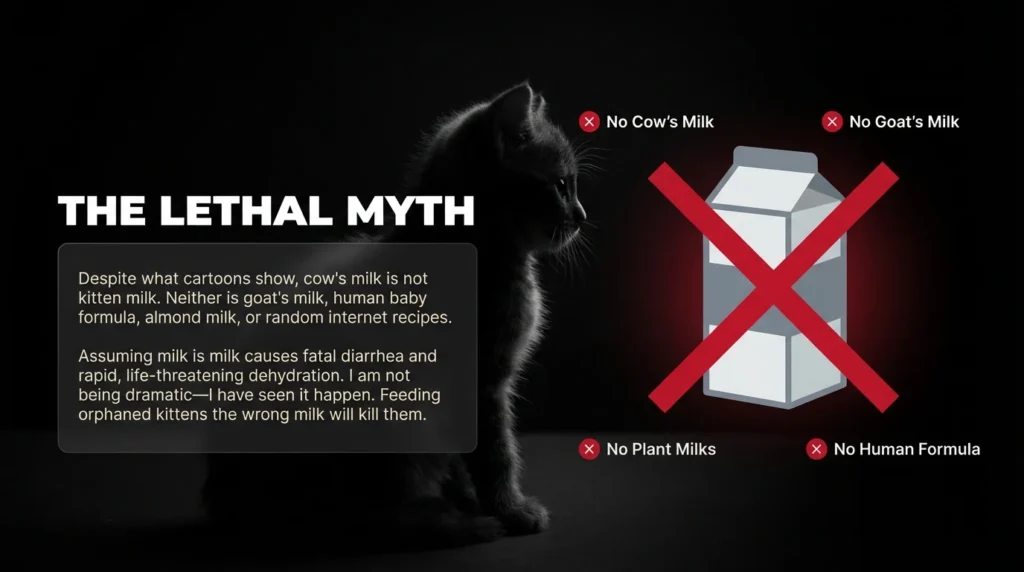
Cow’s milk is NOT kitten milk, despite what cartoons show. Neither is:
- Goat’s milk
- Human baby formula
- Almond, soy, or oat milk
- Any “homemade kitten milk recipe” from random websites
These will kill orphaned kittens. I’m not being dramatic – I’ve seen it happen.
Why Cow’s Milk Kills Kittens
This is critical to understand because the cow’s milk myth persists everywhere.
The Deadly Nutritional Gap
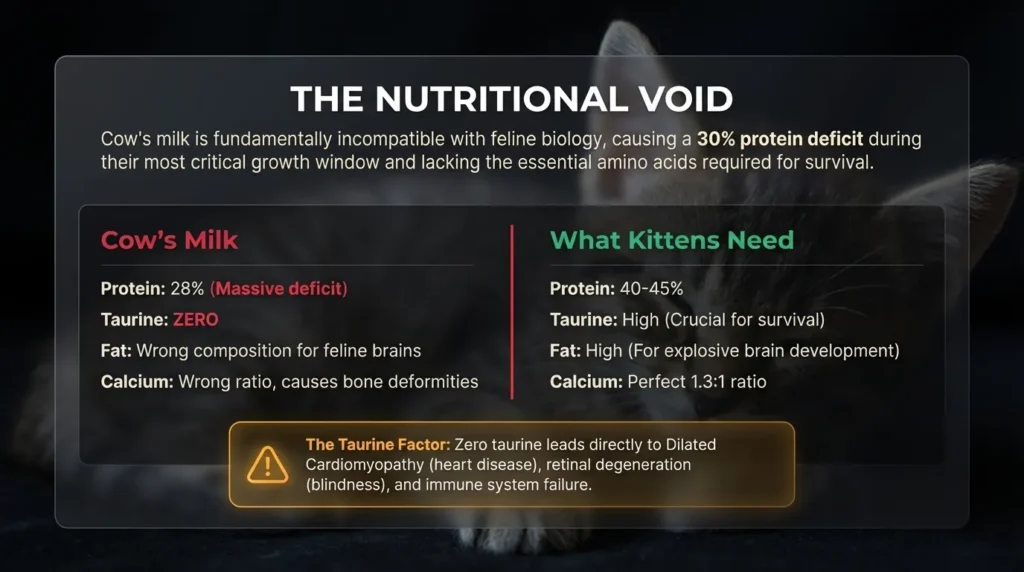
Cow’s milk compared to what kittens need:
Protein: Cow’s milk has only 28% protein. Kittens need 40-45%. That’s a 30% deficit during the most critical growth period of their lives.
Taurine: Cow’s milk has ZERO taurine. Kittens fed cow’s milk develop:
- Heart disease (dilated cardiomyopathy)
- Blindness (retinal degeneration)
- Developmental delays
- Immune system failure
Fat composition: Wrong type. Doesn’t support feline brain development.
Minerals: Wrong calcium-to-phosphorus ratio causes bone deformities.
Lactose: Even nursing kittens can’t handle cow’s milk lactose levels. Causes severe diarrhea.
The Death Timeline
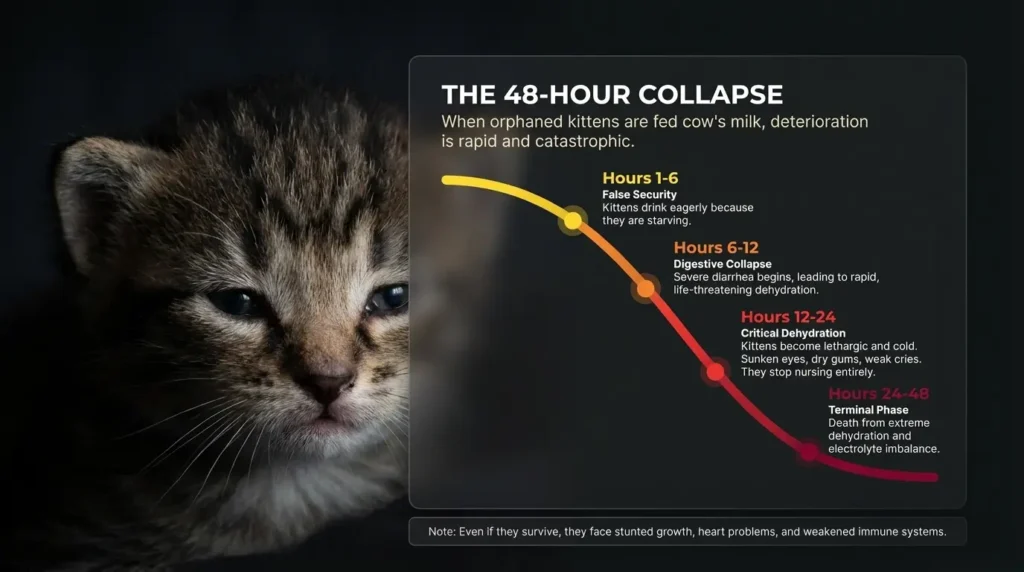
Here’s what actually happens when you feed cow’s milk to orphaned kittens:
Hours 1-6: Kittens drink eagerly because they’re starving. They don’t know it’s wrong.
Hours 6-12: Diarrhea begins. In tiny kittens, this means rapid, life-threatening dehydration.
Hours 12-24: Dehydration becomes severe. Kittens become lethargic, cold, stop nursing. Sunken eyes, dry gums, weak cries.
Hours 24-48: Many kittens die from dehydration and electrolyte imbalance.
Survivors: Develop stunted growth, heart problems, vision issues, weakened immune systems.
My neighbor’s kittens showed textbook symptoms – severe diarrhea starting at hour 8, dehydration by hour 12. The emergency vet said if we’d waited until morning, at least two would have died.
Best Kitten Milk Replacers (What Actually Works)
These are the brands professional rescuers and vets actually recommend.
PetAg KMR – The Gold Standard


This is what I use first for every orphaned kitten situation.
Why it’s best:
- Most widely available (pet stores, Amazon, Walmart)
- Closest match to mother cat’s milk
- 42% protein, 25% fat – perfect ratios
- Includes taurine and DHA
- Proven track record over decades
- Available in powder (economical) and liquid (convenient)
Cost: $15-20 for powder making 80+ bottles.
My experience: I’ve raised six litters of orphaned kittens on PetAg KMR. Every single kitten thrived, gained weight appropriately, and developed into healthy cats.
Breeder’s Edge Nurture Mate – For Struggling Kittens
When to use this:
- Premature kittens
- Underweight or weak babies
- Kittens failing to thrive on standard formula
- Kittens with sensitive digestion
Why it works:
- Higher fat content (28% vs 25%)
- Includes probiotics for gut health
- Easier digestion
- Many professional breeders swear by it
Cost: $25-30 per container.
I switch to this when kittens aren’t gaining weight fast enough on standard KMR.
Royal Canin Baby Cat Milk – Premium Emergency Option
When I use this:
- Critically ill or premature kittens
- When other formulas have failed
- Kittens with persistent digestive issues
- Medical emergencies requiring best possible nutrition
Why it’s premium:
- Pharmaceutical-grade formulation
- Highest protein content (44%)
- Ultra-digestible
- Microencapsulated nutrients
Cost: $35-45. Expensive but worth it for critical cases.
How to Feed Kitten Milk Properly
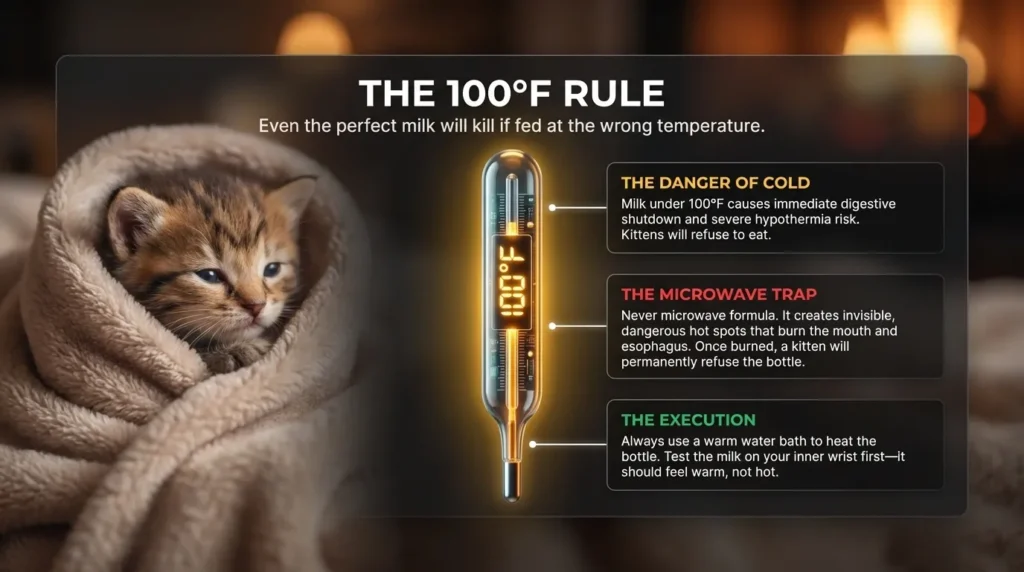
Even perfect kitten milk kills if fed incorrectly. Here’s what you must know.
Temperature is Critical
Correct temperature: 100°F (body temperature). Test on your wrist – should feel warm, not hot.
Too cold: Kittens refuse to eat, digestive shutdown, hypothermia risk.
Too hot: Burns mouth and esophagus. Kittens refuse food after being burned once.
Never microwave. Creates dangerous hot spots. Always use warm water bath.
Position Prevents Death
NEVER feed kittens on their backs like human babies. This is the #1 cause of aspiration pneumonia death in bottle-fed kittens.
Correct position:
- Belly-down on towel
- Head level with or slightly higher than body
- Natural nursing position
- Never tilted backward
I place kittens on my lap, belly-down, supporting chest with my palm. This mimics nursing from mama cat.
Feeding Schedule by Age
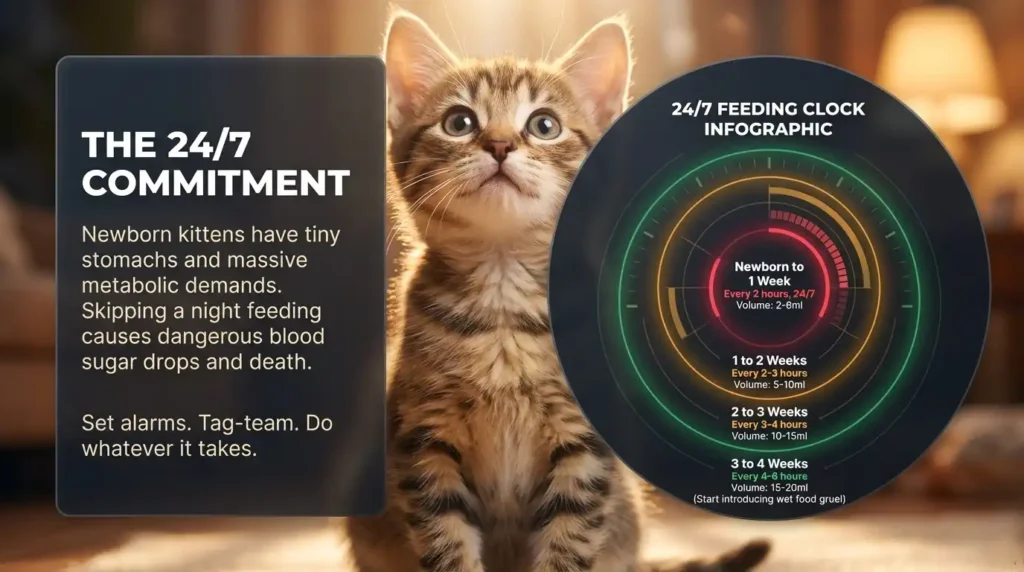
Newborn to 1 week: Every 2 hours, 24/7 (yes, including overnight). Amount: 2-6ml per feeding.
1-2 weeks: Every 2-3 hours. Amount: 5-10ml per feeding.
2-3 weeks: Every 3-4 hours. Amount: 10-15ml per feeding.
3-4 weeks: Every 4-6 hours, start weaning. Amount: 15-20ml plus wet food gruel.
4-8 weeks: Primarily solid food, kitten milk as supplement.
Missing feedings kills kittens. Set alarms. Do whatever it takes.
After Feeding: Critical Steps
Burp them: Gently pat back to release air bubbles.
Stimulate elimination: Kittens under 3-4 weeks can’t pee or poop alone. Use warm, damp cloth to gently stimulate genital area after every feeding until they go.
Weigh daily: Use kitchen scale. Kittens should gain 10-15 grams per day. No gain = vet emergency.
Emergency Kitten Milk Options (When Stores Are Closed)
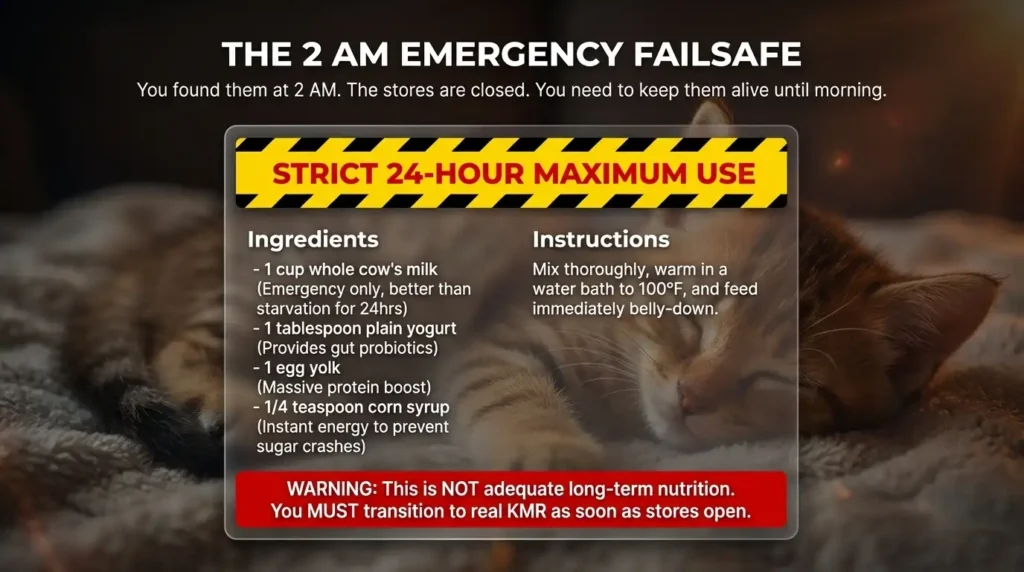
You find kittens at 2 AM. Stores are closed. What do you do?
Emergency Recipe (24 Hours Maximum)
This can keep kittens alive until you get real KMR:
Ingredients:
- 1 cup whole milk (cow’s – not ideal but better than nothing for 24 hours)
- 1 tablespoon plain yogurt (probiotics)
- 1 egg yolk (protein boost)
- 1/4 teaspoon corn syrup (quick energy)
Mix thoroughly, warm to body temperature, feed immediately.
CRITICAL: This is NOT adequate nutrition long-term. Get proper kitten milk replacer within 24 hours maximum.
I’ve used this recipe twice for true middle-of-the-night emergencies. Both times, I got real KMR within 12 hours and the kittens transitioned fine.
What NOT to Do in Emergencies
Don’t use:
- Straight cow’s milk (causes severe diarrhea)
- Goat’s milk alone (inadequate nutrition)
- Human baby formula (missing taurine)
- Plant-based milks (completely wrong)
- Condensed or evaporated milk (way too concentrated)
Even in emergencies, some options are worse than waiting and keeping kittens warm until stores open.
Common Kitten Milk Mistakes That Kill
Mistake 1: Using Cow’s Milk
I’ve covered this, but it bears repeating: cow’s milk kills orphaned kittens. Period.
Mistake 2: Wrong Temperature
Feeding cold kitten milk causes digestive shutdown. Feeding too-hot milk burns tiny mouths.
Always test on your wrist first.
Mistake 3: Back Position Feeding
Feeding kittens on their backs causes aspiration pneumonia. Formula goes into lungs instead of stomach. Kittens drown internally.
Always belly-down position.
Mistake 4: Skipping Night Feedings
“They’ll be fine for 6 hours while I sleep, right?”
No. Newborn kittens have tiny stomachs and fast metabolisms. Missing feedings causes dangerous blood sugar drops and death.
Set alarms. Tag-team with family. Do whatever it takes.
Mistake 5: Not Stimulating Elimination
Kittens under 3-4 weeks cannot pee or poop on their own. If you don’t stimulate them after every feeding, their bladders and bowels can rupture.
This isn’t optional.
When to Call the Vet Immediately
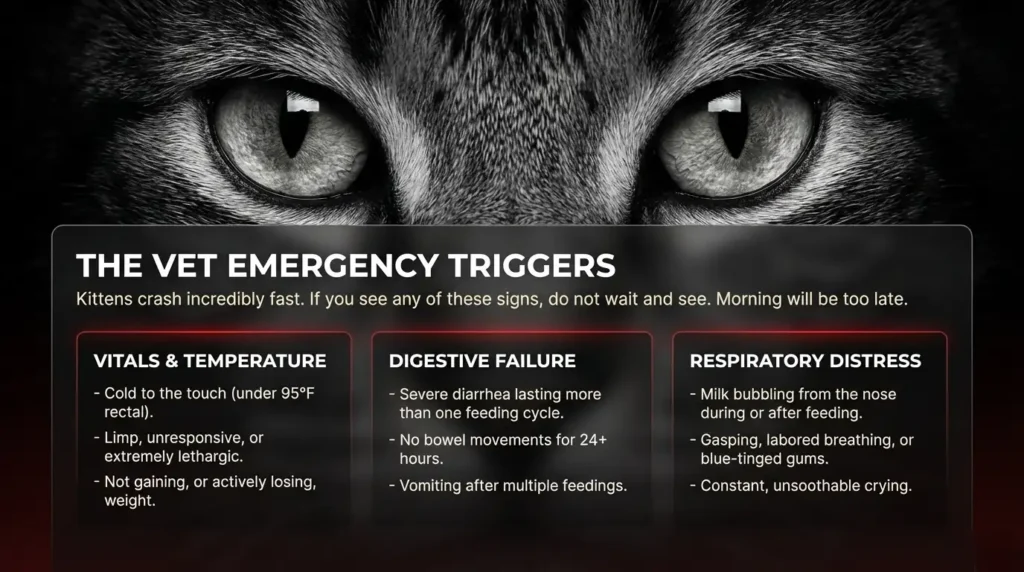
The Bottom Line on Kitten Milk
Kitten milk means commercial kitten milk replacer (KMR) – not cow’s milk, not goat’s milk, not any milk you have in your fridge.
Use PetAg KMR, Breeder’s Edge, or Royal Canin Baby Cat Milk. Feed warmed to body temperature, every 2-4 hours depending on age, with kittens positioned belly-down.
It’s exhausting. The overnight every-2-hours feedings will destroy you for the first two weeks.
But watching those tiny, helpless babies grow into healthy, playful kittens makes every sleepless night worth it.
My neighbor’s four kittens? They’re eight months old now. All healthy, all thriving, all in forever homes. They survived because we switched from deadly cow’s milk to proper kitten milk replacer immediately.
Your orphaned kittens deserve the same chance.
Can I give kittens regular milk from the store? ▼
No, absolutely never give kittens regular cow’s milk from the store. Cow’s milk causes severe, potentially fatal diarrhea in kittens under 8 weeks old, leading to rapid dehydration and death within 24-48 hours. It also lacks essential nutrients kittens need: 30% less protein than required, zero taurine (causing heart disease and blindness), wrong fat composition for brain development, and incorrect mineral ratios causing bone deformities.
Always use commercial kitten milk replacer (KMR) like PetAg KMR ($15-20), Breeder’s Edge, or Royal Canin Baby Cat Milk, which are specially formulated to match mother cat’s milk with proper protein (42-44%), essential taurine, DHA for brain development, and correct nutrients for survival and growth. Goat’s milk, human baby formula, and plant-based milks are also inadequate and dangerous. If stores are closed, an emergency homemade recipe can sustain kittens for 24 hours maximum, but get proper kitten milk replacer immediately.
How often do kittens need milk? ▼
Kittens need kitten milk replacer every 2-4 hours depending on age: Newborn to 1 week need feeding every 2 hours including overnight (2-6ml per feeding); 1-2 weeks old every 2-3 hours (5-10ml); 2-3 weeks old every 3-4 hours (10-15ml); 3-4 weeks old every 4-6 hours while starting weaning onto wet food (15-20ml plus solid food). Never skip feedings, even overnight for newborns – their tiny stomachs and fast metabolisms require constant nutrition.
Feed kitten milk warmed to body temperature (test on wrist), with kittens positioned belly-down in natural nursing position – never on their backs, which causes deadly aspiration pneumonia. After each feeding, stimulate kittens under 3-4 weeks with warm damp cloth to help them urinate and defecate (they can’t eliminate alone yet). Weigh kittens daily – they should gain 10-15 grams per day. No weight gain, weight loss, or any concerning symptoms require immediate veterinary attention as kittens decline rapidly.
Got questions about what your cat should or shouldn’t eat? Check out our guide to safe and toxic foods for cats, or drop a comment below with your specific situation.
Sources & Further Reading:
- petmd.com : Can Cats Drink Milk?
- Can Cats Drink Lactose-Free Milk? Finally, Some Good News!
- Can Cats Drink Regular Milk? 8 Safety Tips for Your Cat
- Can Cats Drink Milk? The Safe Truth About Feline Dairy
- Can Cats Drink Almond Milk? 11 Safety Facts Owners Need
And if you’ve got a “my cat drank milk” horror story, share it – sometimes we all need to know we’re not alone in our pet parenting mistakes!