The 5 Best Kitten Foods of 2026, Picks for Healthy Growth
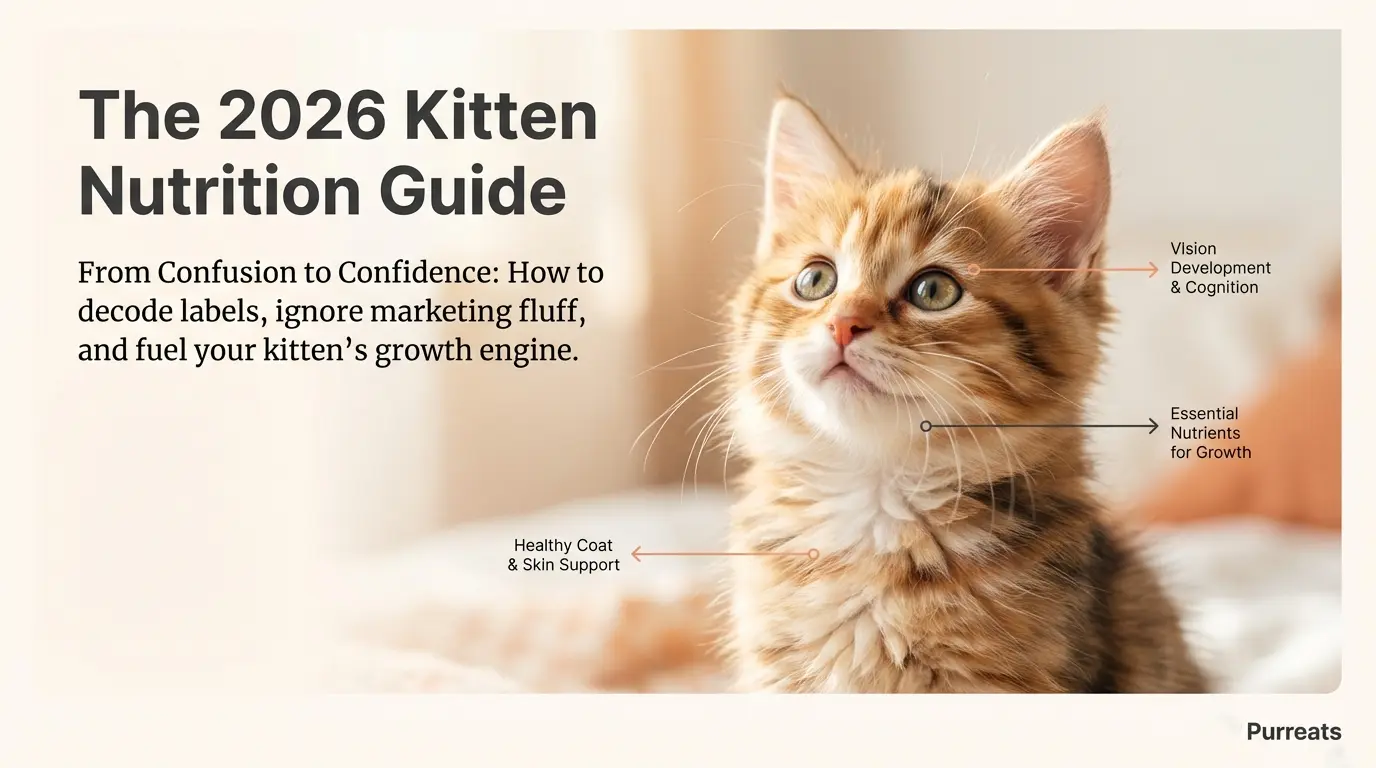
You just brought home a tiny purring fluffball — and now you’re standing in the pet aisle, staring at 47 different bags and cans, each one screaming “veterinarian recommended,” “natural,” and “complete nutrition.”
I’ve been there. It’s overwhelming on a good day.
Here’s the truth: choosing the right kitten food doesn’t require a veterinary degree. It requires knowing three things — what your kitten’s growing body actually needs, how to read a label without being fooled by marketing buzzwords, and which brands consistently deliver both quality and value.
This guide covers all three. By the end, you’ll know exactly what to buy, how much to feed, and how to avoid the most common (and costly) mistakes new kitten owners make.
Disclaimer: Purreats earns a small commission if you buy through our links — but we only recommend foods we’ve personally researched and would feed to our own cats.
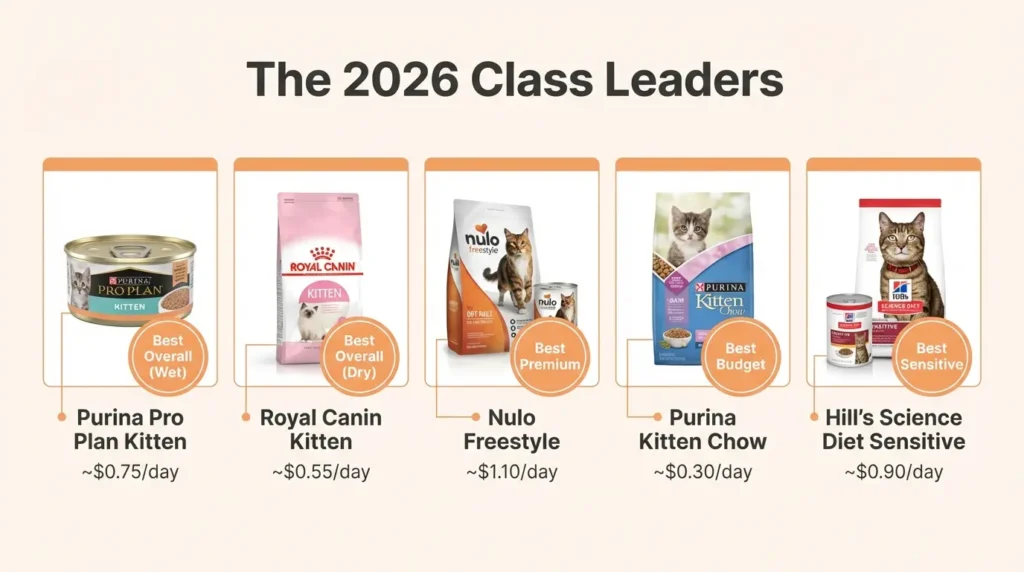
Quick Picks: Best Kitten Food at a Glance
(Jump to full reviews below for full pros, cons, and cost breakdowns.)
| Category | Our Top Pick | Best For | Cost/Day |
|---|---|---|---|
| Best Overall (Wet) | Purina Pro Plan Kitten Chicken & Rice | All kittens, 2–12 months | ~$0.75 |
| Best Overall (Dry) | Royal Canin Kitten Dry | Structure + convenience | ~$0.55 |
| Best Budget | Purina Kitten Chow Nurturing | Price-conscious owners | ~$0.30 |
| Best Premium | Nulo Freestyle Kitten Turkey & Chicken | High-protein, grain-free focus | ~$1.10 |
| Best Sensitive Stomach | Hill’s Science Diet Kitten Sensitive | Digestive issues, picky eaters | ~$0.90 |
What Kittens Actually Need From Their Food
Before you pick a product, you need to understand why kitten food is different from adult cat food — because this single piece of knowledge will make every label you read from now on make sense.
Kitten vs. Adult Cat Nutrition: Why It’s Not the Same
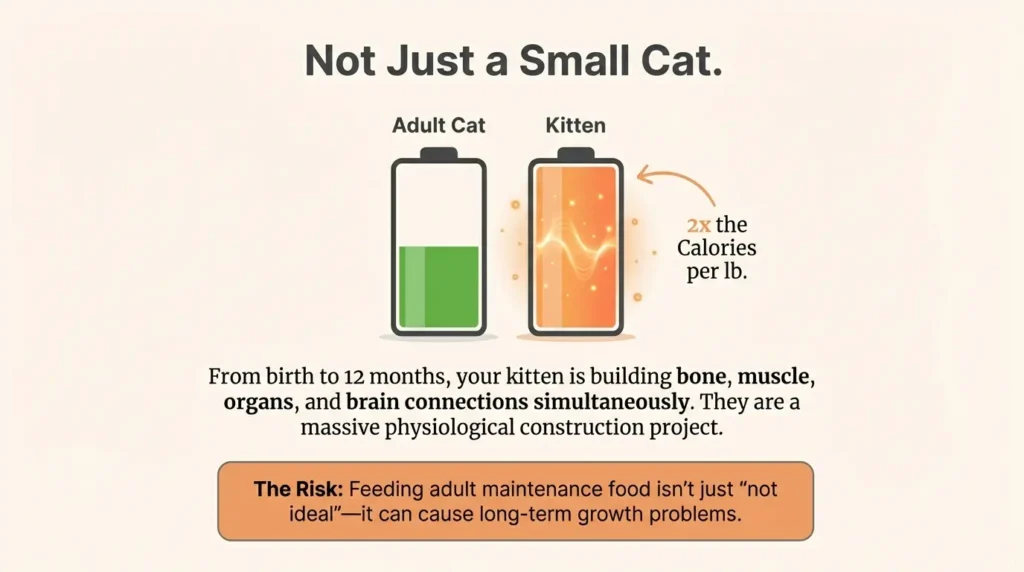
A kitten isn’t a small adult cat. From birth to about 12 months, their bodies are doing something extraordinary: building muscle, bone, organs, immune function, and brain connections simultaneously. That requires dramatically more fuel.
Kittens need roughly 2x the calories per pound of body weight compared to adult cats. Their protein needs are higher. Their fat needs are higher. And critically, they need specific nutrients — like taurine and DHA — that support heart health and brain development during those first months.
Feeding an adult formula to a kitten isn’t just “not ideal.” It can actually cause growth problems over time.
The 5 Nutrients Every Kitten Food Must Have
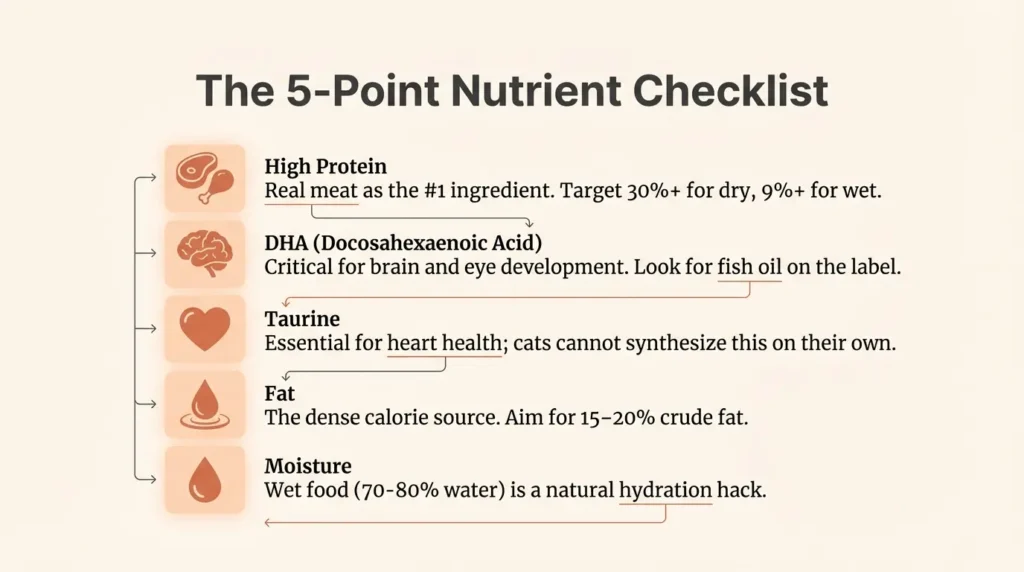
When you pick up a bag or can, these are the five things worth checking:
- High protein (real meat first): Look for at least 30% crude protein on dry food, 9%+ on wet. The first ingredient should always be a named animal protein — chicken, turkey, salmon — not “meat by-products” or “poultry meal” in the top spot.
- DHA (docosahexaenoic acid): This omega-3 fatty acid supports brain and eye development. It’s usually listed as “fish oil” or “DHA” in the ingredient list.
- Taurine: An essential amino acid cats can’t synthesize on their own. It supports heart health and vision. All reputable kitten foods include it, but it’s worth a quick check.
- Appropriate fat levels: Fat provides the dense calories kittens need. Aim for 15–20%+ crude fat on dry food.
- Moisture (especially in wet food): Kittens can be inconsistent drinkers. Wet kitten food — at 70–80% moisture — is a natural way to boost hydration without forcing water.
How to Read an AAFCO Statement (and Why It Matters)
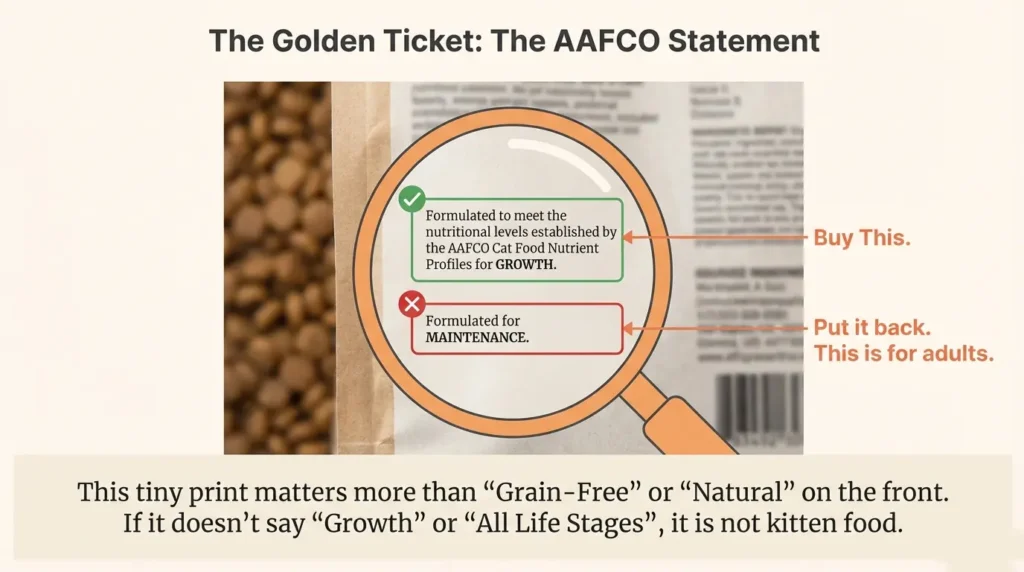
Here’s the one label line that separates a real kitten food from a well-packaged bluff:
“[Purreats] is formulated to meet the nutritional levels established by the AAFCO Cat Food Nutrient Profiles for growth.”
Or it might say “all life stages,” which also covers kittens. If it says “maintenance” only, put it back on the shelf — that food is formulated for adult cats.
The AAFCO statement (the Association of American Feed Control Officials nutritional adequacy claim) tells you the food has been formulated to meet established nutritional standards for kitten growth. No statement, or a “maintenance only” statement, means it’s not appropriate as your kitten’s primary food.
Quick reality check: That statement is more important than the “grain-free,” “natural,” or “premium” claims on the front of the bag. Those are marketing. The AAFCO line is the actual proof.
Wet vs. Dry Kitten Food: When to Use Each
Neither is universally better. They each have a role:
| Wet Kitten Food | Dry Kitten Food | |
|---|---|---|
| Hydration | ✅ Excellent (70–80% moisture) | ❌ Low moisture |
| Calories per gram | Lower | Higher (easy to overfeed) |
| Cost | Higher per calorie | More economical |
| Convenience | Less (needs refrigeration after opening) | More (free-feeding possible) |
| Picky kittens | Often more palatable | Sometimes refused at first |
My recommendation for most owners: start with wet food as the primary, add dry as a complement. It builds better hydration habits and keeps kittens interested in food. You can always shift the ratio as they grow.
Best Kitten Food Reviews: Full Picks by Category
Now that you know what to look for, let’s get to the actual recommendations.
Best Overall Wet Kitten Food: Purina Pro Plan Kitten Chicken & Rice


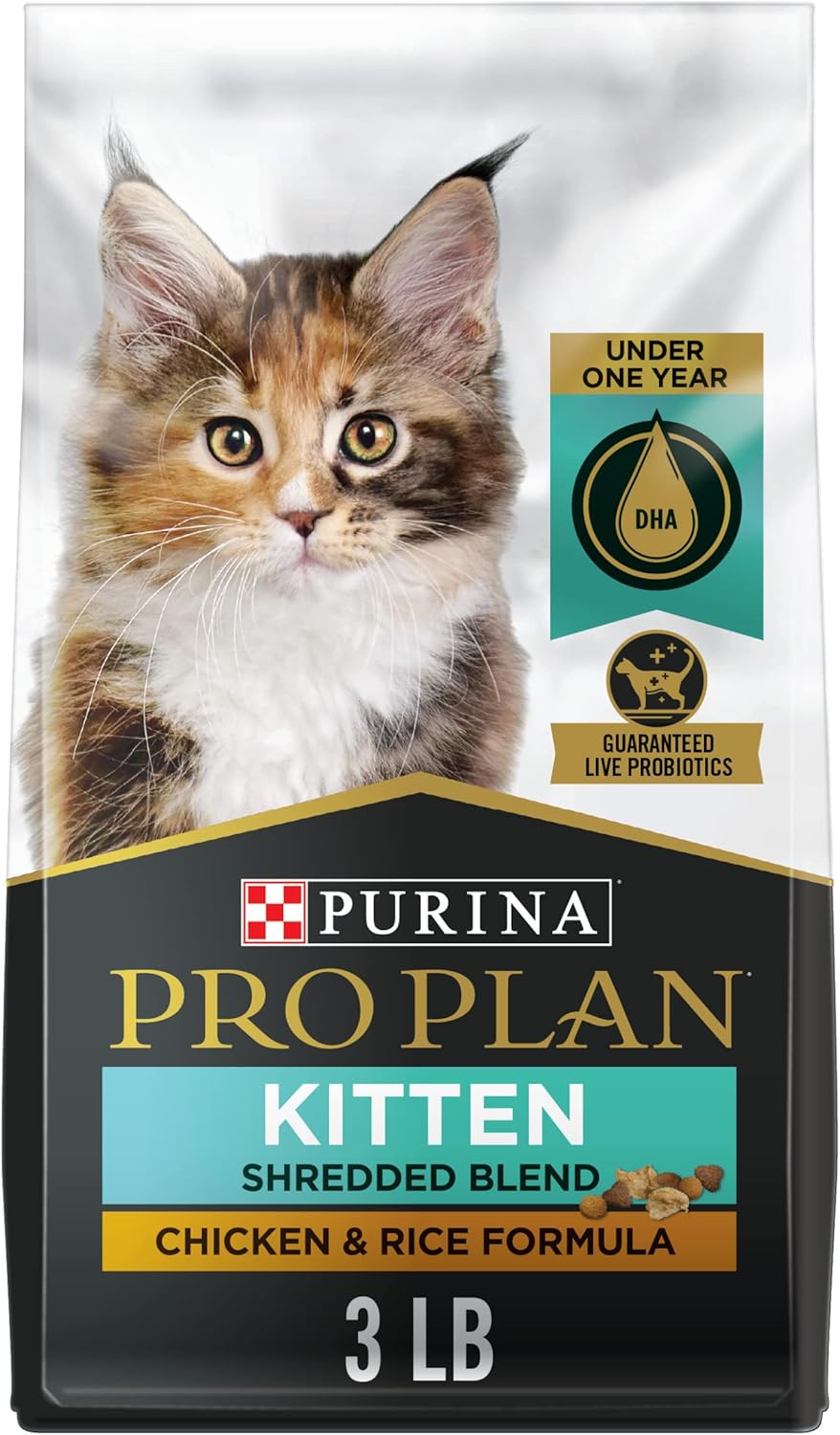
Purina Pro Plan Kitten is the one I recommend to almost every new kitten owner who asks me where to start. It checks the critical boxes: real chicken as the first ingredient, DHA from fish oil, taurine included, and an AAFCO growth statement.
But what actually makes it stand out is consistency. I’ve yet to meet a kitten who refuses it. The texture is a soft pâté that shreds easily for tiny mouths. It’s widely available at Chewy, Amazon, and most pet stores.
✅ Best for: Most kittens 2–12 months, first-time owners, general feeding
Main protein: Chicken
AAFCO: Growth ✓
Approx. cost/day: ~$0.75 (based on standard feeding for a 4–5 lb kitten)
Watch out: Strong fish smell on the fish varieties — some owners find it intense.
Best Overall Dry Kitten Food: Royal Canin Kitten Dry
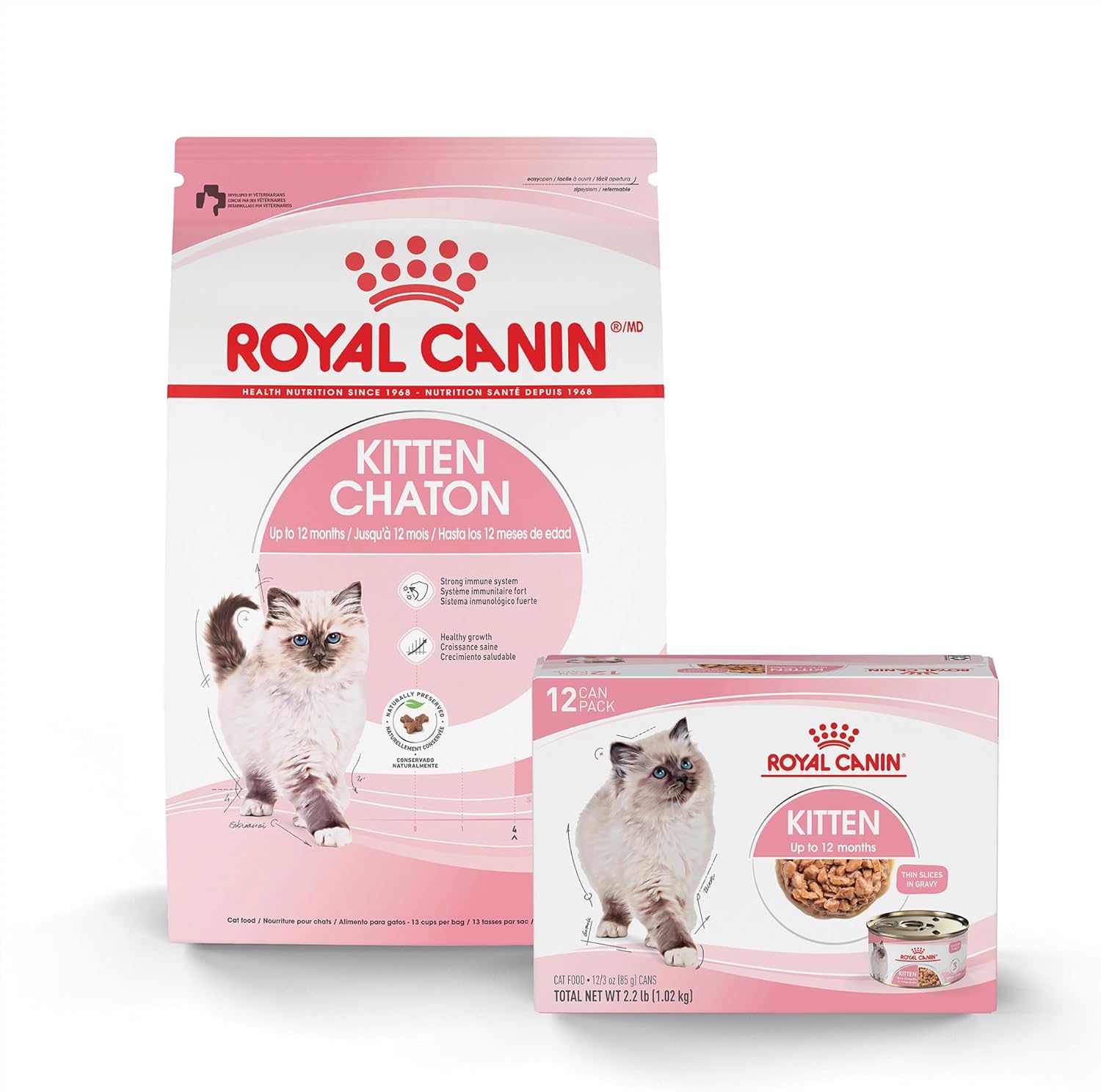

Royal Canin Kitten is a shelter staple for good reason. It’s specifically designed for kittens up to 12 months, with a kibble size and texture formulated for smaller jaws. The ingredient quality is mid-range, but the consistency and palatability are excellent.
If you want a “set it and forget it” dry food to leave out for grazing while you supplement with wet food, this is it.
✅ Best for: Mixed wet + dry feeding, busy owners, apartment kittens
Main protein: Chicken by-product meal, pork by-products
AAFCO: Growth ✓
Approx. cost/day: ~$0.55
Watch out: “By-product meal” in the top 3 is less ideal than whole meat sources — acceptable for a budget dry food but not premium.
Best Budget Kitten Food: Purina Kitten Chow Nurturing Formula
Let’s be honest: not everyone can spend $1+/day on kitten food, and that’s completely okay. Purina Kitten Chow has been around for decades, carries an AAFCO growth statement, and gets the nutritional job done at a very accessible price point.
It’s not a premium food. The first few ingredients include ground corn and corn gluten meal. But it’s complete and balanced for growth, widely available at grocery stores, and a legitimate option for owners on tight budgets.
✅ Best for: Budget-first owners, multi-kitten households, short-term use during transitions
Main protein: Chicken (whole + by-products)
AAFCO: Growth ✓
Approx. cost/day: ~$0.30
Watch out: Grain-heavy formula; may not suit kittens with food sensitivities.
Best Premium High-Protein Kitten Food: Nulo Freestyle Kitten Turkey & Chicken

This is the food I personally gravitate toward for kittens with great appetites and no sensitivities. Nulo Freestyle uses high-quality named proteins as the first two ingredients, keeps carbohydrates low with no corn, wheat, or soy, and includes added probiotics for digestive support.
The DHA content from salmon oil is clearly labeled. The AAFCO growth statement is present. And the ingredient list is something you can read without needing a chemistry degree.
✅ Best for: Premium-first owners, high-protein diets, kittens needing weight gain
Main protein: Turkey, chicken
AAFCO: Growth ✓
Approx. cost/day: ~$1.10 (wet), ~$0.65 (dry)
Watch out: Higher price point; requires budget planning for daily wet feeding.
Best Kitten Food for Sensitive Stomachs: Hill’s Science Diet Kitten Sensitive

If your kitten has soft stools, vomits after meals, or seems uncomfortable after eating, this is the first food I’d try before heading to the vet. Hill’s Sensitive uses easy-to-digest proteins and a highly controlled ingredient list specifically developed for GI-prone kittens.
It’s not the most exciting ingredient panel — but “exciting” isn’t what you want when your kitten’s stomach is unhappy. You want consistent, gentle, and effective.
✅ Best for: Sensitive stomachs, soft stools, post-illness recovery
Main protein: Chicken
AAFCO: Growth ✓
Approx. cost/day: ~$0.90
Watch out: Contains some grain; not a fit for owners specifically seeking grain-free options.
How Much to Feed a Kitten (By Age and Weight)
This is the section most guides rush through or skip entirely. I think it’s one of the most important.
Daily Calorie Needs by Age and Weight
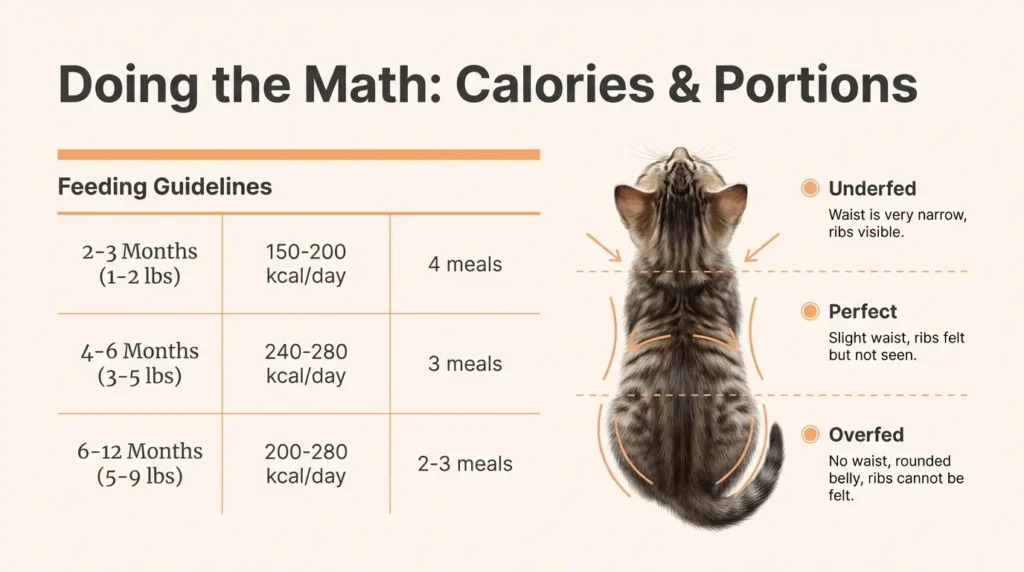
These are general guidelines based on typical growth stage calorie multipliers. Always cross-check with the feeding chart on your specific food’s label — calorie density varies by brand.[aaha]
| Kitten Age | Approx. Weight | Estimated Daily Calories | Meals Per Day |
|---|---|---|---|
| 4–8 weeks | 0.5–1 lb | 100–160 kcal | 4–5x |
| 2–3 months | 1–2 lbs | 150–200 kcal | 4x |
| 3–4 months | 2–3 lbs | 200–250 kcal | 3–4x |
| 4–6 months | 3–5 lbs | 240–280 kcal | 3x |
| 6–12 months | 5–9 lbs | 200–280 kcal | 2–3x |
Purreats tip: A useful starting rule: feed roughly 3.5–4.5 oz of wet food per pound of body weight per day for young kittens, then adjust based on their stool, energy, and weight gain week to week.[chewy]
Sample Daily Feeding Schedule (3–6 Month Kitten)
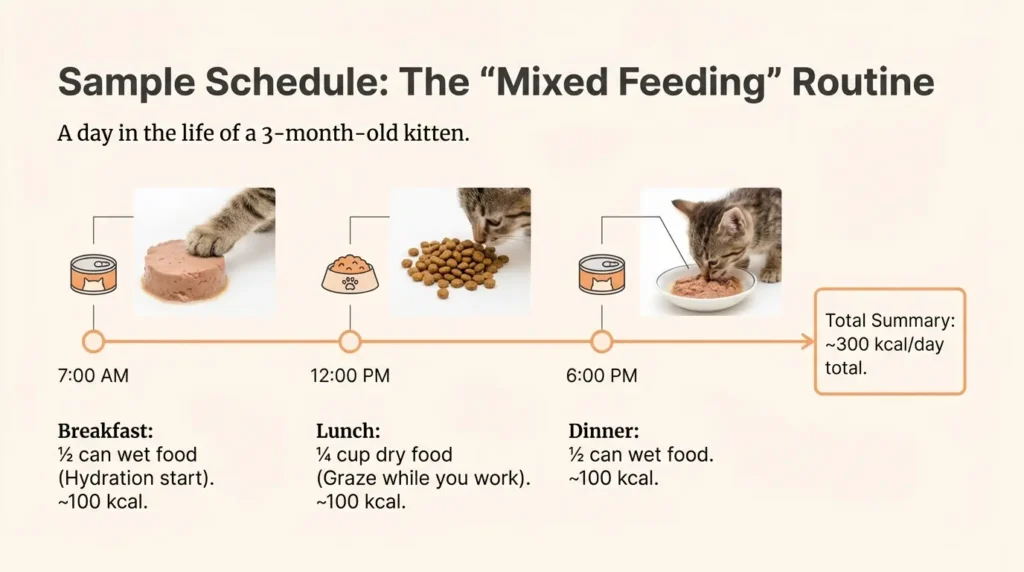
Here’s what a simple routine looks like for a 3-month-old, 2 lb kitten on mixed feeding:
- Morning (7am): ½ can wet kitten food (~100 kcal)
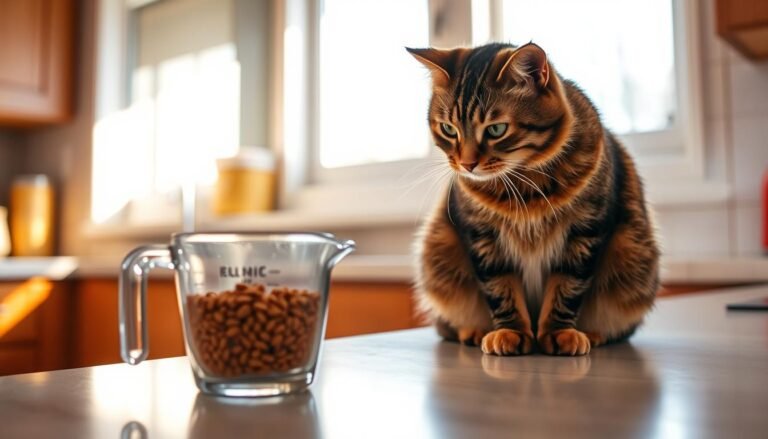
- Midday (12pm): ¼ cup dry kitten food (~100 kcal)
- Evening (6pm): ½ can wet kitten food (~100 kcal)
- Total: ~300 kcal/day ✓
Adjust portions up or down based on body condition: you should be able to feel your kitten’s ribs without pressing hard, but not see them prominently. Visible ribs = underfed. Can’t feel them at all = overfed.
Signs You’re Overfeeding or Underfeeding
Overfeeding signs:
- Soft, frequent stools
- Visibly rounded belly (beyond post-meal fullness)
- Lethargy after meals
- Difficulty feeling ribs
Underfeeding signs:
- Visible spine and ribs
- Crying between meals
- Poor coat condition (dull, rough)
- Slow weight gain week to week
🛠 Kitten Feeding Calculator
Use this tool to estimate your kitten’s daily calorie and serving needs. Always verify with your food’s label and consult your vet for medical conditions.
How to Switch Kitten Food Without Stomach Upset
Here’s the part most guides skip — and the mistake I see new kitten owners make most often.
Switching foods abruptly is the #1 cause of kitten diarrhea that has nothing to do with illness. A kitten’s GI tract needs time to adjust to a new protein source, new fiber level, and new fat content.
The 7–10 Day Transition Plan
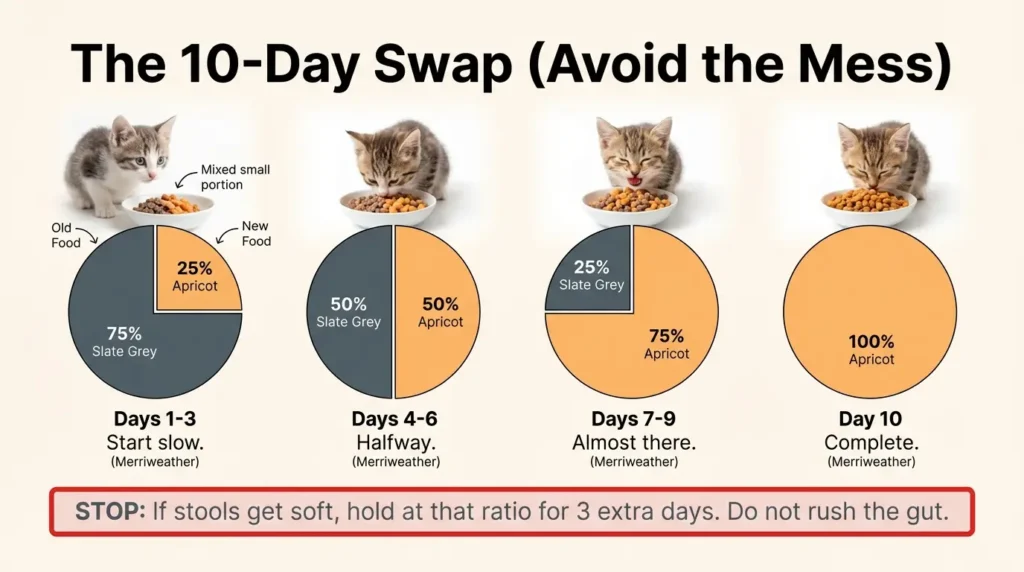
Follow this gradual swap and your kitten’s stomach will thank you:
- Days 1–3: 75% old food + 25% new food
- Days 4–6: 50% old food + 50% new food
- Days 7–9: 25% old food + 75% new food
- Day 10+: 100% new food
If you see soft stools at any stage, slow down — spend 3–4 extra days at that ratio before advancing.
What to Do If Your Kitten Refuses the New Food
Picky is a real personality trait in cats, not just behavior. If your kitten sniffs and walks away:
- Try warming the wet food slightly in the microwave (10–15 seconds) to release aroma — kittens navigate heavily by smell.
- Add a tiny bit of low-sodium chicken broth as a topper to make it more enticing.
- Change the texture: if they refuse pâté, try shreds or chunks in gravy. Or vice versa.
- Don’t panic-switch again — give each new food at least 5–7 days before concluding they dislike it.
I learned the hard way that “best” doesn’t matter if your kitten won’t touch it. Palatability is a real criterion.
When to Switch from Kitten to Adult Food
Most kittens should transition to adult food around 12 months of age, or when they reach their expected adult weight (this can vary slightly by breed — larger breeds like Maine Coons may need kitten food until 18 months).
Use the same 7–10 day gradual transition. Don’t rush it.
Special Situations: Picky, Underweight, and Sensitive Kittens
Not every kitten fits the “healthy standard-weight, eats anything” mold. Here’s what to do in the three most common special cases.
Helping Picky Eaters
If your kitten regularly refuses or half-eats meals, start by ruling out the obvious:
- Bowl too close to the litter box? (Cats hate this — move it.)
- Bowl material causing whisker fatigue? (Try a flat, wide dish instead of a narrow bowl.)
- Food sitting out too long? (Wet food loses appeal quickly; replace after 30–45 minutes.)
Then rotate protein sources slowly — chicken one week, turkey the next. Keeping some variety prevents your kitten from becoming exclusively fixated on one flavor.
Safe Feeding for Underweight or Orphaned Kittens
For kittens under 4 weeks or those coming in severely underweight from shelters:
- Under 4 weeks: Use kitten milk replacer (KMR), not regular milk — cow’s milk causes diarrhea in kittens.
- Transitioning to solid food (4–6 weeks): Mix a small amount of wet kitten food with warm water or KMR to make a “slurry,” gradually thickening it over 2 weeks.
- Underweight older kittens: Feed a calorie-dense wet food (Purina Pro Plan or Nulo are excellent here) 4–5 times daily until they reach a healthy body condition score.
Managing Sensitive Stomachs
For kittens with ongoing digestive issues — loose stools, vomiting after meals, or frequent gas — the approach is systematic elimination:
- Switch to a limited-ingredient diet (LID) with a single novel protein source.
- Give it 3 full weeks before evaluating — the gut needs time to settle.
- If no improvement, consult your vet: true food allergies, parasites, or IBD need a professional eye.
Real-Life: What I Actually Feed My Kitten (and Why)
I want to be transparent about how I make these recommendations. I’m not a veterinarian. I’m a cat parent who has spent years researching, testing, and writing about cat nutrition, including fostering kittens from shelter intake through their first year.
My Current 30-Day Feeding Plan (For a 4-Month-Old, 3.5 lb Kitten)
Here’s exactly what I’m doing right now:
- Morning: 1 can Purina Pro Plan Kitten Chicken (3 oz, ~100 kcal)
- Afternoon: ¼ cup Royal Canin Kitten dry (~95 kcal)
- Evening: 1 can Purina Pro Plan Kitten Chicken (~100 kcal)
- Total daily cost: ~$1.30
- Total kcal: ~295 kcal ✓ (appropriate for this age/weight)
Result after 4 weeks: solid, well-formed stools, soft coat, steady weekly weight gain of ~2–3 oz, excellent energy.
What I Got Wrong Early On
- I switched too fast the first time I tried Nulo. Two days in, soft stools. I went back to the basics and did the full 10-day transition the second time. Zero issues.
- I trusted “veterinarian recommended” on the front of the bag instead of reading the AAFCO statement. Some “vet recommended” foods are formulated for maintenance, not growth.
- I underestimated how much texture matters. My first foster kitten refused every pâté I offered. Shreds in gravy? Gone in 30 seconds.
Kitten Food: Frequently Asked Questions
Not as a primary diet. Adult cat food is formulated for “maintenance,” not growth. It doesn’t contain the higher protein, fat, DHA, or calorie levels that kittens need during their first 12 months. In a pinch, one meal won’t cause harm — but consistently feeding adult food to a kitten can lead to nutritional deficiencies over time.
Most cats should transition to adult food at 12 months. Larger breeds (Maine Coons, Ragdolls) may benefit from staying on kitten food up to 18 months due to slower maturation. Check with your vet if you’re unsure about your specific breed.
No, they don’t require both — but combining them is generally a smart approach. Wet food improves hydration and is easier for small kittens to chew. Dry food is convenient and supports a grazing pattern. Most vets suggest wet food as the majority of the diet, especially for young kittens.
Grain-free food is generally safe for kittens. The concerns around grain-free diets (specifically a potential link to DCM — dilated cardiomyopathy) have been studied primarily in adult dogs, not kittens. That said, there’s no strong evidence that kittens benefit from a grain-free formula unless they have a grain sensitivity. Ingredient quality matters more than grain presence or absence.
Technically yes, but it’s genuinely difficult to get right. Homemade diets for kittens risk serious nutritional imbalances — too little taurine alone can cause heart disease and blindness. If you want to go this route, work with a board-certified veterinary nutritionist (not just a general vet) to formulate a balanced recipe. For most owners, a high-quality commercial food is safer and more practical.
First, slow down the transition — go back to the previous food ratio and advance more gradually. Soft stools within 24–48 hours of a food switch are usually the GI tract adjusting, not an illness. If diarrhea lasts more than 3–4 days, is bloody, or is accompanied by lethargy or vomiting, call your vet.
- 0–3 months: 4–5 times per day
- 3–6 months: 3–4 times per day
- 6–12 months: 2–3 times per day
Young kittens have tiny stomachs and can’t hold large meals. Frequency matters more than total volume in the early months.
You can, and many owners do. The risk is overfeeding — kittens (unlike adult cats) often don’t self-regulate well, especially with highly palatable foods. If you free-feed dry, monitor body condition weekly. If you notice your kitten rounding out beyond a healthy weight, switch to measured meals.
Key Takeaways
- ✅ Always check for the AAFCO “growth” or “all life stages” statement — this is the one non-negotiable.
- ✅ Look for a named protein (chicken, turkey, salmon) as the first ingredient.
- ✅ Feed young kittens wet food as the primary diet — dry as a complement.
- ✅ Never switch foods overnight — use the 7–10 day gradual transition.
- ✅ Adjust portions based on your kitten’s actual body condition, not just label guidelines.
- ✅ Kittens stay on kitten food until 12 months (18 months for large breeds).
Your 4-Step Action Plan
- Choose 1 wet + 1 dry food from the picks above that match your budget and your kitten’s current age.
- Run the feeding calculator above to get a starting daily portion for your specific kitten.
- Start the 7–10 day transition if switching from a previous food — patience here saves you vet visits.
- Watch your kitten for 3–4 weeks: track stool quality, energy, and weekly weight. Those three signals tell you more than any label claim.
Have a question about your specific kitten or a food you’re considering? Drop it in the comments below — I read and respond to every one.
📌 Bookmark this page — we update product picks and cost data quarterly.
→ Next: Best Wet Kitten Food: Full Reviews & Canned Food Guide