5 Best Hypoallergenic Cat Food: Vet-Style Trial Plan

You’ve done everything right. You switched to a grain-free formula. You tried the “sensitive skin” bag from the pet store. You spent $60 on a “limited ingredient” kibble a neighbor recommended. And yet — there’s your cat at 2 a.m., thump-thump-thumping the side of the couch with her back leg, scratching the same patch of skin raw.
I hear this story every single week from the PurrEats community.
Here’s the hard truth: most of you aren’t failing because you picked a bad food. You’re failing because nobody told you that “hypoallergenic cat food” isn’t one thing — it’s three completely different diet strategies. And without knowing which one you actually need, you can spend hundreds of dollars and months of frustration going in circles.
This guide is your exit from that cycle. I’m going to walk you through what the label terms actually mean, help you pick the right path for your cat’s specific symptoms, and give you a step-by-step elimination diet protocol that veterinary dermatologists actually use — not the watered-down version you’ll find on most pet blogs.
Heads up: Purreats uses affiliate links. If you buy through them, we earn a small commission at no extra cost to you — and we only recommend foods we’d genuinely feed our own cats.
Table of Contents
What “Hypoallergenic” Cat Food Actually Means
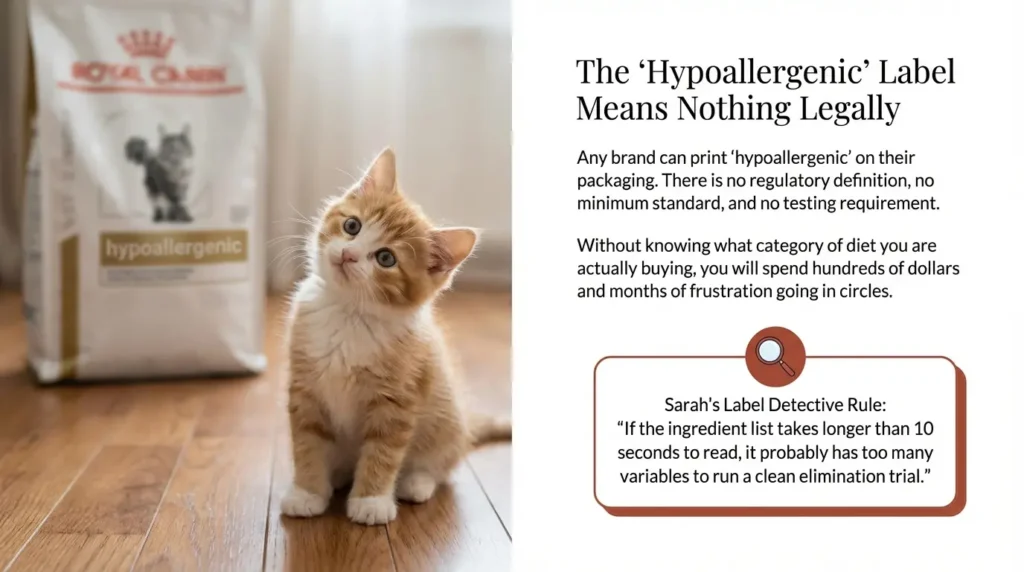
Let me save you a lot of confusion upfront: the word “hypoallergenic” on a cat food bag means almost nothing legally. Any brand can print it on the packaging. There’s no regulatory definition, no minimum standard, no testing requirement. What actually matters is the category of diet you’re dealing with.
The Three Categories (and Why They’re Not Interchangeable)
1. Hydrolyzed Protein Diets
This is the closest thing to truly hypoallergenic cat food that exists. In a hydrolyzed diet, the protein is broken down into such tiny fragments that your cat’s immune system can’t recognize them as a threat — meaning the allergic response never fires. These are prescription diets (Royal Canin HP, Hill’s z/d, Purina Pro Plan HA) and require a vet visit. They’re the gold standard for diagnostic food trials.
2. Novel Protein Diets
A “novel” protein is simply a protein your cat has never eaten before. If your cat has eaten chicken her whole life, switching to duck, rabbit, or venison removes the suspected trigger. These are available OTC and are a smart first move for many cats — as long as the food is truly single-protein with no cross-contamination.
3. Limited Ingredient Diets (LID)
These diets use fewer ingredients overall — typically one protein and one carb source. The goal is to reduce the number of potential triggers. The problem? Many LIDs still contain common allergens (chicken fat, “poultry,” fish oil), and OTC manufacturing often involves shared equipment, which introduces cross-contamination. LIDs can help, but they’re the weakest of the three strategies for true allergy management.
The Label-Reading Rule That Changes Everything
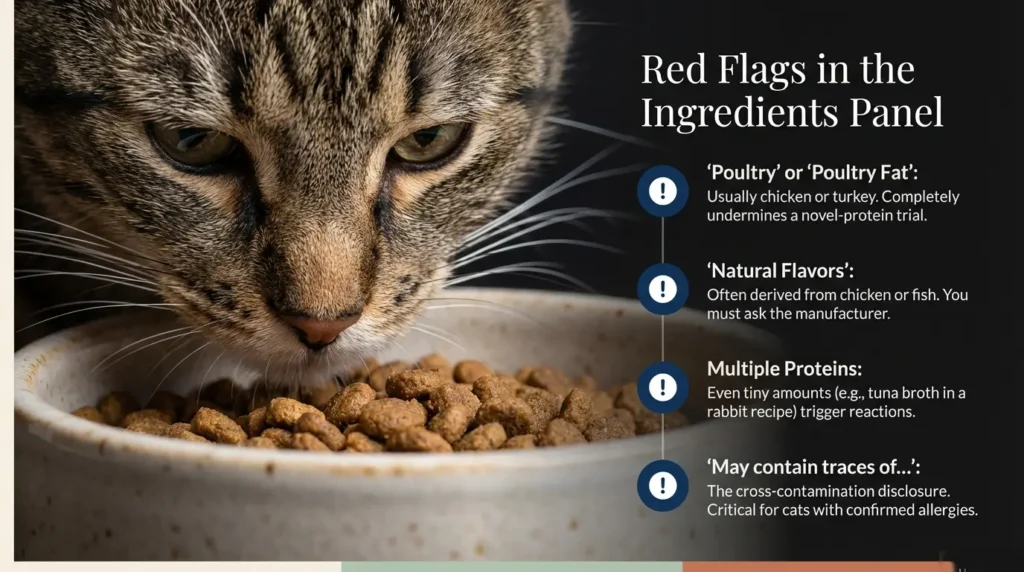
When you pick up a bag labeled “hypoallergenic” or “limited ingredient,” flip it over and read the full ingredient list before you buy. Watch for:
- “Poultry” or “poultry fat” — this is usually chicken or turkey and will undermine a novel-protein trial
- “Natural flavors” — often derived from chicken or fish; ask the manufacturer
- Multiple protein sources — even in small amounts (e.g., tuna broth in a rabbit recipe)
- “May contain traces of…” — this is the cross-contamination disclosure; critical for cats with confirmed allergies
🔍 Sarah’s Label Detective Rule: If the ingredient list takes longer than 10 seconds to read, it probably has too many variables to run a clean elimination trial.
Is It a Food Allergy, Intolerance, or Something Else Entirely?
Before you spend $80 on a prescription hydrolyzed diet, spend five minutes figuring out whether food is even the likely culprit. It saves time, money, and a lot of stress on your cat.
Read Your Cat’s Symptom Pattern
| Symptom Pattern | More Likely Cause |
|---|---|
| Chronic itching at head, neck, ears — year-round | Food allergy (strong indicator) |
| Itching that gets worse in spring/fall | Environmental allergy (pollens) |
| Chronic vomiting or diarrhea without skin signs | Food intolerance or GI condition |
| Both skin AND GI signs, year-round | Food allergy or combined triggers |
| Itching that responds to antihistamines | Environmental allergy |
| Signs that started after a food change | Food-related (intolerance more common) |
Key distinction: A true food allergy is an immune response — it triggers skin reactions, itchy ears, and sometimes GI signs. A food intolerance is a digestive sensitivity — it usually stays in the GI tract (vomiting, diarrhea) without skin involvement. The dietary approach overlaps, but understanding the difference helps you set the right expectations.
Food-Trigger Clues vs. Environmental-Trigger Clues
Year-round, non-seasonal symptoms that don’t improve with antihistamines are the biggest red flag for a food component. If your cat scratches constantly in winter — when outdoor allergens are low — and doesn’t respond to allergy medication, food is a very reasonable suspect.
🚨 Red Flags: When to Call the Vet Before You Try Anything
Don’t DIY if your cat has:
- Open skin wounds, hot spots, or signs of secondary bacterial infection
- Significant weight loss alongside GI symptoms
- Blood in stool or vomit
- Sudden onset of severe symptoms (vs. gradual chronic pattern)
- Symptoms in a kitten under 6 months
Pick Your Best Path: A Practical Decision Guide
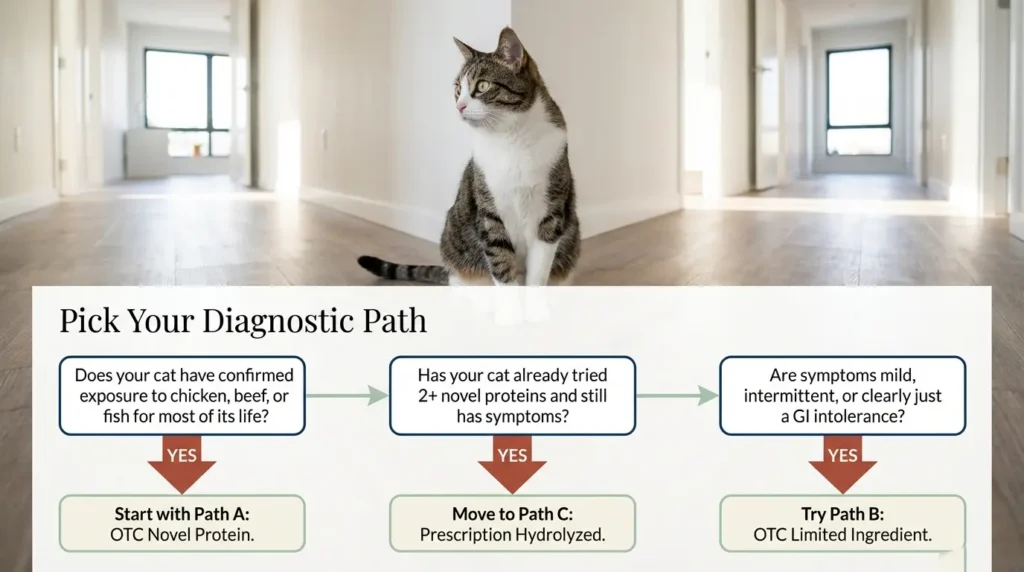
Here’s the framework I use when helping readers figure out where to start. Ask yourself these questions and follow the branch:
Does your cat have confirmed exposure to chicken, beef, or fish for most of its life?
→ Yes → Start with Path A: Novel Protein OTC
Has your cat tried 2+ novel proteins and still has symptoms?
→ Yes → Move to Path C: Prescription Hydrolyzed
Are symptoms mild, intermittent, or you suspect intolerance more than allergy?
→ Yes → Try Path B: LID OTC first, upgrade if needed
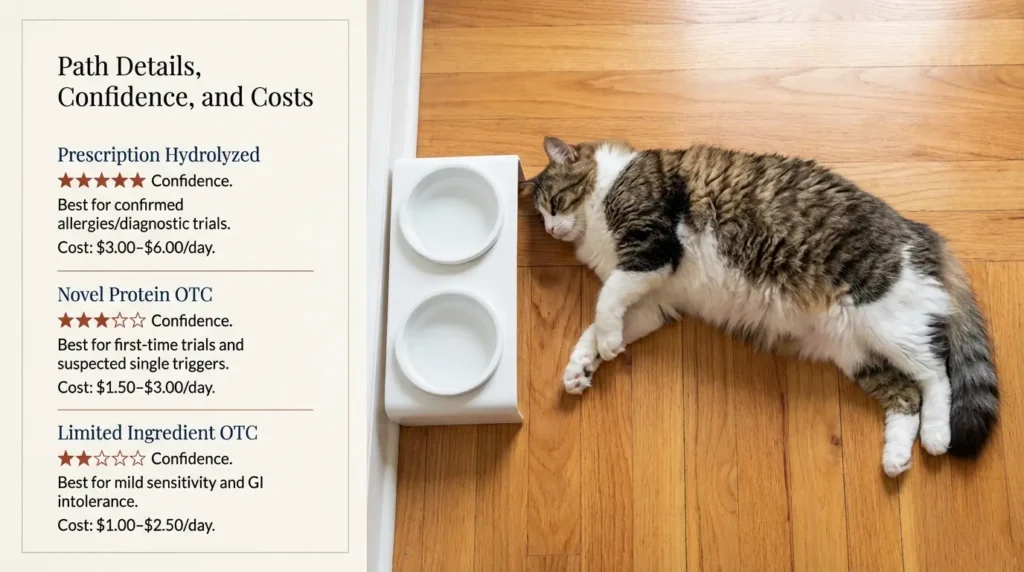
Path A: OTC Novel Protein (Best First Try for Most Cats)
Pick a protein your cat has genuinely never eaten. Common options: duck, rabbit, venison, kangaroo, or green-lipped mussel. The key is single-protein integrity — one named animal protein, nothing else.
Best for: Cats with suspected chicken/beef allergy, first-time diet trial, budget-conscious owners
Watch out for: Hidden poultry fat, fish oil derived from common fish species, “natural flavors”
Estimated cost: $1.50–$3.00/day (wet) or $1.00–$2.00/day (dry)
Path B: OTC Limited Ingredient (Moderate Confidence)
A good starting point for cats with suspected intolerances (primarily GI signs) or owners who aren’t ready to go full elimination yet.
Best for: Mild GI sensitivity, cats that haven’t been on many food types
Watch out for: Cross-contamination disclaimers, multiple protein sources in a “limited ingredient” formula
Estimated cost: $1.50–$2.50/day
Path C: Prescription Hydrolyzed (Highest Confidence)
This is what veterinary dermatologists actually recommend for a diagnostic elimination trial. It’s the only category where you can have high confidence that the immune system won’t react to the protein source.
Best for: Cats with confirmed allergic skin disease, failed OTC trials, multi-symptom cases
Watch out for: Some cats refuse the taste; some formulas contain corn starch (usually fine for protein-allergic cats, but relevant if you suspect grain intolerance separately)
Estimated cost: $3.00–$6.00/day
| Diet Type | Confidence Level | Prescription? | Best for | Avg Cost/Day |
|---|---|---|---|---|
| Hydrolyzed protein | ★★★★★ | Yes | Confirmed allergies, diagnostic trials | $3–6 |
| Novel protein OTC | ★★★☆☆ | No | First-time trials, suspected single trigger | $1.50–3 |
| Limited ingredient OTC | ★★☆☆☆ | No | Mild sensitivity, GI intolerance | $1–2.50 |
The Elimination Diet Trial, Done Correctly
This is where most people fail — not because they chose the wrong food, but because they ran the trial incorrectly. One treat. One flavored pill pocket. One stolen bite of another cat’s food. That’s all it takes to invalidate weeks of progress.
Step 1: Prep Your Household Before Day 1
Before you open the new bag or can, do this:
- Remove ALL treats from the house (or lock them away completely)
- Check every medication your cat takes — flavored chewables and compounded medications often contain chicken or fish. Ask your vet for unflavored alternatives
- Wash all food bowls and replace water bowls (residue matters for sensitive cats)
- If you have multiple cats: decide on a feeding strategy (separate rooms, scheduled meals, microchip feeder)
- Tell everyone in the household. One person giving “just one treat” resets the clock.
Step 2: Transition Gradually, Then Stay Strict
Transition over 7–10 days (mix old and new food to avoid GI upset from the switch itself — not the allergy). After that, zero deviation for the duration of the trial.
Step 3: Run the Trial for the Full Duration
According to VCA Hospitals’ veterinary diet trial guidance, the trial should run a minimum of 8 weeks — and for skin-predominant signs, up to 12 weeks may be necessary because it takes longer for skin allergens to clear the system than GI symptoms.
Here’s what to expect week by week:
| Week | What You Might See |
|---|---|
| 1–2 | Possible mild GI adjustment (softer stools) as gut adapts |
| 3–4 | GI signs often improve first if food is the trigger |
| 5–6 | Ear itching may reduce; scratching frequency decreasing |
| 7–8 | Skin coat quality improving; evaluate results vs. baseline |
| 9–12 | Skin-primary cases may need the full 12 weeks |
📊 Track it: Use the symptom tracker at the end of this article (or download it below). Rate itch severity (1–10), stool quality (1–5), and note vomiting episodes weekly. Without a baseline, you’ll forget how bad it was — and miss the gradual improvement.
Step 4: The Challenge Phase (This Is How You Confirm It)
After remission, reintroduce the old food for 1–2 weeks. If symptoms return within 1–2 weeks of reintroducing the original diet, you’ve confirmed a food trigger. This challenge phase is what separates a diagnostic trial from just “switching foods and hoping.”
Why bother with the challenge? Because without confirmation, you might unnecessarily restrict your cat’s diet forever — or miss the real culprit.
Best Hypoallergenic Cat Food: Top Picks by Scenario
I apply the same five criteria to every product I recommend here:
- Single named protein source (no “poultry,” no “meat”)
- No hidden common allergens in small print (natural flavors, animal fat)
- Clear manufacturing statement (dedicated facility or clear cross-contamination disclosure)
- Palatability track record for picky cats
- Consistent formula (no silent recipe changes in the last 12 months)
🏆 Best Prescription Hydrolyzed: Royal Canin Veterinary PR Hydrolyzed Protein


Sarah’s Quick Take: The most widely used prescription hydrolyzed diet in veterinary practice. Soy protein hydrolysate as the primary source means the proteins are broken down small enough that even highly reactive cats rarely respond. It comes in wet and dry, which helps with palatability.
- Who it’s for: Any cat with chronic skin allergies, failed OTC trials, or cats on a proper vet-supervised elimination trial
- Who should skip it: Cats with soy sensitivity (rare, but exists); owners who can’t get a vet prescription
- Cost/day: ~$3.50–$5.50 depending on format and cat size
- Palatability: Most cats accept it; wet formula has higher acceptance
🐇 Best OTC Novel Protein: Instinct Limited Ingredient Duck

Sarah’s Quick Take: Single animal protein (duck), single carbohydrate (tapioca), no chicken fat or fish oil. The ingredient list is genuinely clean — I’ve read it three times. Available in wet and dry.
- Who it’s for: Cats with suspected chicken/beef allergy running their first OTC trial
- Who should skip it: Cats who’ve eaten duck before (it won’t be “novel” for them)
- Cost/day: ~$1.80–$2.50 (wet); ~$1.20–$1.70 (dry)
- Palatability: High — duck tends to be well accepted
🦌 Best for Picky Eaters: Ziwi Peak Venison

Sarah’s Quick Take: Air-dried, single animal protein (venison), extremely palatable even for cats that normally refuse novel proteins. More expensive, but the acceptance rate is extraordinary. Useful when you’ve tried rabbit and duck and your cat turns her nose up at everything.
- Who it’s for: Picky eaters who’ve rejected other novel proteins; cats needing high-palatability options
- Who should skip it: Budget-conscious households; cats that do fine on cheaper OTC options
- Cost/day: ~$3.00–$4.50
💰 Best Budget-Friendly OTC: Purina Pro Plan Sensitive Skin & Stomach (Salmon)


Sarah’s Quick Take: This is a good budget starting point only if your cat has never been exposed to salmon as a primary protein and you’re addressing suspected chicken allergy. It’s not a clean LID (it has more ingredients than the others), but it’s widely available, affordable, and highly palatable. Not suitable for a strict diagnostic trial — but appropriate for mild sensitivities.
- Who it’s for: Cats with suspected mild chicken sensitivity, tight budgets, cats needing a transitional step
- Who should skip it: Cats in a strict diagnostic elimination trial (too many variables)
- Cost/day: ~$0.80–$1.50
🩺 Best Wet for GI-Primary Signs: Hill’s Prescription Diet z/d

Sarah’s Quick Take: Hydrolyzed chicken protein (the chicken is so thoroughly processed the immune system doesn’t recognize it) combined with a very low-antigen profile. The wet version has higher moisture content, which supports gut health and makes the food more digestible during a flare.
- Who it’s for: Cats with GI-primary signs (vomiting, diarrhea) on a vet-supervised trial
- Who should skip it: Cats who resist prescription foods or have budget constraints that make a vet prescription difficult
- Cost/day: ~$3.00–$5.00 (wet)
Switching Foods Without Making Symptoms Worse
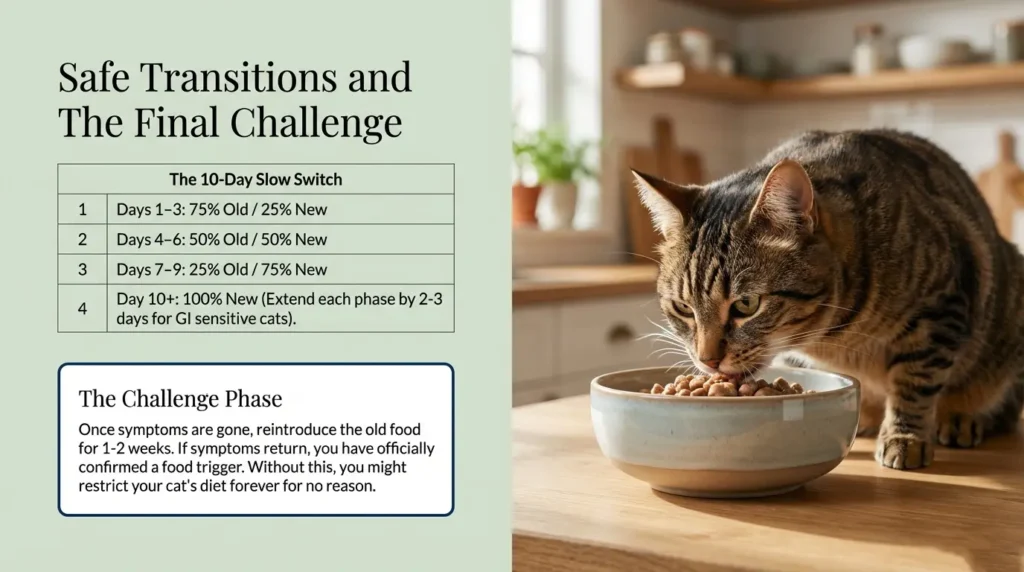
Here’s a scenario I see constantly: an owner switches their cat to a new “hypoallergenic” food and the cat has diarrhea for three days. They conclude the food doesn’t work and go back to the old one. The food was actually fine — the problem was the transition speed.
The Standard Transition Schedule
| Day | Old Food | New Food |
|---|---|---|
| 1–3 | 75% | 25% |
| 4–6 | 50% | 50% |
| 7–9 | 25% | 75% |
| Day 10+ | 0% | 100% |
For cats with GI sensitivity, extend each phase by 2–3 extra days. Slower is always safer.
What to Do If Your Cat Refuses the New Food
Novel proteins and prescription hydrolyzed diets often smell different from what your cat is used to. Try these:
- Warm the food slightly (10–15 seconds in microwave, stir well, test temperature) — enhances aroma
- Add a small amount of low-sodium chicken broth during the first week only (note: only if the trial is for skin-primary signs, not if you’re trying to rule out chicken)
- Use a food topper made from the same protein (same novel protein, no additional allergens)
- Feed at the same time every day — routine reduces food neophobia in cats
The Multi-Cat Household Problem
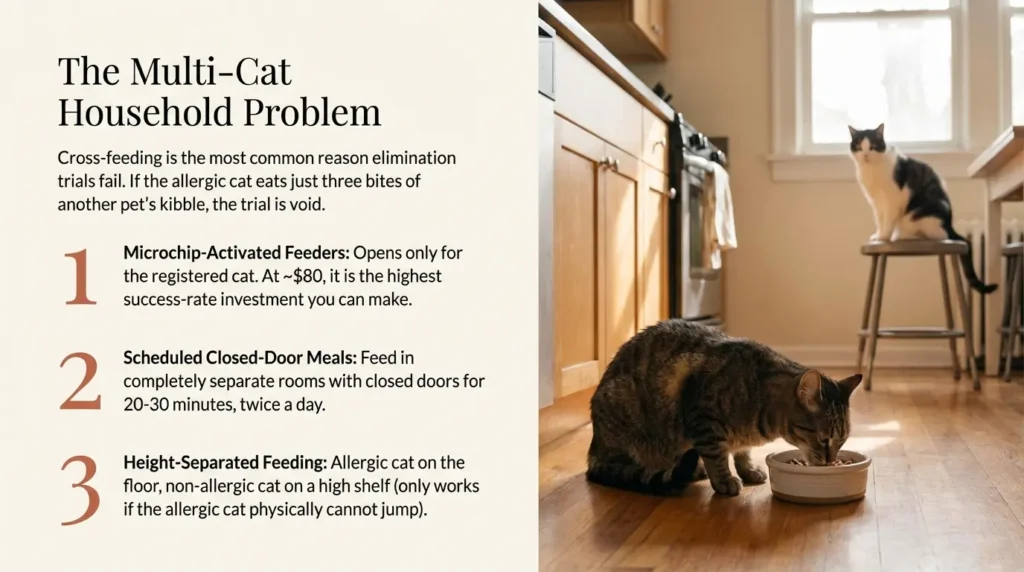
This is one of the most common reasons elimination trials fail, and almost no other guide addresses it directly.
If you have two cats, you need a plan for feeding the allergic cat separately. Options in order of preference:
- Scheduled meals in separate rooms (close doors during feeding, 20–30 minutes)
- Microchip-activated feeders (opens only for the registered cat — ~$80, worth every cent)
- Height-separated feeding (allergic cat eats on the floor, non-allergic cat on a shelf) — works only if the allergic cat can’t jump or doesn’t want to
Troubleshooting: When Nothing Seems to Be Working
You’re eight weeks in. You’ve been strict. And your cat is still scratching. Before you give up on diet, run through this checklist — because in my experience, one of these almost always explains the problem.
The 6 Most Common Reasons Diet Trials Fail
- Flavored medications — pill pockets, flavored liquid antibiotics, compounded medications in chicken flavor. These are often overlooked because they’re “medicine, not food.” They contain enough protein fragments to trigger a reaction.
- Treats given by another household member — even one treat per week can prevent remission
- Cross-feeding from another pet’s bowl — the allergic cat eating 3 bites of the dog’s kibble daily
- Cross-contamination in the OTC food itself — shared manufacturing equipment. For a true diagnostic trial, this is why prescription diets are preferred
- The trial wasn’t long enough — skin allergies need the full 12 weeks in some cases; people often evaluate at 4–6 weeks
- Environmental allergy component — food was never the primary trigger. If you’ve done everything right and seen zero improvement, a vet visit for environmental allergy testing is the right next step
When to Escalate to Prescription Hydrolyzed
If you’ve done two clean OTC novel-protein trials (different proteins each time) with strict compliance and seen no improvement, it’s time for a prescription hydrolyzed diet. OTC foods have too much potential for cross-contamination to rule out food allergy with confidence.
Long-Term Maintenance After You Find “The Safe Diet”
Once your cat responds positively and you’ve confirmed it with a challenge phase, stay on that diet consistently. You can try reintroducing other proteins one at a time (with 2-week observation windows each) to build a “safe protein list” — this gives you more future flexibility and prevents lifelong over-restriction.
Interactive Tool: Your Diet Trial Cost Calculator
🧮 Hypoallergenic Diet Trial Cost Estimator
Find out what an 8–12 week elimination trial will actually cost before you commit.
📅 Daily cost: —
📦 8-week trial total: —
📦 12-week trial total: —
* vs. ~$150 vet visit for a steroid injection + office exam
FAQ: Hypoallergenic Cat Food
What is truly hypoallergenic cat food?
The only foods that come close to being truly hypoallergenic are prescription hydrolyzed protein diets, where the proteins are broken into fragments too small for the immune system to recognize. OTC “hypoallergenic” or “limited ingredient” labels have no regulatory standard and are not equivalent.
How long does a cat food elimination diet take?
According to VCA Hospitals’ elimination diet guidelines, a minimum of 8 weeks is required, with skin-primary cases often needing up to 12 weeks. GI signs typically improve earlier (weeks 3–4) than skin signs (weeks 6–12).
Can I give treats during an elimination diet trial?
No — zero treats of any kind unless they are made from the exact same single protein as the trial food. Even one chicken-flavored treat per week contains enough protein fragments to prevent remission. This includes flavored medications and pill pockets.
Should I choose novel protein or hydrolyzed first?
For most cat owners, starting with an OTC novel protein is a reasonable first step if you can identify a protein your cat has genuinely never eaten. If you’ve already tried 2+ novel proteins with strict compliance and seen no improvement, escalate to a prescription hydrolyzed diet for a definitive trial.
Is limited ingredient cat food the same as hypoallergenic?
No. Limited ingredient means fewer total ingredients, but it doesn’t guarantee the absence of common allergens, and OTC manufacturing often involves shared equipment (cross-contamination). LID diets are useful for mild sensitivities but are not equivalent to hydrolyzed diets for true allergy management.
My cat’s trial failed. What should I do next?
Before assuming food isn’t the problem, check the six most common failure points: flavored medications, hidden treats, cross-feeding from another pet, cross-contamination in the food itself, insufficient trial duration, and environmental allergy as the primary driver. If all are ruled out, consult your vet about prescription hydrolyzed diets and environmental allergy testing.
Key Takeaways
- “Hypoallergenic” is a marketing term, not a medical standard. What matters is the category: hydrolyzed (highest confidence), novel protein (good first step), or LID (mildest option).
- The elimination trial must be strict — no treats, no flavored meds, no cross-feeding, for a full 8–12 weeks depending on your cat’s primary symptom type.
- Confirm with a challenge phase. Reintroducing the old food and watching for symptom return is the only way to know food was actually the trigger — not just coincidence.
Your 5-Step Action Plan
- Pick your path today — based on your cat’s symptom pattern and diet history, choose novel protein (OTC), LID (OTC), or prescription hydrolyzed. Use the decision guide above.
- Prep your household — remove treats, check medications, brief everyone in the family, set up a multi-cat feeding plan if needed.
- Start tracking from Day 1 — note itch score (1–10), stool score (1–5), and vomiting count weekly so you have real data, not just a vague sense of “maybe slightly better?”
- Run the full trial — set a calendar reminder for Week 8 (and Week 12 if your cat has skin-primary signs). Commit to the full window before evaluating.
- Challenge, confirm, and maintain — once in remission, reintroduce old food to confirm the trigger, then build your cat’s long-term safe diet list one protein at a time.
Have a question about your specific Hypoallergenic Cat food you’re considering? Drop it in the comments below — I read and respond to every one.
→ Next: Best Wet Kitten Food: Full Reviews & Canned Food Guide
→ Deep dive: The 9 Best Hypoallergenic Cat Foods
📌 Bookmark this page — product picks and pricing verified quarterly.