Best Dry Kitten Food: Label Guide Feeding Tips (2026)
You’re staring at a wall of dry kitten food bags — some promising “natural,” some “grain-free,” some “vet recommended” — and every single one seems to cost a different amount for a wildly different weight. You’re not sure what any of it actually means, and you’re not sure which one your kitten actually needs.
That’s exactly where this guide starts.
Dry kitten food gets a complicated reputation online. Some cat nutrition corners treat kibble as essentially junk food. Others treat it as the obvious, practical default. The truth is considerably more useful than either extreme: dry kitten food can be an excellent part of your kitten’s routine — if you pick the right formula and use it correctly.
Here’s everything you need to know to do exactly that.
Transparency note: Purreats uses affiliate links. If you buy through our links, we earn a small commission at no extra cost to you — and every recommendation here is one I’d stand behind for my own cats.
Does Your Kitten Actually Need Dry Food?
Short answer: no, dry food isn’t strictly required. A kitten can grow up healthy on wet food alone — and for kittens under 8 weeks, wet food or a slurry of wet food mixed with kitten milk replacer should be the entire diet.
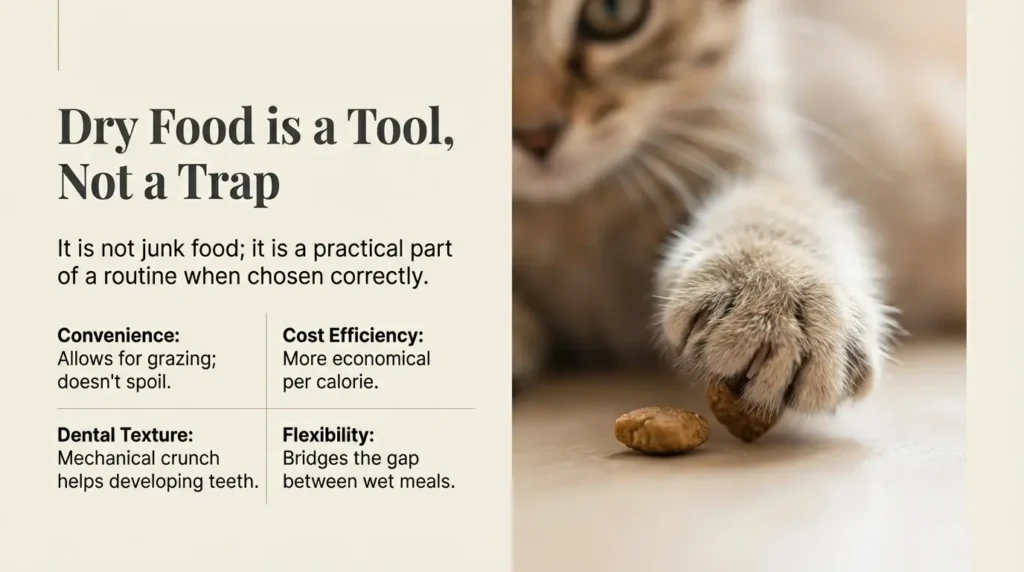
But dry kitten food earns its place in the routine for several practical reasons that are worth understanding clearly:
Convenience. Dry kibble doesn’t spoil at room temperature, doesn’t smell up your kitchen after 30 minutes, and can be left out for grazing between scheduled wet meals without the mess or waste.
Cost efficiency. Per calorie, dry kitten food is almost always more economical than wet. If your budget has a ceiling, dry food as a supplement to one or two wet meals daily stretches your dollars without abandoning nutrition quality.
Dental texture. The crunch of kibble provides mild mechanical action on developing teeth. This isn’t a substitute for dental care — no kibble is — but it’s a marginal benefit that dry food provides and wet food doesn’t.
Routine flexibility. For busy households, a measured dry food portion in the afternoon keeps your kitten from going too long between wet meals without requiring you to be home at a specific time.
The important word in all of the above is supplement — not replacement. If dry food is your kitten’s only food source, you need to actively support hydration through a water fountain or additional wet meals. Kittens on dry-only diets drink less than they should, and that has real consequences for kidney and urinary tract health over time.
What to Look for on a Dry Kitten Food Label
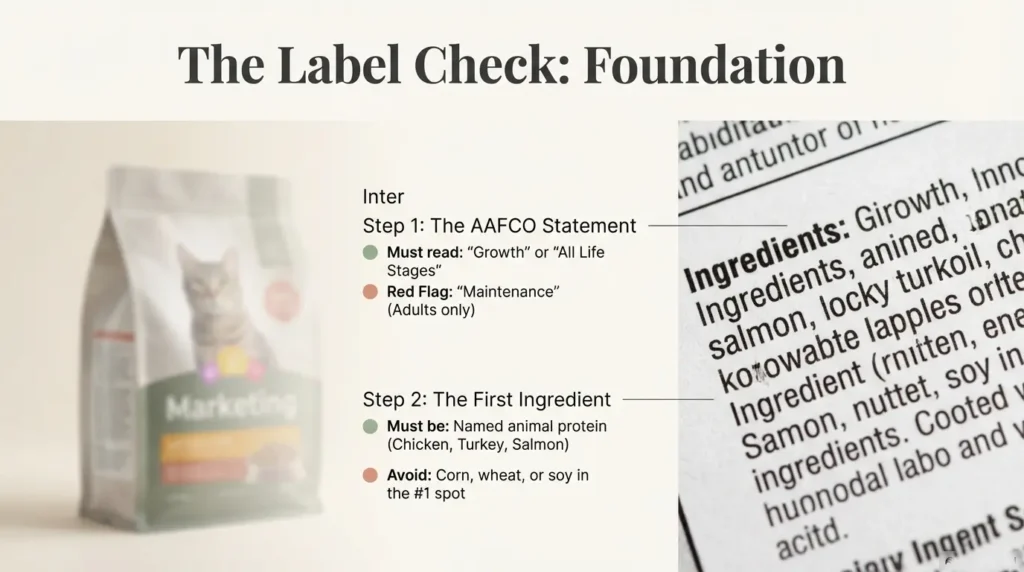
The front of the bag is marketing. The back of the bag is information. Here’s your four-step check for every dry kitten food you evaluate:
Step 1: Find the AAFCO “growth” or “all life stages” statement.
This is the one non-negotiable. If the nutritional adequacy statement says “maintenance,” that food is formulated for adult cats — not your growing kitten. A food can look premium on the front and fail this test on the back. Always check.
Step 2: Check the first ingredient.
It should be a named animal protein: chicken, turkey, salmon, beef. “Poultry meal” or “chicken by-product meal” in the first position is a step down aesthetically but not always nutritionally — these are concentrated protein sources. What you want to avoid: corn, wheat, or soy as the very first ingredient, which signals a carbohydrate-first formulation.
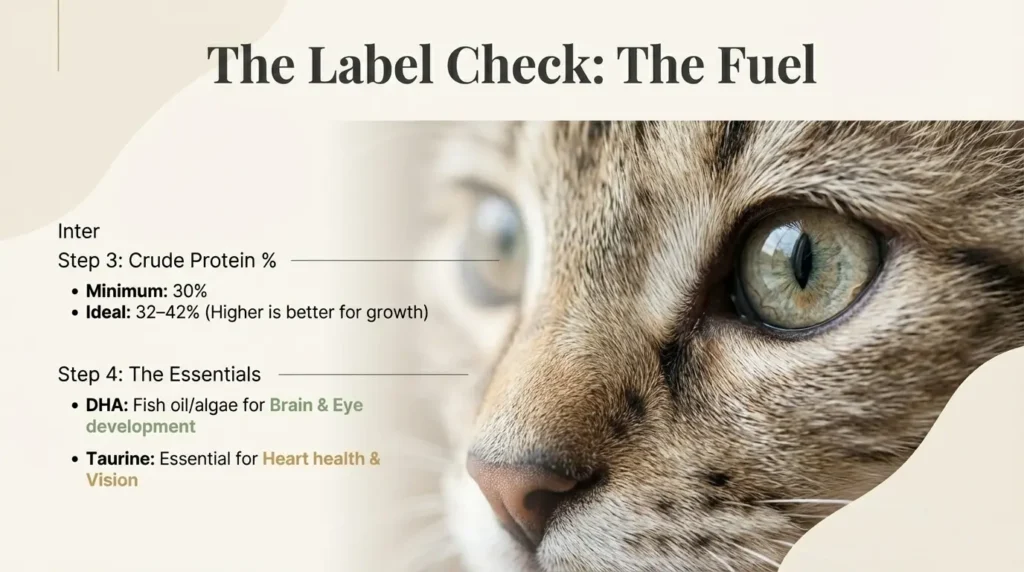
Step 3: Check crude protein percentage.
For dry kitten food, look for a minimum of 30% crude protein on the guaranteed analysis panel. Quality formulas typically sit at 32–42%. Higher is generally better for a growing kitten, as long as the protein is coming from animal sources rather than plant proteins like corn gluten meal.
Step 4: Confirm DHA and taurine are included.
DHA (often listed as fish oil or marine microalgae oil) supports brain and eye development during the critical growth window. Taurine is essential for heart health and vision — cats can’t synthesize it themselves. Both should be clearly listed in any legitimate kitten formula.
Best Dry Kitten Food Picks for 2026
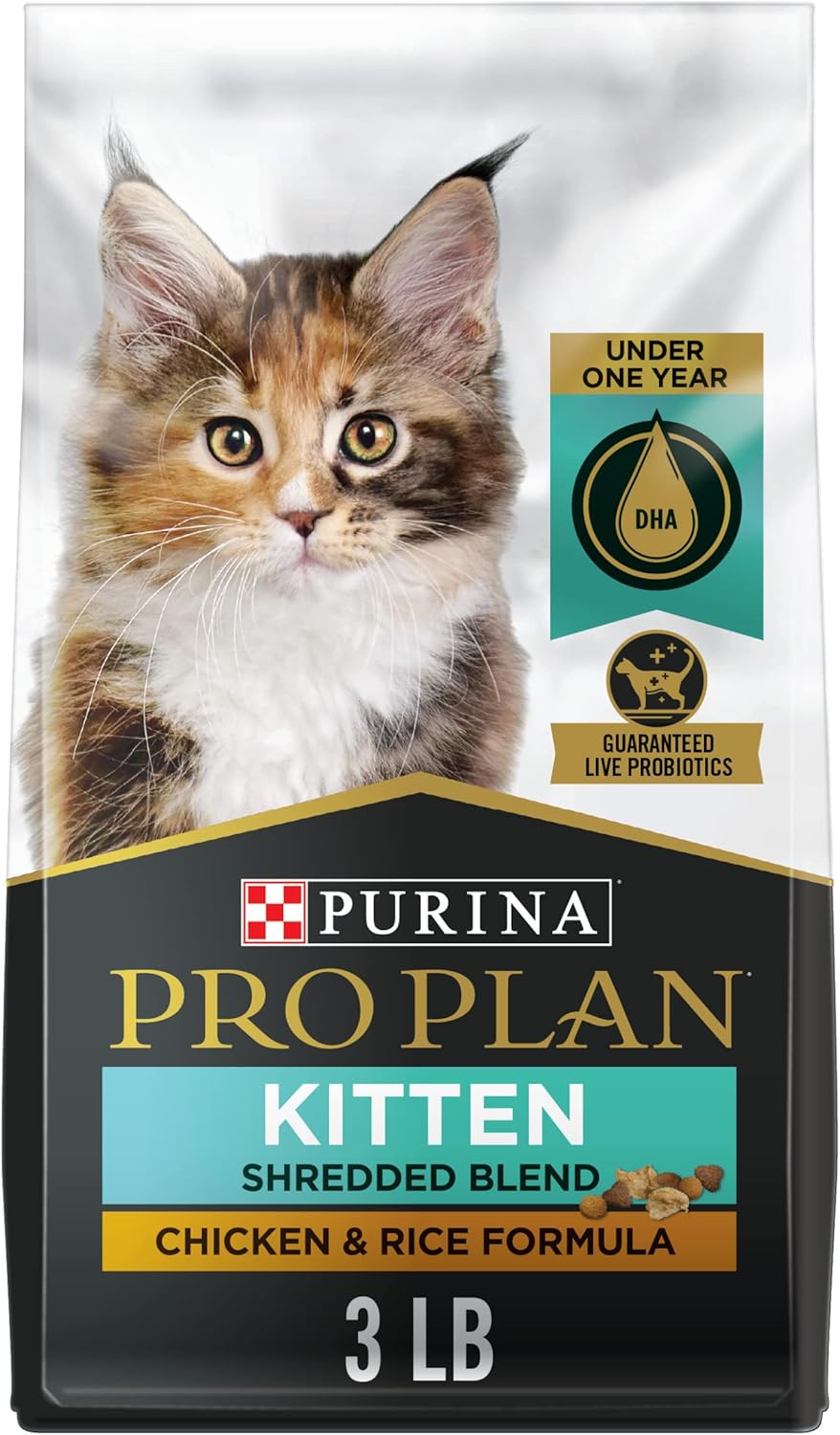
🥇 Best Overall: Purina Pro Plan Kitten Chicken & Rice Formula


If you ask me to name one dry kitten food without knowing anything else about your situation, this is the one I’d say — consistently, every time.
Real chicken is the first ingredient. Crude protein sits at 42% — genuinely impressive for a dry formula at this price point. DHA from fish oil is explicitly labeled. Taurine is confirmed. AAFCO growth statement present and feeding-trial validated.
Palatability is consistently strong across different kitten personalities, ages, and backgrounds. The kibble size is appropriate for kittens from about 8 weeks onward. And the price puts it in reach for most budgets without requiring a premium-brand spending commitment.
✅ Best for: Most kittens 8 weeks–12 months, everyday primary dry food, first-time owners
First ingredient: Chicken
Crude protein: 42%
AAFCO: Growth ✓
Cost/day: ~$0.45–$0.55
🥈 Best for Structure + Palatability: Royal Canin Kitten Dry
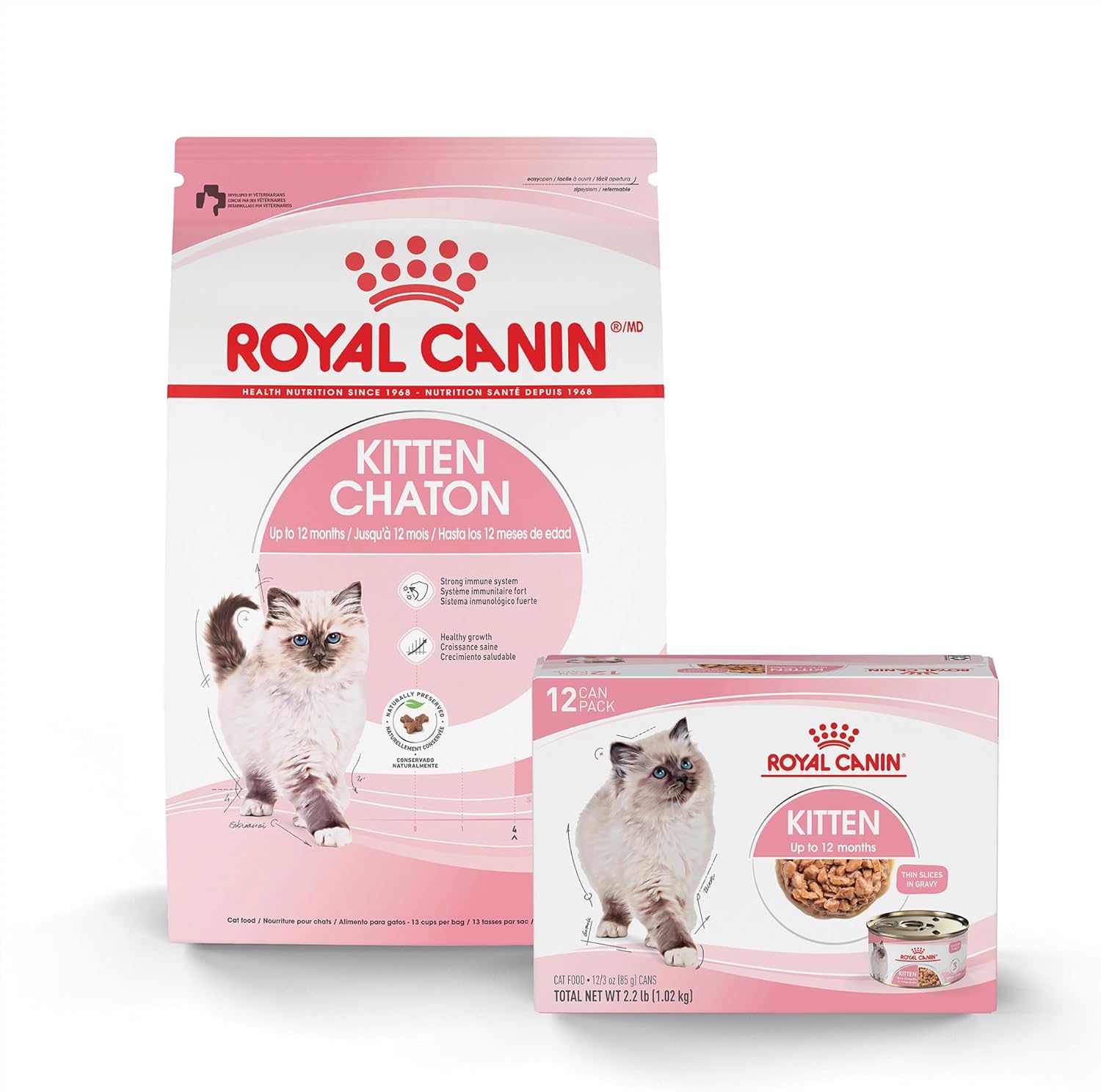

Royal Canin Kitten is a shelter and veterinary clinic standard — and that consistency across thousands of different kittens tells you something important about reliability.
What makes it genuinely distinctive is the kibble design: each piece is specifically shaped and sized for kittens’ smaller mouths and developing teeth, making it physically easier for young kittens to pick up and chew. The prebiotic fiber blend supports digestive comfort, and palatability testing across multiple kitten litters consistently shows near-100% first-offering acceptance.
The tradeoff: chicken by-product meal leads the ingredient list rather than whole chicken, and the protein percentage (34%) is lower than Pro Plan. For owners prioritizing whole meat sources at the top of the label, Pro Plan is the better fit. For picky eaters, sensitive stomachs, or kittens coming from shelters already used to Royal Canin — this formula is hard to beat.
✅ Best for: Picky eaters, shelter transitions, sensitive digestion, vet-recommended routines
First ingredient: Chicken by-product meal
Crude protein: 34%
AAFCO: Growth — Feeding trial ✓
Cost/day: ~$0.55–$0.70
🥉 Best Premium: Nulo Freestyle Kitten Salmon & Peas

If ingredient quality is your primary criterion and budget isn’t the limiting factor, Nulo Freestyle sets the bar for dry kitten food.
Deboned salmon is the first ingredient. Crude protein sits at 38% from high-quality animal sources. The formula is low in starch — no corn, wheat, or soy — and includes added BC30 probiotics for digestive support. The DHA from salmon meal and fish oil is clearly present.
It’s one of the few dry kitten foods that genuinely bridges the quality gap between standard kibble and premium wet food formulas. Pair it with a budget-friendly wet food for the primary meal and you get excellent overall nutrition at a managed total daily cost.
✅ Best for: Premium-first owners, grain-sensitive kittens, high-protein priorities
First ingredient: Deboned salmon
Crude protein: 38%
AAFCO: Growth ✓
Cost/day: ~$0.65–$0.80
Best Budget: Purina Kitten Chow Nurturing Formula
Not every household can spend $40+/month on kitten food. That’s a real constraint, and there’s no point pretending otherwise.
Purina Kitten Chow carries an AAFCO growth statement, includes taurine, and delivers a nutritionally complete diet for growing kittens at the lowest price point on this list. Ground yellow corn leads the ingredient list — that’s the honest tradeoff you’re making — but the formula meets growth nutritional standards and is available at virtually every grocery store in the US.
If you’re using Kitten Chow, pair it with at least one affordable wet meal daily (Fancy Feast Classic Pâté is a solid complement) to offset the low moisture content. That combination gives your kitten a more balanced nutritional foundation than dry food alone.
✅ Best for: Tight budgets, multi-kitten households, transitional or emergency feeding
First ingredient: Ground yellow corn
Crude protein: ~34%
AAFCO: Growth ✓
Cost/day: ~$0.25–$0.35
How Much Dry Kitten Food to Feed Per Day
Use this as your starting framework — and always verify against your specific brand’s feeding guide since calorie density varies:
| Kitten Age | Approx. Weight | Dry Food Per Day | Meals Per Day |
|---|---|---|---|
| 8–12 weeks | 1–2 lbs | ¼ – ⅓ cup | 3–4 times |
| 3–4 months | 2–3 lbs | ⅓ – ½ cup | 3–4 times |
| 4–6 months | 3–5 lbs | ½ – ¾ cup | 3 times |
| 6–12 months | 5–9 lbs | ½ – ¾ cup | 2–3 times |
If you’re combining dry and wet: Reduce the dry portion proportionally. One 3 oz can of wet food replaces approximately ¼ cup of dry food in calorie terms — though verify this against your specific brands since densities vary significantly.
Body condition always overrides the chart. Feel your kitten’s ribs gently — you should feel them without pressing hard, but not see them. Visible ribs means increase portions. Can’t feel ribs at all means pull back slightly and reassess over 1–2 weeks.
The Dry Kitten Food Mistakes Most New Owners Make
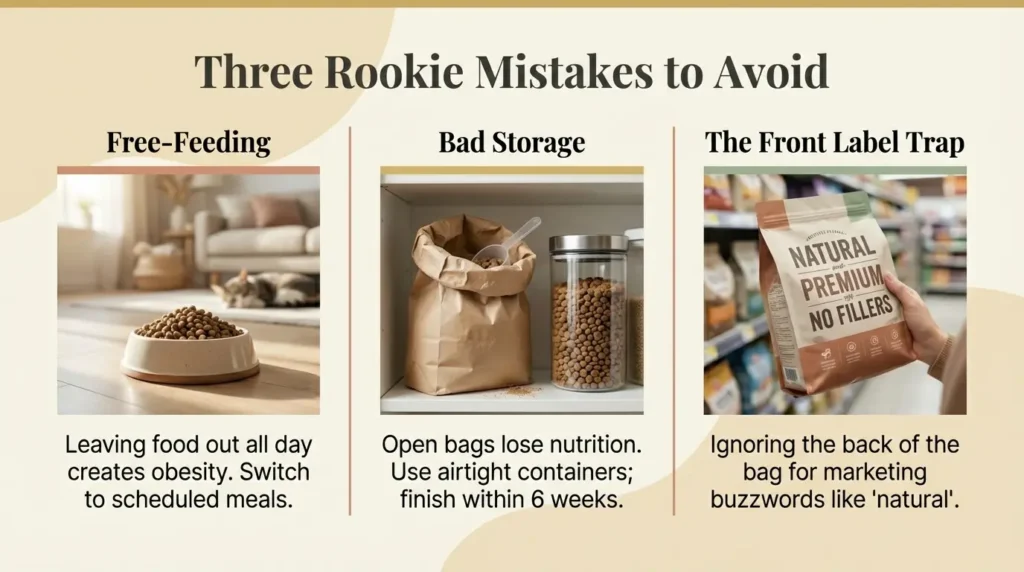
Free-feeding without monitoring body condition.
Leaving dry kibble out all day is convenient, but many kittens — especially those in the 3–6 month high-growth window — will overeat highly palatable food. If you notice your kitten getting visibly round, switch from free-feeding to measured scheduled meals.
Choosing based on the front of the bag.
“Natural,” “premium,” “vet recommended,” and “grain-free” on the front label tell you almost nothing useful. The AAFCO statement and first five ingredients on the back tell you everything. Make that your starting point every single time.
Skipping the food transition.
Even switching between two dry kitten formulas — same brand, different line — requires a gradual 7–10 day transition. GI upset from abrupt food changes is one of the most common and entirely preventable problems I hear about from new kitten owners.
Relying on dry food alone for hydration.
If dry kibble is your kitten’s only food, you need to actively compensate for the low moisture content. A circulating pet water fountain dramatically increases how much most kittens drink. Or — better yet — add at least one canned food meal daily to bring moisture into the diet naturally.
Storing dry food incorrectly.
An open bag left on a shelf loses nutritional integrity and palatability faster than most owners realize. Once opened, transfer to an airtight container and use within 6 weeks. Store away from heat sources and humidity.
→ Back to the full guide: The 5 Best Kitten Foods of 2026
→ Also read: The 11 Best Kitten Foods of 2026
Have a question about your specific kitten or a food you’re considering? Drop it in the comments below — I read and respond to every one.
📌 Bookmark this page — picks and cost data updated quarterly.