Best Canned Kitten Food: Top Picks, Feeding Tips (2026)
You’ve decided canned food deserves a place in your kitten’s routine — and honestly, that’s one of the better early decisions you can make as a new kitten owner.
But the canned food aisle — whether you’re standing in PetSmart or scrolling through hundreds of Chewy listings — is genuinely overwhelming. Some cans look premium but deliver mostly water and thickeners. Others look basic but have genuinely solid nutritional profiles. The packaging almost never tells you which is which.
This guide cuts through that confusion. Here’s what to look for on every can, which specific products are worth your money in 2026, how much to feed by age, and the canned food mistakes that show up most often in my inbox.
Transparency note: Purreats uses affiliate links. If you buy through our links, we earn a small commission at no extra cost to you — and every recommendation here is one I’d genuinely make to a friend.
Why Canned Food Is Particularly Valuable for Kittens
You might be wondering whether canned kitten food is really that different from dry. For adult cats, the difference is meaningful but manageable. For kittens — especially under 6 months — it’s more significant.
Here’s why canned food earns its place in your kitten’s early diet:
Moisture content is doing real work. Canned kitten food typically contains 70–82% moisture. That’s not filler — it’s passive hydration that supports kidney function and urinary tract health from day one. Young kittens are inconsistent water drinkers, and the moisture in canned food compensates for that naturally.
Soft texture supports developing jaws. A 6–10 week old kitten transitioning from milk doesn’t have the jaw strength or tooth development to crunch kibble effectively. Canned pâté or shredded food lets them eat complete meals without struggling, which means they’re actually consuming the nutrition they need rather than picking around hard pieces.
Higher animal protein, fewer fillers. Because canned food doesn’t need binding agents to hold a shape the way dry kibble does, manufacturers rely less on carbohydrates. The result: canned kitten foods typically show higher real-meat protein percentages and lower starch content than their dry counterparts.
Better palatability for picky eaters. The aroma released from opening a fresh can of kitten food is something most kittens find irresistible. If you’re dealing with a hesitant eater, adding a canned meal almost always solves the problem within a feeding or two.
How to Read a Canned Kitten Food Label
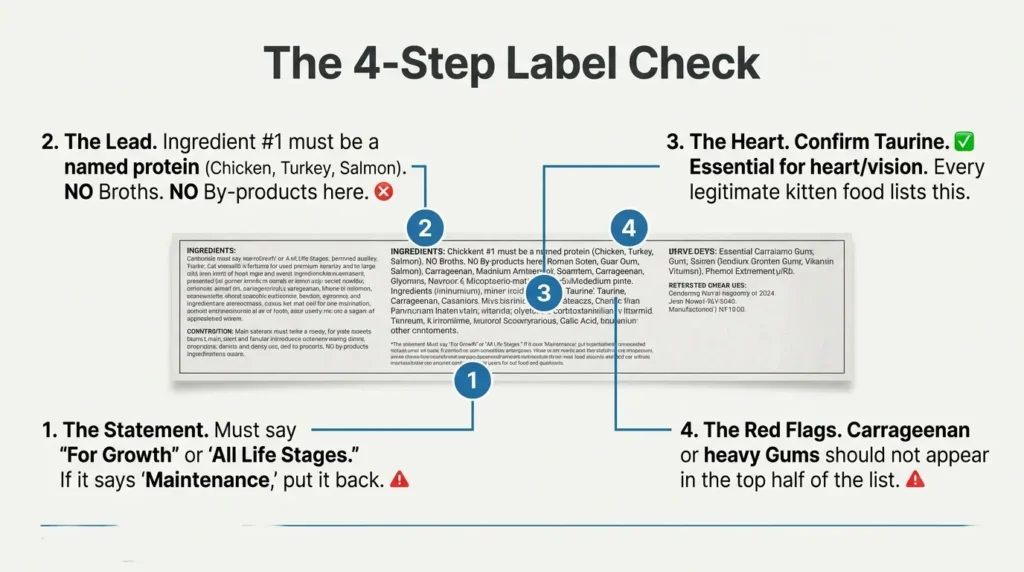
Before we get to specific brands, here’s your four-step label check. Run through this every time you evaluate a new canned food:
Step 1: Find the AAFCO statement.
It should say: “[Brand] is formulated to meet the nutritional levels established by the AAFCO Cat Food Nutrient Profiles for growth” — or “all life stages.” If it says “maintenance,” it’s formulated for adult cats. Set it back down.
Step 2: Check the first ingredient.
It should be a named animal protein: chicken, turkey, salmon, tuna, beef. Not “fish broth” or “meat by-products” in the top position. Broth as the first ingredient means water is the dominant component — not protein.
Step 3: Confirm taurine is listed.
Cats cannot produce taurine on their own. Deficiency leads to heart disease and vision damage. Every legitimate kitten food includes it, but a quick scan gives you peace of mind.
Step 4: Scan for low-value additives near the top.
Carrageenan, guar gum, and xanthan gum in large amounts as early ingredients are signs of a thickener-heavy, lower-quality formulation. Small amounts further down the list are common and generally not a concern — but they shouldn’t be doing the heavy lifting in the top half of the ingredient panel.
Best Canned Kitten Food Picks for 2026
🥇 Best Overall: Purina Pro Plan Kitten Chicken & Rice Entrée


This is the canned kitten food I recommend to almost every new owner who asks where to start.
Real chicken is the first ingredient — not broth, not by-products. DHA from fish oil is explicitly included for brain and eye development. Taurine is confirmed. The AAFCO growth statement is present and verified. The pâté texture is smooth enough for kittens as young as 6 weeks transitioning off milk replacer, and the chicken aroma is strong enough to engage even hesitant eaters.
In every bowl-by-bowl palatability test I’ve done across different kitten litters, this one gets finished first — consistently.
✅ Best for: All kittens 6 weeks–12 months, everyday primary canned food, first-time owners
First ingredient: Chicken
Moisture: ~82%
AAFCO: Growth ✓
Cost/day: ~$0.75 (approx. 2 cans for a 3–5 lb kitten)
Watch out: Strong fish smell on the fish-flavor varieties — stick to chicken or turkey if that bothers you.
🥈 Best Budget Canned Kitten Food: Fancy Feast Classic Pâté
Yes — Fancy Feast. Specifically the Classic Pâté line (not the Gourmet Broths, not the Medleys, not the gravy-heavy varieties). The plain Classic Pâté has earned a quiet reputation among cat nutritionists as one of the best budget options on the market.
Named poultry or fish in the first ingredient position, taurine included, AAFCO growth statement confirmed. It lacks the explicitly added DHA and probiotics of premium options, but as a daily budget-friendly canned food for a healthy kitten with no special needs, it genuinely holds up. At roughly $0.45–$0.55 per day, it’s one of the most economical ways to feed canned food daily without cutting nutritional corners entirely.
✅ Best for: Budget-first owners, multi-kitten households, daily rotation partner
First ingredient: Chicken or fish (varies by flavor)
AAFCO: Growth ✓
Cost/day: ~$0.45–$0.55
Watch out: Formula varies across flavors — stick to Classic Pâté and avoid added gravies or sauces.
🥉 Best Premium Canned Kitten Food: Nulo Freestyle Kitten Turkey & Chicken

If you want the cleanest canned kitten food available without going raw, this is where that bar is set.
Whole turkey and chicken are the first two ingredients — not by-products, not broth. Salmon oil is added for DHA. BC30 probiotics support digestive health. Zero corn, wheat, or soy. The guaranteed analysis is strong: high animal protein, appropriate fat, clear AAFCO growth statement.
After switching to Nulo Freestyle as the primary canned food for my foster litters, I consistently see coat condition improve within 3–4 weeks. That’s the kind of result that keeps a food on your shortlist.
✅ Best for: Premium-first owners, high-protein focus, sensitive digestion, coat improvement
First ingredient: Turkey, chicken
AAFCO: Growth ✓
Cost/day: ~$1.10
Watch out: Higher daily cost — a mixed strategy (Nulo for one meal, budget wet for another) helps manage this.
Best Canned Kitten Food for Sensitive Stomachs: Hill’s Science Diet Kitten Sensitive Stomach & Skin

If your kitten has loose stools, post-meal vomiting, or visible discomfort after eating, this is the first canned food I’d try before scheduling a vet visit (assuming no blood, lethargy, or fever present).
Hill’s Sensitive uses precisely controlled, highly digestible protein sources specifically designed for GI-prone kittens. The ingredient list isn’t glamorous, but that restraint is the point — fewer variables means a more predictable, gentle digestive response. Shelters and rescue programs use it regularly for kittens coming in with compromised digestive systems.
✅ Best for: GI-sensitive kittens, shelter transitions, post-illness recovery
First ingredient: Chicken
AAFCO: Growth ✓
Cost/day: ~$0.90
Watch out: Contains some grain — not ideal if you’re specifically targeting grain-free formulas.
How Much Canned Kitten Food to Feed Per Day
Use this as your starting framework — then adjust based on your specific kitten’s body condition, not just the chart:
| Kitten Age | Approx. Weight | Canned Food Per Day | Feeding Frequency |
|---|---|---|---|
| 6–8 weeks | 0.5–1 lb | 2–3 oz | 4–5 times/day |
| 2–3 months | 1–2 lbs | 4–6 oz | 4 times/day |
| 3–6 months | 2–5 lbs | 5–9 oz | 3 times/day |
| 6–12 months | 5–8 lbs | 4–7 oz | 2–3 times/day |
The body condition check: You should be able to feel your kitten’s ribs easily without pressing hard — but not see them clearly. Visible ribs means increase portions. Can’t feel ribs at all means pull back slightly and reassess over a week.
If you’re combining canned and dry food — which is a great approach — reduce the dry portion accordingly. A 3 oz can of canned food replaces approximately ¼ cup of dry food in calorie terms, though you should verify this against your specific brands since calorie density varies.
Canned Kitten Food Mistakes You Want to Avoid
Leaving it out too long. Canned food left at room temperature for more than 30–45 minutes starts losing palatability and building bacteria. If your kitten walks away and comes back later, the food may already be past its best. Refrigerate leftovers immediately and warm gently before the next serving.
Switching flavors or brands too fast. Even within the same brand, a flavor change can cause temporary soft stools in a kitten with a sensitive gut. Rotate flavors gradually — not all at once.
Confusing “premium packaging” with premium nutrition. Some of the most attractively packaged boutique canned foods have weaker nutritional profiles than Purina Pro Plan. Always read the label, not the branding.
Buying “all life stages” food without checking the fine print. “All life stages” is acceptable for kittens — but only if the AAFCO statement specifically confirms it covers growth. Some “all life stages” claims are based on nutrient calculation rather than feeding trial validation. Check which standard applies.
Skipping the transition when switching canned brands. Even switching between two wet kitten foods should use the 7–10 day gradual swap — 75/25, then 50/50, then 25/75. GI upset from abrupt food changes is real and entirely preventable.
FAQ: Canned Kitten Food
FAQ
How long does opened canned kitten food last in the fridge?
Can you mix canned kitten food with dry kibble in the same bowl?
Can kittens eat canned food meant for adult cats?
Is grain-free canned kitten food worth the extra cost?
→ Back to the full guide: The 5 Best Kitten Foods of 2026, Picks for Healthy Growth
→ Also read: Best Dry Kitten Food: Label Guide Feeding Tips (2026)
📌 Bookmark this page — picks and cost data updated quarterly.