5 Best Cat Food for Senior Cats for Strong Health

Two weeks ago, my friend texted me a photo from the pet store aisle. Twelve different bags of senior cat food lined up in her cart, and the caption read: “HELP. I’ve been here for an hour. My brain has melted.”
Her 13-year-old cat had started refusing food, losing weight, and she was panicking. I get it. When your cat crosses into those senior years and suddenly everything feels urgent, the sheer number of options becomes paralyzing.
Here’s what I told her – and what I wish someone had told me years ago when my Leo started aging: The best cat food for senior cats isn’t the one with the fanciest label or the highest price tag. It’s the one that solves your specific cat’s actual problem.
A healthy 8-year-old needs completely different nutrition than a 15-year-old with kidney disease and missing teeth. Let me break down what actually matters so you can stop second-guessing every decision.
Table of Contents
What Actually Makes Cat Food Good for Senior Cats
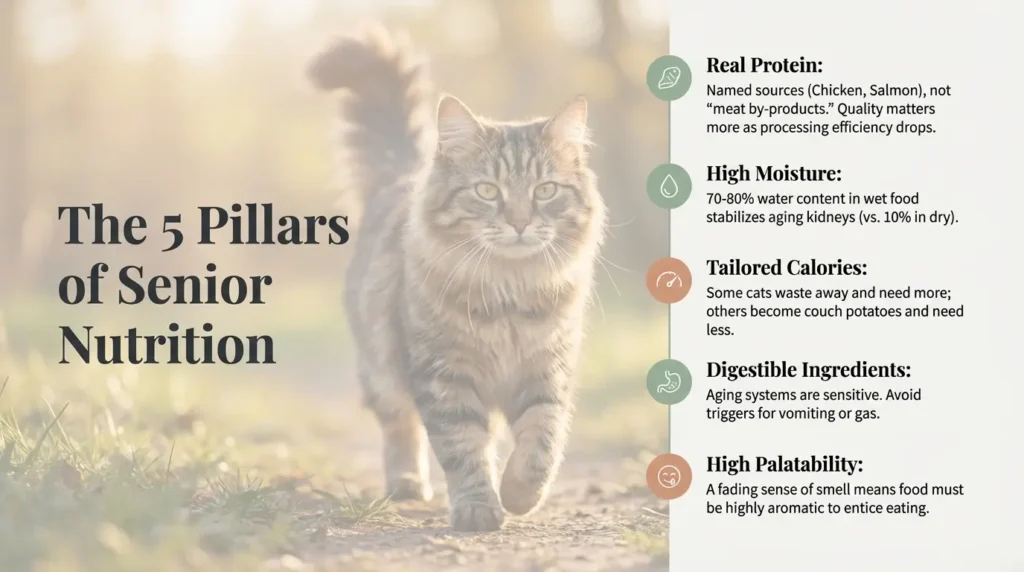
Forget the marketing for a minute. Here’s what the best cat food for senior cats genuinely provides.
Real animal protein as the foundation. Not “meat by-products” or “poultry meal.” Named sources like chicken, turkey, salmon, or beef. Senior cats become less efficient at processing protein, which means quality matters more than ever.
Moisture content that supports aging kidneys. This is huge and often overlooked. Wet food with 70-80% water content versus dry food’s 10% can be the difference between stable kidney values and progressive decline.
Appropriate calorie density. Some senior cats need MORE calories because they’re wasting away. Others need FEWER because they’ve become couch potatoes. One-size-fits-all doesn’t work.
Digestible ingredients for sensitive stomachs. Aging digestive systems get pickier. The best cat food for senior cats doesn’t trigger vomiting, diarrhea, or constant gas.
Palatability for declining senses. As cats age, their sense of smell fades. Food needs to be aromatic enough to entice them, or they simply won’t eat.
When my Leo hit 14 and started getting skinny, I realized the “senior” food I’d been buying checked none of these boxes. It was just rebranded adult food with clever packaging.
My Top Picks for Best Cat Food for Senior Cats
Let me give you actual recommendations based on real situations I’ve seen work.
For Healthy Seniors Who Just Need Good Nutrition
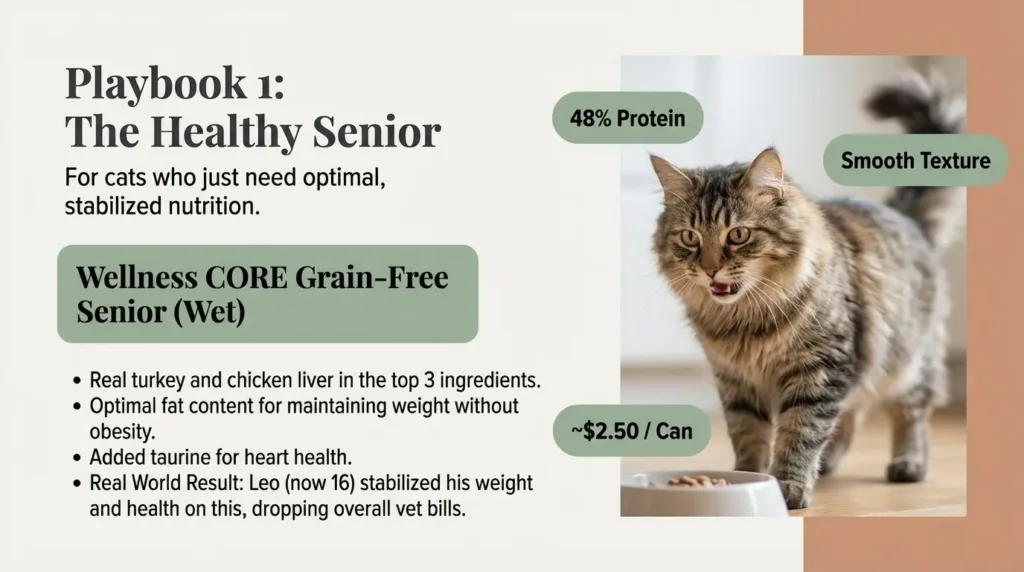
Wellness CORE Grain-Free Senior (wet) is what I feed Leo now that his health has stabilized.
Why it works: High protein at 48% dry matter basis. Real turkey and chicken liver in the first three ingredients. Good fat content for maintaining weight without going overboard. Taurine for heart health.
The texture is smooth enough for older cats but not baby-food mushy. Leo actually gets excited at mealtime now, which wasn’t happening with his old food.
Cost reality: About $2.50 per 5.5oz can. Yes, that’s $150 monthly for a 10-pound cat eating two cans daily. But his vet bills dropped significantly once his nutrition improved.
For Cats Not Drinking Enough Water
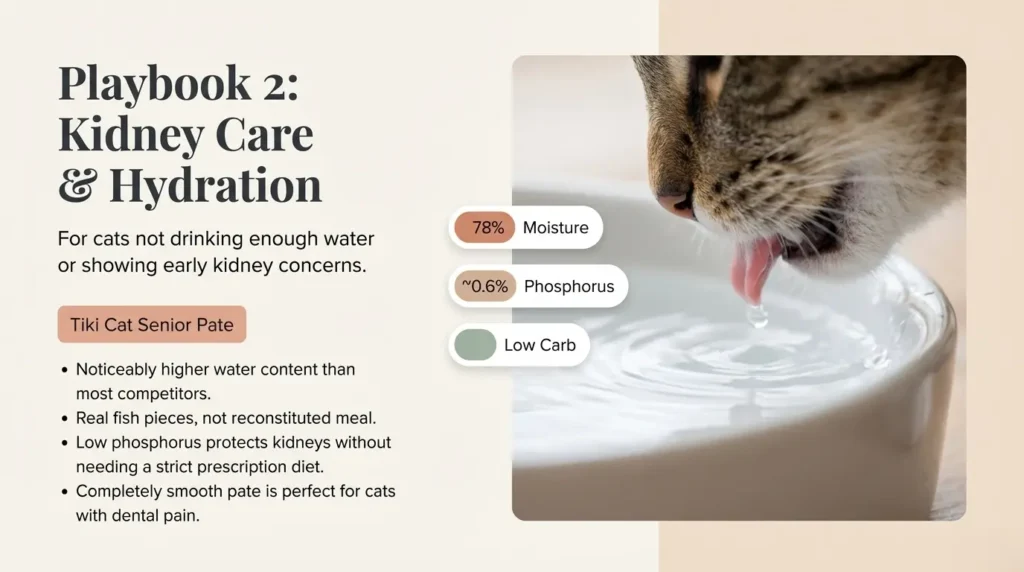
Tiki Cat Senior Pate saved my neighbor’s cat from worsening kidney disease.
Why it works: 78% moisture content – noticeably higher than most competitors. Real fish pieces, not reconstituted meal. Low carbs. Phosphorus levels around 0.6% dry matter basis, which protects kidneys without being prescription-strict.
Her cat’s bloodwork improved after three months on this. The vet specifically said the hydration from wet food made the difference.
Texture bonus: Completely smooth. Perfect for cats with dental pain who can’t chew chunks.
For Overweight, Less Active Seniors
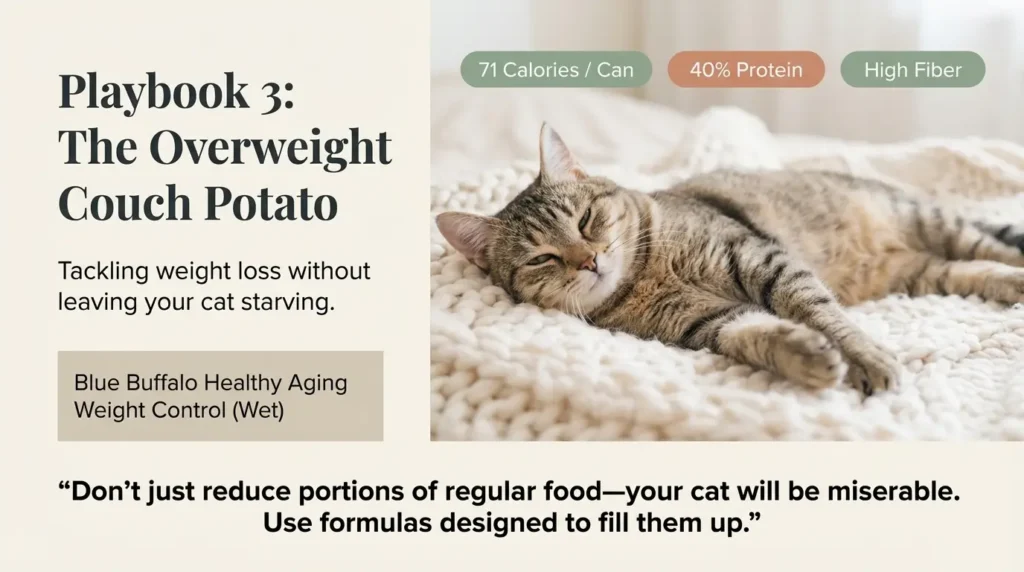
Blue Buffalo Healthy Aging Weight Control (wet) tackles weight loss without leaving cats starving.
Why it works: Only 71 calories per 2.8oz can compared to 90-120 in regular formulas. But protein stays high at 40% dry matter basis, so they lose fat while maintaining muscle. Extra fiber helps them feel satisfied.
My friend’s tubby 12-year-old lost three pounds over five months on this – healthy, gradual weight loss that stuck.
Don’t make this mistake: Don’t just reduce portions of regular food. Cats will be miserable. Use actual weight control formulas designed to fill them up with fewer calories.
For Underweight or Super Picky Seniors
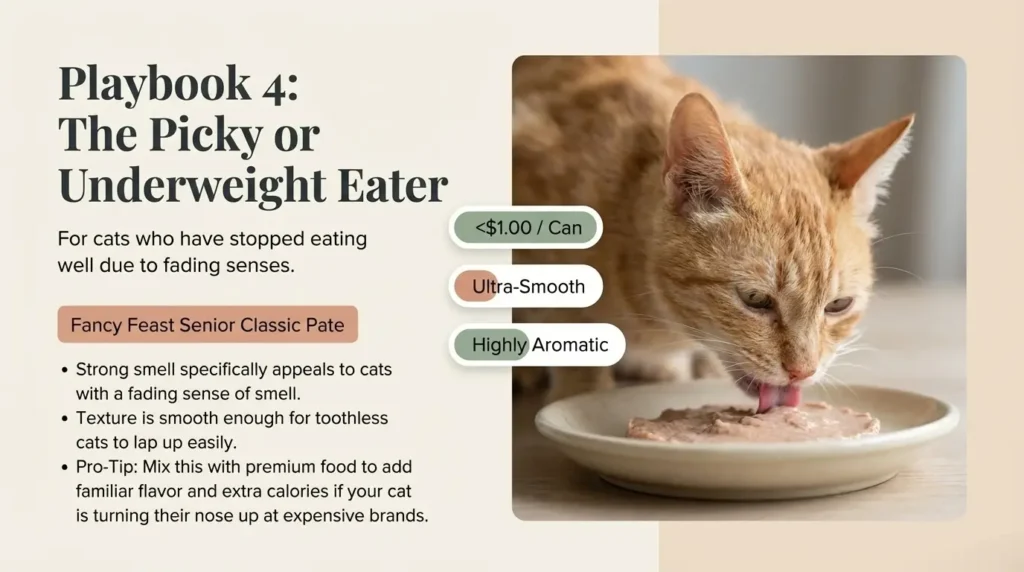
Fancy Feast Senior Classic Pate is my secret weapon for cats who’ve stopped eating well.
I know it sounds too basic to be “best,” but listen: Ultra-smooth texture even toothless cats can lap up. Strong smell that appeals to cats with fading sense of smell. Under $1 per can, so you can afford to be generous.
When Leo was losing weight and turning his nose up at everything, I mixed this with his premium food. The combination of familiar flavor and extra calories got him eating again.
Sometimes the best cat food for senior cats is the one they’ll actually consume.
For Dental Disease or Missing Teeth
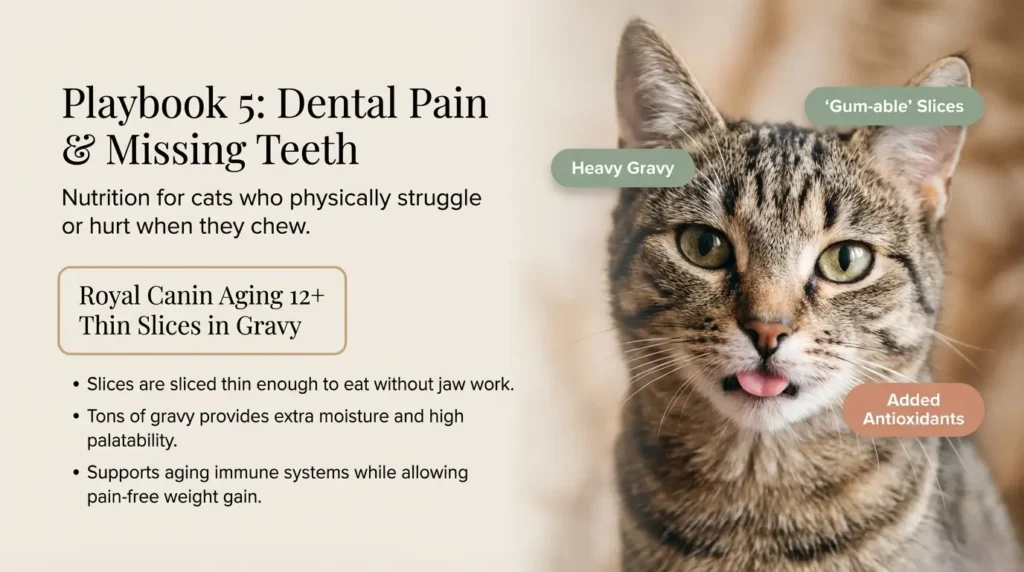
Royal Canin Aging 12+ Thin Slices in Gravy was designed for cats who struggle to chew.
Why it works: Slices thin enough to gum if needed. Tons of gravy for extra moisture and palatability. Soft texture requires minimal jaw work. Added antioxidants support aging immune systems.
A cat I pet-sit had severe dental disease and lost two pounds because eating hurt. His owner tried six foods before finding this one. Now he eats pain-free and has regained the weight.
For Tight Budgets (But Still Quality-Conscious)
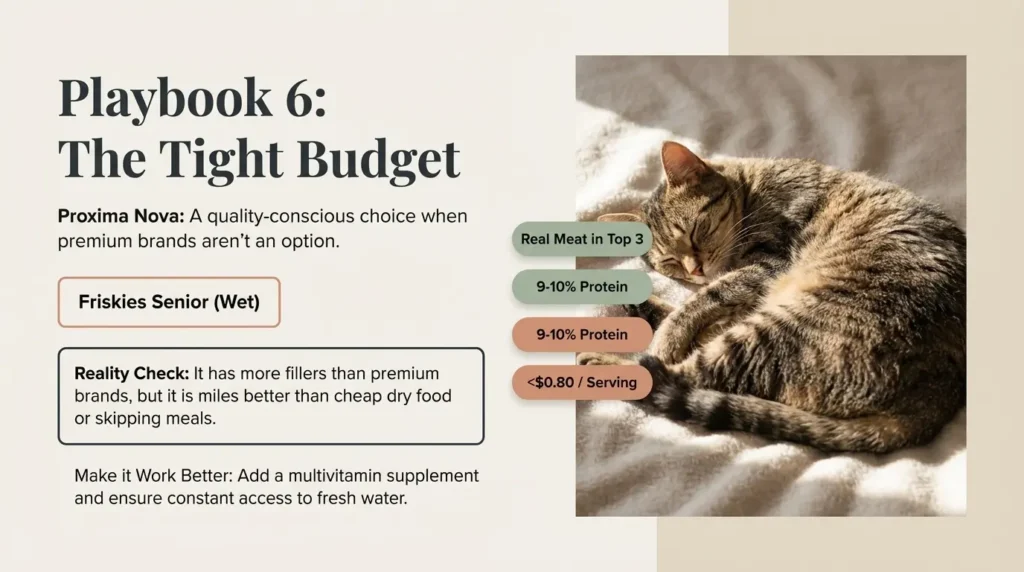
Friskies Senior (wet) is what I recommend when money is genuinely an issue.
Real talk: It’s not as good as premium brands. The protein quality is lower, there are more fillers, ingredients are less transparent. But it’s miles better than cheap dry food or skipping meals because you can’t afford groceries.
Why it’s acceptable: Real meat in the top three ingredients. Adequate 9-10% protein. Widely available everywhere. Under $0.80 per serving.
Make it work better: Add a multivitamin supplement and ensure constant fresh water access.
How to Actually Choose the Best Cat Food for Senior Cats
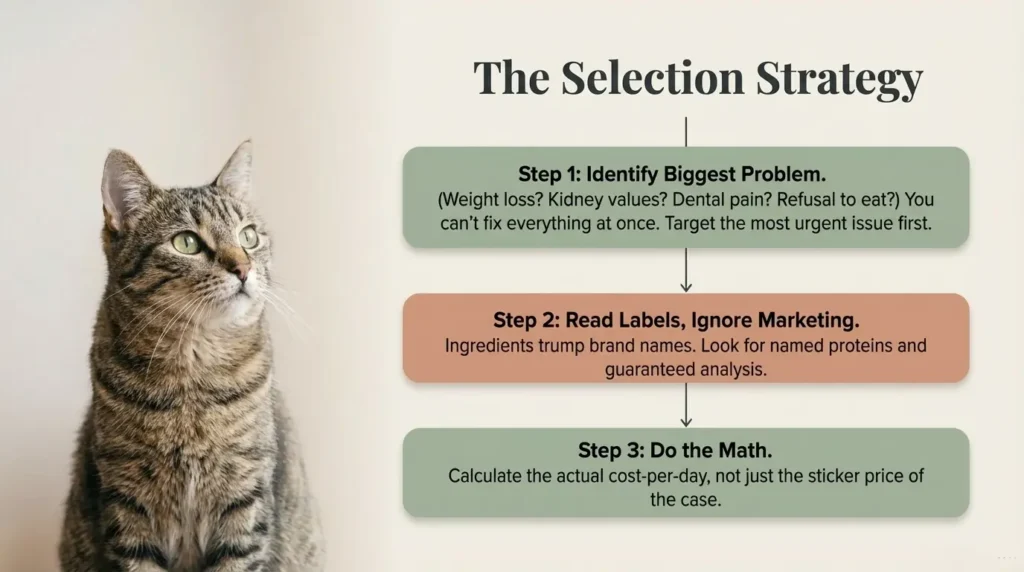
Here’s my real process when Leo’s needs changed.
Start With Your Cat’s Biggest Problem
You can’t fix everything at once. What’s the most urgent issue?
Weight loss despite normal eating? Kidney values creeping up? Dental pain making eating difficult? Vomiting after meals? Complete refusal to eat?
For Leo at 14, it was early kidney concerns plus unexpected weight loss. That immediately narrowed my search to high-moisture, high-calorie, kidney-friendly options.
Read the Back, Ignore the Front
I flip every package and scan the first five ingredients. Named animal proteins? Keep reading. Corn, wheat, or “meat by-products” dominating? Put it back.
Then I check guaranteed analysis. For wet food: minimum 8-10% protein (30-40% dry matter basis). For dry: minimum 30-40% protein. Fat should match your cat’s weight goals – higher for thin cats, lower for heavy ones.
Do the Cost-Per-Day Math
That $30 case looks expensive until you calculate actual daily cost.
Premium food: $30 for twelve 5.5oz cans = $2.50 per can. A 10-pound cat needs roughly 1.5 cans daily = $3.75/day = $112.50/month.
Budget food: $15 for twelve 3oz cans = $1.25 per can. Same cat needs 2.5 cans daily = $3.12/day = $93.75/month.
The difference is under $20 monthly – less than $5 weekly – for significantly better nutrition. When I framed it that way, premium food felt more manageable than the sticker shock suggested.
Never Buy in Bulk Initially
Learn from my expensive mistake: Don’t buy a 24-pack of food your cat has never tried.
Start with singles or a 3-pack. Cats develop weird preferences. Leo loves chicken but absolutely refuses duck. I discovered this after buying a case of duck-based food that sat untouched.
Give It a Month Before Judging
The best cat food for senior cats shows results within 3-4 weeks: better energy, shinier coat, stable weight, normal stools, enthusiastic eating.
No improvements after a month? The food isn’t working, regardless of reviews or price. Try something else.
Mistakes I See (And Made Myself)
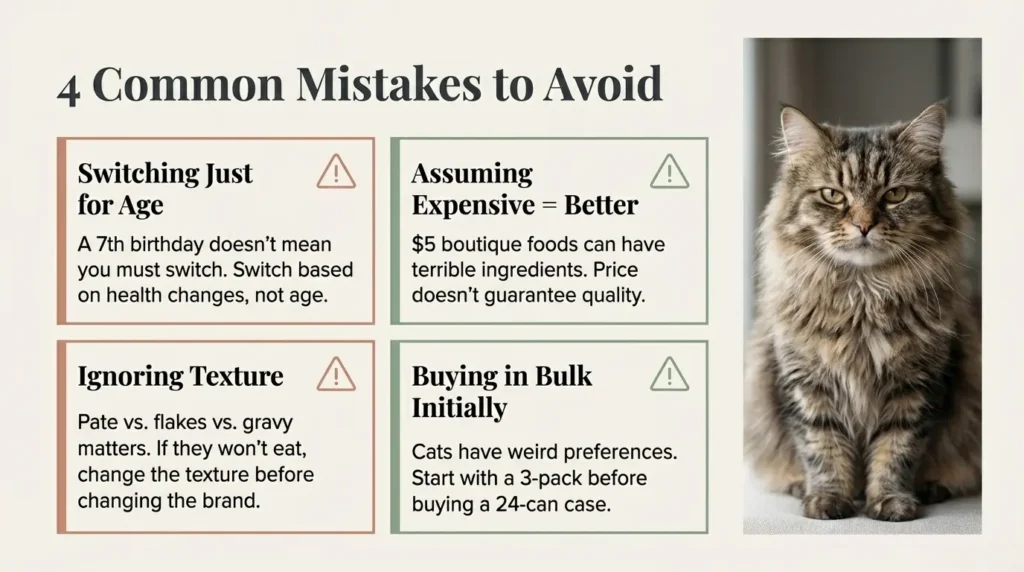
Switching Just Because of Age
Your cat turning seven doesn’t automatically mean they need “senior” food. If they’re healthy, maintaining good weight, and thriving on quality adult food, don’t change anything.
Switch when health status changes, not when a birthday happens.
Assuming Expensive = Better
I’ve examined $5-per-can boutique foods with terrible ingredient lists. Price doesn’t guarantee quality.
The best cat food for senior cats has excellent ingredients at a price you can sustain indefinitely. A $4/can food you can only afford two months is worse than a $2/can food you can feed consistently for years.
Ignoring Texture Completely
Some cats prefer smooth pate. Others want chunky flakes. Some love gravy.
If your cat consistently leaves food or eats reluctantly, try a different texture of the same brand before switching formulas entirely. Leo went from picking at chunks to devouring smooth pate – same ingredients, different texture, total game-changer.
Following Feeding Guides Religiously
Package recommendations are starting points, not gospel.
If the guide says 1.5 cans daily but your cat is losing weight, feed more. If they’re gaining unwanted weight, feed less. Adjust based on your cat’s actual body condition, not theoretical calculations.
When Over-The-Counter Isn’t Enough
Sometimes the best cat food for senior cats requires a prescription.
You need vet-prescribed therapeutic food if your cat has:
- Diagnosed kidney disease (any stage) – Hill’s k/d or Royal Canin Renal Support
- Diabetes – High-protein, low-carb like Purina DM
- Severe food allergies – Hydrolyzed protein diets
- Urinary issues – Specialized pH-controlling formulas
- Inflammatory bowel disease – Limited ingredient prescription options
These conditions need nutritional management beyond what commercial foods provide. Don’t try to DIY serious medical issues.
Leo’s kidney values haven’t reached prescription-diet territory yet, but I know Hill’s k/d is ready if needed. We monitor his bloodwork every six months.
What Actually Matters Most
After years of trial, error, and too many vet bills, here’s what I know for certain:
The best cat food for senior cats solves YOUR cat’s specific problem. Generic “senior” labels mean nothing. Match food to actual health status.
Wet food wins for most aging cats because hydration impacts everything – kidneys, digestion, overall health. The moisture content difference between wet and dry is massive.
Ingredients trump brand names and marketing. Read labels. Look for named proteins, appropriate nutrition levels, formulas matching your cat’s needs.
Your cat’s response tells the truth. Better energy, healthy weight, good coat, normal digestion – these prove the food works, regardless of reviews or price tags.
Leo is 16 now. Stable kidney values, good weight, still plays daily. Getting his nutrition right made this possible.
Your senior cat deserves the same attention. Choose thoughtfully, monitor closely, adjust as needed. That’s how you find the best cat food for senior cats – the one that works for YOUR specific cat.
What is the healthiest cat food for senior cats? ▼
The healthiest cat food for senior cats depends on your cat’s specific health status. For generally healthy seniors, look for high-moisture wet food (70-80% water content) with named animal proteins as the first ingredients, minimum 30-35% protein on a dry matter basis, and moderate phosphorus levels under 250mg per 100 kcal.
Top healthy options include Wellness CORE Grain-Free Senior for balanced nutrition, Tiki Cat Senior for hydration and kidney support, and Hill’s Science Diet Senior 11+ for clinical nutrition backing. The healthiest choice addresses your cat’s primary concern – whether that’s weight management, kidney support, dental issues, or digestive sensitivity.
Should senior cats eat wet or dry food? ▼
Senior cats should primarily eat wet food because hydration becomes critical as they age. Wet food provides 70-80% moisture versus only 10% in dry food, which supports aging kidneys, helps prevent urinary issues, and is easier for cats with dental problems. Older cats also have declining thirst drives and often don’t drink enough water on their own.
However, mixed feeding works well for many seniors – primarily wet food (80-90% of calories) with small amounts of quality dry food available for cats who enjoy crunching. If your cat strongly prefers dry food, choose high-quality kibble and add water or low-sodium broth to increase moisture intake. The key is ensuring adequate total daily hydration.
Have a question about your specific cat? Drop a comment below with their name, age, and what you’re seeing. I read every single one — and I often write new articles based on the questions I get most.
📌 Bookmark this page — product picks and pricing are reviewed quarterly.
- → Also read: FULL GUIDE CAT FOOD REVIEWS
- → Related: 8 Best Senior Cat Food: Vet-Informed Picks by Age
- → Related: 6 Powerful Best Senior Cat Food Picks for Healthy Aging
- → Related: 10 Best Cat Foods for Senior Cats