Best Dry Cat Food for Indoor Cats: 7 Picks Worth Buying (2026)
Direct Answer
The best dry cat food for indoor cats has named animal protein first, 40%+ protein on a dry matter basis, controlled calories under 380 kcal per cup, and real fiber — not just powdered cellulose. Purina Pro Plan Indoor, Wellness CORE Indoor, and Blue Buffalo Indoor Hairball Control are the strongest options across budget levels in 2026.
I used to think any bag with “indoor” on the label was doing my cat a favor. It took me an embarrassingly long time to realize those words mean nothing nutritionally.
Most dry indoor formulas are standard kibble with added cellulose — a cheap fiber filler — and a reduced calorie count achieved by diluting quality ingredients, not improving them.
Indoor cats deserve better than that. This guide breaks down exactly what makes dry food genuinely suitable for a lower-activity, indoor lifestyle — and which 7 products actually deliver it.
Quick Comparison Table
| Product | Protein DMB | Cal/Cup | Fiber Source | Best For | Cost/Day |
|---|---|---|---|---|---|
| Purina Pro Plan Indoor | 45% | ~394 kcal | Natural fiber blend | Best overall dry | ~$0.70 |
| Wellness CORE Indoor | 50% | ~370 kcal | Flaxseed + fiber blend | Grain-free pick | ~$1.10 |
| Blue Buffalo Indoor Hairball | 42% | ~358 kcal | Beet pulp + chicory root | Hairball control | ~$0.85 |
| Hill’s Science Diet Indoor | 40% | ~360 kcal | Beet pulp | Vet-recommended | ~$0.90 |
| Iams Indoor Weight & Hairball | 38% | ~346 kcal | Beet pulp blend | Budget pick | ~$0.45 |
| Purina ONE Indoor Advantage | 43% | ~371 kcal | Natural fiber | Mid-range upgrade | ~$0.60 |
| Orijen Cat & Kitten | 58% | ~440 kcal | Freeze-dried liver | Premium high-protein | ~$2.10 |
Based on a healthy 10 lb adult indoor cat. DMB = Dry Matter Basis.
Why Most “Indoor” Dry Food Fails Indoor Cats
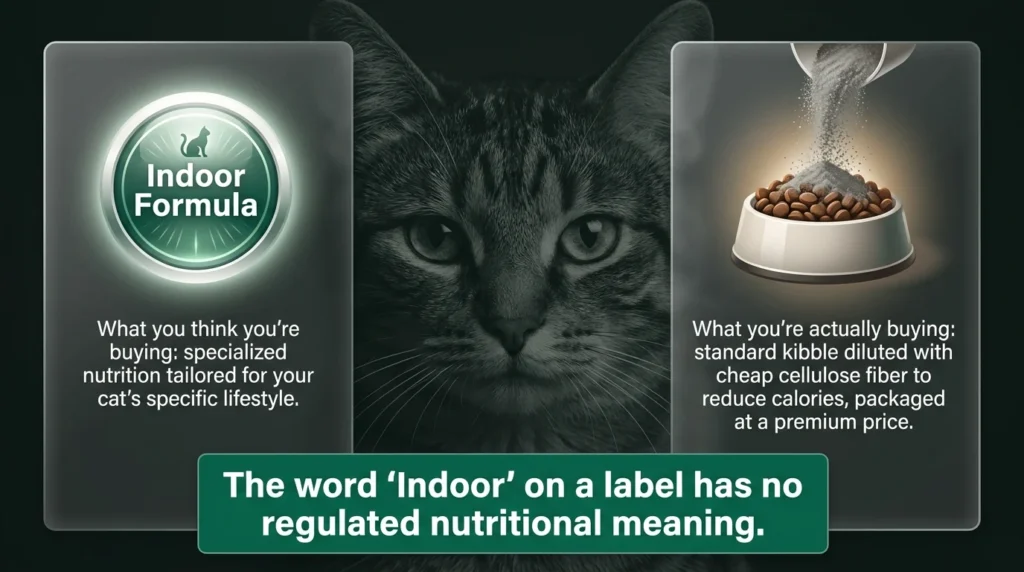
Here is the uncomfortable truth most pet food brands count on you not noticing.
Walk into any pet store and pull three bags labeled “indoor formula” off the shelf. Flip them over. Scan the ingredient list past ingredient one — which is usually a named meat — and look at ingredients two, three, and four.
On most bags you will find corn meal, soy flour, brewers rice, or wheat gluten within the first five ingredients. These are inexpensive carbohydrate sources that add bulk, calories, and very little else to a cat’s diet.
Cats are obligate carnivores. They have no biological requirement for carbohydrates. Their digestive systems are not designed to process large amounts of grain. Yet the average grocery-store “indoor” dry food gets 35–45% of its calories from exactly these sources.
The “indoor” formula trick works like this: reduce calories by adding more cellulose fiber to create bulk without nutrition, keep the same base recipe, charge slightly more, and market it as a specialized product for lifestyle-conscious cat owners.
I fell for it with Luna. Most cat parents do at least once.
What Dry Food for Indoor Cats Should Actually Do
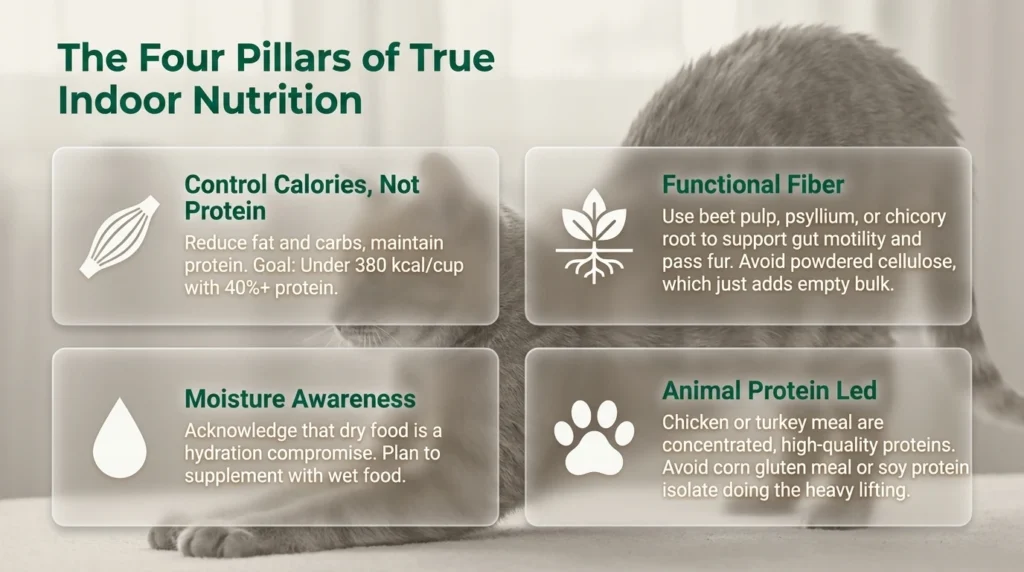
A dry food genuinely suited to indoor cats needs to accomplish four specific things.
Control calories without sacrificing protein. The right way to reduce calories in cat food is to lower fat and carbohydrates — not protein. Indoor cats need lean muscle maintenance even with reduced activity. Look for foods under 380 kcal per cup that still deliver 40%+ protein on a dry matter basis.
Use functional fiber, not filler fiber. Beet pulp, psyllium husk, and dried chicory root are functional fibers. They support gut motility and help move ingested fur through the digestive tract. Powdered cellulose does almost none of that. It exists to add bulk and reduce how much food a cat eats per serving — not to support digestive health.
Keep moisture in mind. Dry food will always be a hydration compromise. A good indoor dry food minimizes this by pairing with wet food feeding, and some formulas include added electrolytes or moisture-retaining ingredients. Knowing this limitation is part of feeding dry food responsibly.
Lead with animal protein, not plant protein. Chicken meal and turkey meal are concentrated protein sources — more protein per gram than fresh meat because the moisture has already been removed. They are not lower quality than fresh chicken. What is lower quality is corn gluten meal or soy protein isolate doing the protein-counting work instead. Named animal protein in the first two or three ingredients is the standard to hold.
The 7 Best Dry Cat Foods for Indoor Cats
1. Purina Pro Plan Indoor Care — Best Overall
This is the dry food I recommend most often, and the one I return to when readers ask me for a single reliable answer.
Real chicken is ingredient one. Protein sits at approximately 45% on a dry matter basis. The formula includes a natural fiber blend for hairball reduction — not just cellulose — and calorie density is controlled at around 394 kcal per cup without sacrificing protein quality.
What sets Pro Plan apart from most mainstream brands is the research behind it. Purina’s team includes over 500 veterinary nutritionists and scientists. The formulations are not marketing decisions — they are the output of genuine nutritional research. That consistency shows in long-term palatability and digestive tolerance.
Best for: Adult indoor cats at a healthy weight who need a reliable daily dry food.
One honest note: Carbohydrates are still present — as they are in every dry food. This is not a low-carb food. It is simply the best mainstream dry food for indoor cats at this price point.
2. Wellness CORE Indoor — Best Grain-Free Dry
Turkey and chicken lead the ingredient list. Nothing after them surprises you. No corn, no wheat, no soy anywhere in the formula. Protein reaches approximately 50% DMB — genuinely exceptional for a dry kibble.
Flaxseed contributes omega-3 fatty acids for coat and skin health. The fiber blend handles hairball control without the cellulose-heavy approach most competitors take. Calorie density lands at a sensible 370 kcal per cup.
For grain-free dry food specifically, CORE Indoor is the most consistent performer I’ve tested across palatability, stool quality, and weight maintenance. The price premium over mainstream brands is real but justified.
Best for: Owners who want grain-free dry food with high animal protein and a clean ingredient deck.
3. Blue Buffalo Indoor Hairball Control — Best for Hairballs
If your indoor cat throws up hairballs more than once a week, the fiber source in their food deserves serious attention.
Blue Buffalo’s Indoor Hairball formula uses beet pulp and dried chicory root alongside their LifeSource Bits — a blend of vitamins, minerals, and antioxidants added at lower temperatures to protect nutrient integrity. This is a meaningfully different approach to hairball management than formulas relying solely on powdered cellulose.
Protein at 42% DMB is solid. Calorie density at 358 kcal per cup is well-controlled. Real chicken leads the ingredient list.
The LifeSource Bits are a genuine differentiator — not just marketing. The cold-processing approach preserves more of the vitamin content than standard kibble extrusion.
Best for: Indoor cats with chronic hairball issues who need functional fiber, not just bulk filler.
4. Hill’s Science Diet Indoor — Best Vet-Recommended
Hill’s Science Diet Indoor does not have the flashiest ingredient list on this page. It is not grain-free. It does not lead with a trendy protein. What it has is decades of clinical backing, consistent formulation, and veterinary trust built through legitimate nutritional research.
Beet pulp provides functional fiber. Protein at 40% DMB meets the minimum threshold I look for. Calorie density at 360 kcal per cup is appropriate for lower-activity indoor adults.
If your veterinarian has specifically recommended Science Diet for your cat — and yours is a healthy indoor adult — this is a defensible, genuinely researched food. Not my top pick for ingredient quality, but a trustworthy option for owners who prioritize clinical backing over premium ingredients.
Best for: Owners whose vet recommends Science Diet, or cats with sensitive digestion who do well on a consistent, mild formula.
5. Purina ONE Indoor Advantage — Best Mid-Range Upgrade
If you’re currently feeding Purina Cat Chow Indoor and want to step up without jumping to Pro Plan pricing, ONE Indoor Advantage is the right intermediate move.
Real chicken leads the ingredient list. Protein reaches approximately 43% DMB — noticeably better than Cat Chow’s 36%. Calorie density at 371 kcal per cup is reasonable. The formula includes natural fiber for hairball reduction and no added artificial colors or flavors.
The gap between Cat Chow and ONE is larger than the price difference suggests. For approximately $0.30 more per day, you get meaningfully better protein quality, a cleaner ingredient list, and better palatability consistency.
Best for: Budget-conscious owners upgrading from entry-level dry food without moving to premium pricing.
6. Iams Indoor Weight & Hairball — Best Budget Dry
Iams Indoor is not the most exciting food on this list. Chicken leads, corn follows. It is not grain-free. The protein at 38% DMB is the lowest threshold I’m comfortable recommending.
But it does what it promises. Calorie density is controlled. The beet pulp blend provides more functional fiber than pure cellulose-based formulas. For a healthy indoor cat at ideal weight with no special dietary needs, this is a responsible daily option at a price that works for multi-cat households.
Best for: Multi-cat households on a strict budget where premium food isn’t practical for every cat.
7. Orijen Cat & Kitten — Best Premium High-Protein
Orijen is built on a different philosophy than every other food on this list. Biologically appropriate nutrition — high animal protein, low carbohydrates, varied protein sources — is the entire premise.
Multiple named proteins lead the ingredient list: fresh chicken, fresh turkey, fresh whole eggs, fresh whole flounder, freeze-dried chicken liver. Protein hits approximately 58% DMB. Carbohydrates are kept genuinely low compared to all mainstream alternatives.
Calorie density at 440 kcal per cup is higher than other indoor picks — which means stricter portion control is essential. This is not a free-feed food under any circumstances.
Best for: Owners who want the highest protein density available in dry food and are committed to strict portion control.
One honest note: At $2.10/day for a 10 lb cat, Orijen is a real budget commitment. If cost is a factor, Wellness CORE Indoor delivers strong protein at roughly half the daily price.
The Dry Matter Basis Calculation You Need
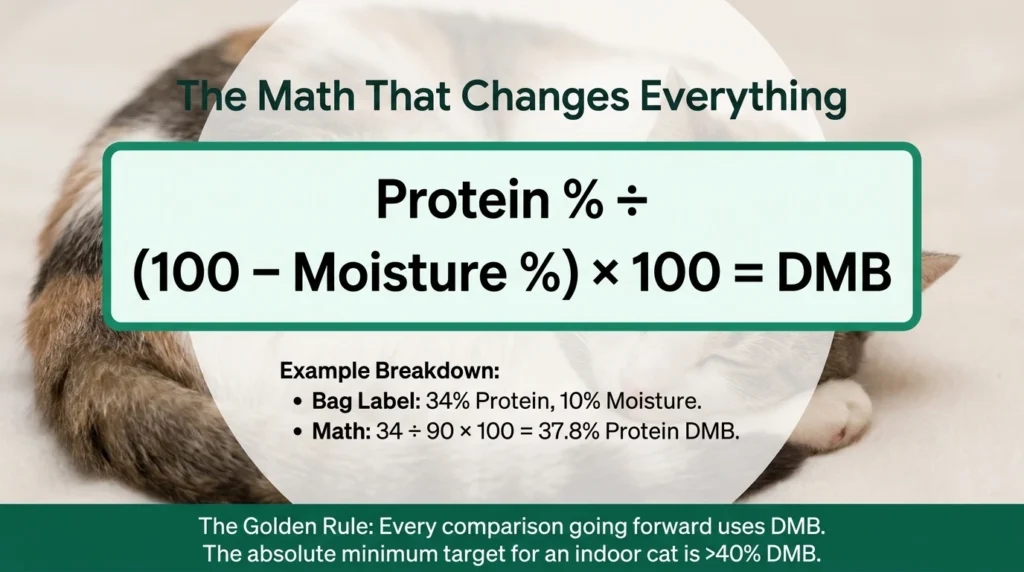
The Non-Negotiable Rule for Feeding Dry Food
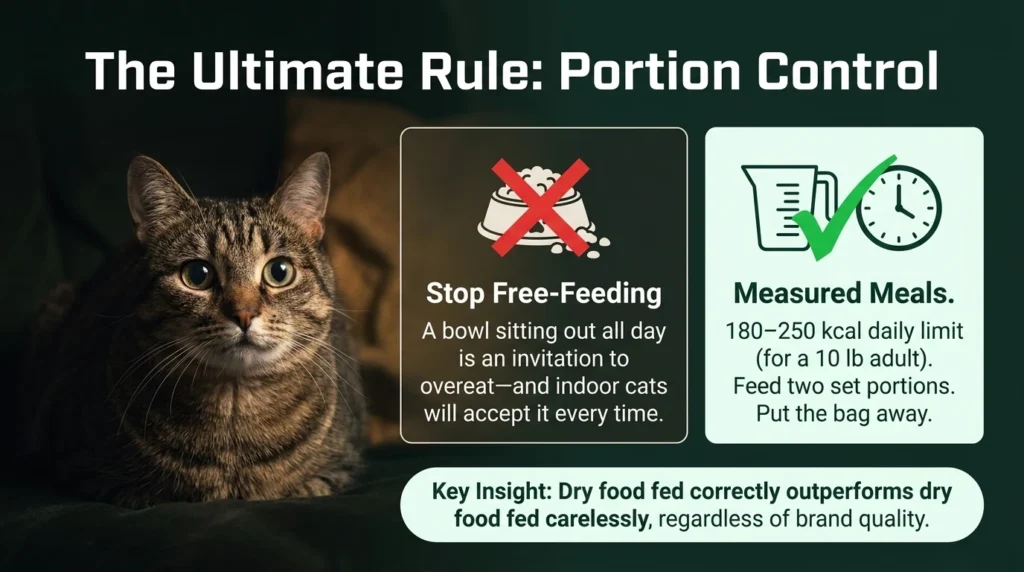
Dry food fed correctly outperforms dry food fed carelessly regardless of quality.
Stop free-feeding. A bowl of kibble sitting out all day is an invitation to overeat — and indoor cats, with nowhere to go and nothing to chase, will accept that invitation every time.
Measure two portions daily based on your cat’s calorie target — roughly 180–250 kcal for a healthy 10 lb adult. Feed at set times. Put the bag away.
Add one wet meal per day alongside your dry food of choice. The hydration difference alone is worth it.
That combination — quality dry food, measured portions, one wet meal — beats any single premium product fed carelessly.
Key Takeaways
- “Indoor” on dry food packaging has no regulated nutritional meaning — always evaluate the guaranteed analysis
- Compare protein on a dry matter basis, not the as-fed percentage on the front label
- Look for named animal protein in the first two ingredients, 40%+ protein DMB, and under 380 kcal per cup
- Functional fiber — beet pulp, chicory root, psyllium — works meaningfully better than powdered cellulose for hairball control
- Stop free-feeding — measured portions at set mealtimes is the single most impactful change for indoor cat weight management
- Add at least one wet meal daily to offset the hydration limitation of any dry food diet
Start Here This Week
- Flip your current bag over and calculate protein on a dry matter basis using the formula above
- Check whether the fiber source is functional — beet pulp or chicory root — or just powdered cellulose
- Pick one food from the comparison table that fits your budget and your cat’s specific challenge
- Set two meal times today, measure the daily portion, and stop leaving food out between meals
Sarah Mitchell evaluates all products independently. No brand pays for placement on Purreats.com. Affiliate links support the site — your cat’s health comes first, always.
Related on Purreats: Best Wet Cat Food for Indoor Cats · Best Cat Food for Indoor Cats · How to Read a Cat Food Label · Best Cat Food for Weight Loss 2026